O74743
Gene name |
tif452 (SPBC1709.18, SPBC409.01) |
Protein name |
Eukaryotic translation initiation factor 4E-2 |
Names |
eIF-4E-2, eIF4E-2, eIF-4F 25 kDa subunit 2, mRNA cap-binding protein 2 |
Species |
Schizosaccharomyces pombe (strain 972 / ATCC 24843) (Fission yeast) |
KEGG Pathway |
spo:SPBC1709.18 |
EC number |
|
Protein Class |
|
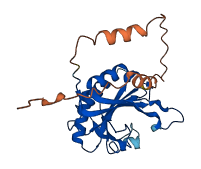
Descriptions
The autoinhibited protein was predicted that may have potential autoinhibitory elements via cis-regPred.
Autoinhibitory domains (AIDs)
Target domain |
|
Relief mechanism |
|
Assay |
cis-regPred |
Accessory elements
No accessory elements
Autoinhibited structure

Activated structure
1 structures for O74743
| Entry ID | Method | Resolution | Chain | Position | Source |
|---|---|---|---|---|---|
| AF-O74743-F1 | Predicted | AlphaFoldDB |
No variants for O74743
| Variant ID(s) | Position | Change | Description | Diseaes Association | Provenance |
|---|---|---|---|---|---|
| No variants for O74743 | |||||
No associated diseases with O74743
1 regional properties for O74743
| Type | Name | Position | InterPro Accession |
|---|---|---|---|
| conserved_site | Eukaryotic translation initiation factor 4E (eIF-4E), conserved site | 118 - 141 | IPR019770 |
2 GO annotations of cellular component
| Name | Definition |
|---|---|
| cytosol | The part of the cytoplasm that does not contain organelles but which does contain other particulate matter, such as protein complexes. |
| eukaryotic translation initiation factor 4F complex | The eukaryotic translation initiation factor 4F complex is composed of eIF4E, eIF4A and eIF4G; it is involved in the recognition of the mRNA cap, ATP-dependent unwinding of the 5'-terminal secondary structure and recruitment of the mRNA to the ribosome. |
2 GO annotations of molecular function
| Name | Definition |
|---|---|
| RNA 7-methylguanosine cap binding | Binding to a 7-methylguanosine group added cotranscriptionally to the 5' end of RNA molecules transcribed by polymerase II. |
| translation initiation factor activity | Functions in the initiation of ribosome-mediated translation of mRNA into a polypeptide. |
2 GO annotations of biological process
| Name | Definition |
|---|---|
| cytoplasmic translational initiation | The process preceding formation of the peptide bond between the first two amino acids of a protein in the cytoplasm. This includes the formation of a complex of the ribosome, mRNA or circRNA, and an initiation complex that contains the first aminoacyl-tRNA. |
| nuclear-transcribed mRNA catabolic process, nonsense-mediated decay | The nonsense-mediated decay pathway for nuclear-transcribed mRNAs degrades mRNAs in which an amino-acid codon has changed to a nonsense codon; this prevents the translation of such mRNAs into truncated, and potentially harmful, proteins. |
No homologous proteins in AiPD
| UniProt AC | Gene Name | Protein Name | Species | Evidence Code |
|---|---|---|---|---|
| No homologous proteins | ||||
| 10 | 20 | 30 | 40 | 50 | 60 |
| MADAEDSRHS | KNEGFPNTSL | ITEKLDLLDL | FGSPKVKTER | EGRPARLLEG | LSAVNAETAF |
| 70 | 80 | 90 | 100 | 110 | 120 |
| VKTHPLQHEW | TLWFLKPPTQ | GLEWSDLLKE | IISFKTVEEF | WGIFKTISKA | SMLPAKSDYS |
| 130 | 140 | 150 | 160 | 170 | 180 |
| YFLKGIRPEW | EDPQNMNGGK | WAYQSKHKGS | NLDELWLYMV | LAAIGETLDP | TGKEVTGVVC |
| 190 | 200 | 210 | 220 | 230 | 240 |
| NMRKGFYRIA | VWTRNCNDKD | VLEKIGLRFK | EVLGISDKET | IEYSAHEDSS | KAGSMRAKTR |
| MSL |