O74536
Gene name |
ssp2 |
Protein name |
SNF1-like protein kinase ssp2 |
Names |
|
Species |
Xenopus tropicalis (Western clawed frog) (Silurana tropicalis) |
KEGG Pathway |
spo:SPCC74.03c |
EC number |
5.6.1.1: Enzymes altering polypeptide conformation or assembly |
Protein Class |
|
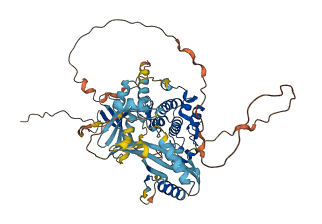
Descriptions
The autoinhibited protein was predicted that may have potential autoinhibitory elements via cis-regPred.
Autoinhibitory domains (AIDs)
Target domain |
34-285 (Protein kinase domain) |
Relief mechanism |
Ligand binding |
Assay |
Structural analysis, Mutagenesis experiment |
Accessory elements
173-195 (Activation loop from InterPro)
Target domain |
34-285 (Protein kinase domain) |
Relief mechanism |
|
Assay |
|
References
Autoinhibited structure

Activated structure
8 structures for O74536
| Entry ID | Method | Resolution | Chain | Position | Source |
|---|---|---|---|---|---|
| 2OOX | X-ray | 260 A | A/C | 440-576 | PDB |
| 2OOY | X-ray | 288 A | A/C | 440-576 | PDB |
| 2QR1 | X-ray | 270 A | A/C | 440-576 | PDB |
| 2QRC | X-ray | 270 A | A/C | 440-576 | PDB |
| 2QRD | X-ray | 241 A | A/C | 440-576 | PDB |
| 2QRE | X-ray | 301 A | A/C | 440-576 | PDB |
| 3H4J | X-ray | 280 A | A/B | 25-351 | PDB |
| AF-O74536-F1 | Predicted | AlphaFoldDB |
No variants for O74536
| Variant ID(s) | Position | Change | Description | Diseaes Association | Provenance |
|---|---|---|---|---|---|
| No variants for O74536 | |||||
No associated diseases with O74536
1 regional properties for O74536
| Type | Name | Position | InterPro Accession |
|---|---|---|---|
| domain | Small GTP-binding protein domain | 9 - 177 | IPR005225 |
Functions
| Description | ||
|---|---|---|
| EC Number | 5.6.1.1 | Enzymes altering polypeptide conformation or assembly |
| Subcellular Localization |
|
|
| PANTHER Family | ||
| PANTHER Subfamily | ||
| PANTHER Protein Class | ||
| PANTHER Pathway Category | No pathway information available | |
5 GO annotations of cellular component
| Name | Definition |
|---|---|
| cytoplasm | The contents of a cell excluding the plasma membrane and nucleus, but including other subcellular structures. |
| cytosol | The part of the cytoplasm that does not contain organelles but which does contain other particulate matter, such as protein complexes. |
| mitotic spindle pole body | The microtubule organizing center that forms as part of the mitotic cell cycle; functionally homologous to the animal cell centrosome. |
| nucleotide-activated protein kinase complex | A protein complex that possesses nucleotide-dependent protein kinase activity. The nucleotide can be AMP (in S. pombe and human) or ADP (in S. cerevisiae). |
| nucleus | A membrane-bounded organelle of eukaryotic cells in which chromosomes are housed and replicated. In most cells, the nucleus contains all of the cell's chromosomes except the organellar chromosomes, and is the site of RNA synthesis and processing. In some species, or in specialized cell types, RNA metabolism or DNA replication may be absent. |
4 GO annotations of molecular function
| Name | Definition |
|---|---|
| ATP binding | Binding to ATP, adenosine 5'-triphosphate, a universally important coenzyme and enzyme regulator. |
| protein serine kinase activity | Catalysis of the reactions: ATP + protein serine = ADP + protein serine phosphate. |
| protein serine/threonine kinase activity | Catalysis of the reactions: ATP + protein serine = ADP + protein serine phosphate, and ATP + protein threonine = ADP + protein threonine phosphate. |
| protein serine/threonine/tyrosine kinase activity | Catalysis of the reactions: ATP + a protein serine = ADP + protein serine phosphate; ATP + a protein threonine = ADP + protein threonine phosphate; and ATP + a protein tyrosine = ADP + protein tyrosine phosphate. |
11 GO annotations of biological process
| Name | Definition |
|---|---|
| CAMKK-AMPK signaling cascade | The series of molecular signals in which calmodulin-dependent protein kinase activity enabled by a CAMKK directly activates an AMPK. The cascade begins with calmodulin binding calcium which in turn binds CAMKK enabling its calmodulin-dependent protein kinase activity. The cascade ends with AMP-activated protein kinase activity. |
| carbohydrate metabolic process | The chemical reactions and pathways involving carbohydrates, any of a group of organic compounds based of the general formula Cx(H2O)y. |
| induction of conjugation with cellular fusion | The process in which a cell initiates conjugation with cellular fusion. Conjugation with cellular fusion is the process that results in the union of cellular and genetic information from compatible mating types. |
| intracellular signal transduction | The process in which a signal is passed on to downstream components within the cell, which become activated themselves to further propagate the signal and finally trigger a change in the function or state of the cell. |
| negative regulation of cytoplasmic translation | Any process that stops, prevents or reduces the frequency, rate or extent of cytoplasmic translation. |
| negative regulation of TORC1 signaling | Any process that stops, prevents or reduces the frequency, rate or extent of TORC1 signaling. |
| positive regulation of ascus development | Any process that activates, maintains or increases the frequency, rate or extent of ascus development, a saclike structure produced by fungi of the phylum Ascomycota (sac fungi) in which sexually produced spores (ascospores), usually four or eight in number, are formed. |
| positive regulation of cell cycle switching, mitotic to meiotic cell cycle | Any process that activates or increases the frequency, rate or extent of mitotic to meiotic cell cycle switching, the process in which a cell switches cell cycle mode from mitotic to meiotic division. |
| positive regulation of transcription by RNA polymerase II | Any process that activates or increases the frequency, rate or extent of transcription from an RNA polymerase II promoter. |
| protein phosphorylation | The process of introducing a phosphate group on to a protein. |
| SREBP signaling pathway | The series of molecular signals from the endoplasmic reticulum to the nucleus generated as a consequence of decreased levels of one or more sterols (and in some yeast, changes in oxygen levels) and which proceeds through activation of a sterol response element binding transcription factor (SREBP) to result in up-regulation of target gene transcription. |
No homologous proteins in AiPD
| UniProt AC | Gene Name | Protein Name | Species | Evidence Code |
|---|---|---|---|---|
| No homologous proteins | ||||
| 10 | 20 | 30 | 40 | 50 | 60 |
| MELSYQALRV | ASQNREAEEL | RTEARRKNLL | ILIMHYLLQE | GYMDSANSLE | QETKISLRRF |
| 70 | 80 | 90 | 100 | 110 | 120 |
| DVCDNVDLET | ILMEYESYYY | IKFQKYPKIT | KKALDHDSRV | QSKPRSAGKL | RRAGSNSTQG |
| 130 | 140 | 150 | 160 | 170 | 180 |
| LPRIAQQTVL | HRPVSGSYFR | THAHQKALSR | ENSKQENGGN | SPREASEIGL | NVSAISKTSG |
| 190 | 200 | 210 | 220 | 230 | 240 |
| EGGQTRRRQV | IDFRSMIQDT | IKGASQEIAL | NSLNCNPDPS | ERLIKPVGAF | IGGNSEMREL |
| 250 | 260 | 270 | 280 | 290 | 300 |
| AAVISRDIYL | QNPNVRWDDI | IGLDAAKRLV | KEAVVYPIRY | PQLFTGILSP | WKGLLLYGPP |
| 310 | 320 | 330 | 340 | 350 | 360 |
| GTGKTLLAKA | VATECNTTFF | NISASTIVSK | WRGDSEKLVR | VLFELARYHA | PSTIFLDELE |
| 370 | 380 | 390 | 400 | 410 | 420 |
| SVMSQRGTGP | GGEHEGSRRM | KTELLVQMDG | LARSDDLVFV | LAASNLPWEL | DYAMLRRLEK |
| 430 | 440 | 450 | 460 | 470 | 480 |
| RILVDLPSKE | ARQAMIQHWL | PPVSNSSGVE | LRTDLDYSTL | GAETDGYSGS | DIRLVCKEAA |
| 490 | 500 | 510 | 520 | 530 | 540 |
| MRPVRKIFDA | LENHHSEHKN | LPVISLDTVT | TSDFLEVLAH | TKPSAKSLAE | KYAAWQKEFE |
| SV |