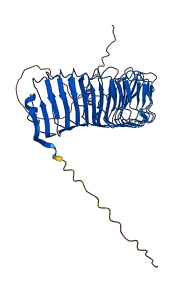
Descriptions
The autoinhibited protein was predicted that may have potential autoinhibitory elements via cis-regPred.
Autoinhibitory domains (AIDs)
Target domain |
|
Relief mechanism |
|
Assay |
cis-regPred |
Accessory elements
No accessory elements
Autoinhibited structure

Activated structure
1 structures for O74411
| Entry ID | Method | Resolution | Chain | Position | Source |
|---|---|---|---|---|---|
| AF-O74411-F1 | Predicted | AlphaFoldDB |
No variants for O74411
| Variant ID(s) | Position | Change | Description | Diseaes Association | Provenance |
|---|---|---|---|---|---|
| No variants for O74411 | |||||
No associated diseases with O74411
1 regional properties for O74411
| Type | Name | Position | InterPro Accession |
|---|---|---|---|
| domain | Receptor L-domain | 46 - 131 | IPR000494 |
6 GO annotations of cellular component
| Name | Definition |
|---|---|
| ascospore wall | The specialized cell wall of the ascospore (spore), which is the product of meiotic division. Examples of this component are found in Fungi. |
| endoplasmic reticulum | The irregular network of unit membranes, visible only by electron microscopy, that occurs in the cytoplasm of many eukaryotic cells. The membranes form a complex meshwork of tubular channels, which are often expanded into slitlike cavities called cisternae. The ER takes two forms, rough (or granular), with ribosomes adhering to the outer surface, and smooth (with no ribosomes attached). |
| extracellular region | The space external to the outermost structure of a cell. For cells without external protective or external encapsulating structures this refers to space outside of the plasma membrane. This term covers the host cell environment outside an intracellular parasite. |
| fungal-type cell wall | A rigid yet dynamic structure surrounding the plasma membrane that affords protection from stresses and contributes to cell morphogenesis, consisting of extensively cross-linked glycoproteins and carbohydrates. The glycoproteins may be modified with N- or O-linked carbohydrates, or glycosylphosphatidylinositol (GPI) anchors; the polysaccharides are primarily branched glucans, including beta-linked and alpha-linked glucans, and may also include chitin and other carbohydrate polymers, but not cellulose or pectin. Enzymes involved in cell wall biosynthesis are also found in the cell wall. Note that some forms of fungi develop a capsule outside of the cell wall under certain circumstances; this is considered a separate structure. |
| plasma membrane | The membrane surrounding a cell that separates the cell from its external environment. It consists of a phospholipid bilayer and associated proteins. |
| prospore membrane | The prospore membrane is a double-membraned structure that extends from the cytoplasmic face of the spindle pole bodies to encompass the spindle pole bodies and the four nuclear lobes that are formed during meiosis. It helps isolate the meiotic nuclei from the cytoplasm during spore formation and serves as a foundation for the formation of the spore walls. An example of this component is found in Schizosaccharomyces pombe. |
No GO annotations of molecular function
| Name | Definition |
|---|---|
| No GO annotations for molecular function |
2 GO annotations of biological process
| Name | Definition |
|---|---|
| ascospore wall assembly | The aggregation, arrangement and bonding together of a set of components to form an ascospore wall. During sporulation in Ascomycota, each ascospore nucleus becomes surrounded by a specialized spore wall, formed by deposition of spore wall components in the lumenal space between the outer and inner leaflets of the prospore membrane. An example of this process is found in Saccharomyces cerevisiae. |
| fungal-type cell wall organization | A process that is carried out at the cellular level which results in the assembly, arrangement of constituent parts, or disassembly of the fungal-type cell wall. |
No homologous proteins in AiPD
| UniProt AC | Gene Name | Protein Name | Species | Evidence Code |
|---|---|---|---|---|
| No homologous proteins | ||||
| 10 | 20 | 30 | 40 | 50 | 60 |
| MRLSSRFYLF | TSFTAWSVVI | AGATPAVCGA | PEYIIETQND | LDVLSNCQVV | NGSIIMNTSS |
| 70 | 80 | 90 | 100 | 110 | 120 |
| ATSLNFNRIE | TITGDLIIRN | NNYLASVALT | SISSVGGELR | FEKLTRLASV | YAPQLANVGQ |
| 130 | 140 | 150 | 160 | 170 | 180 |
| LTMRILPNLQ | GIRFDKGIKK | AHKLTIEDTQ | LSTLAGISLN | TTDTMVIVNN | NYLREVDMPY |
| 190 | 200 | 210 | 220 | 230 | 240 |
| LESVESKFYV | SYNAREISVT | LPRLKTVGDM | TIQRVAHLQL | SNLEEVKGFL | GFLNSTLQDI |
| 250 | 260 | 270 | 280 | 290 | 300 |
| SCPNITRIGQ | SLFFIGNQEL | TSLNFKQLES | IGGTFMIANS | AALAQIKGYD | KLKTVAGSID |
| 310 | 320 | 330 | 340 | 350 | 360 |
| FTGNFSSVEL | PKLRDVKGGL | NIQTTSSDFT | CPFRQSDGII | KGKSFVCRGS | VDNPRQSKES |
| 370 | 380 | 390 | 400 | 410 | |
| SFDDDDFDEL | LGNGTIKGSK | NSTSPVKQSG | AAKVDSRPFR | LVTFFLVLVS | GFAHLL |