O74212
Gene name |
DES1 |
Protein name |
Acyl-lipid (8-3)-desaturase |
Names |
Delta(5) fatty acid desaturase, Delta-5 fatty acid desaturase |
Species |
Mortierella alpina (Oleaginous fungus) (Mortierella renispora) |
KEGG Pathway |
|
EC number |
1.14.19.30: With oxidation of a pair of donors resulting in the reduction of molecular oxygen to two molecules of water |
Protein Class |
|
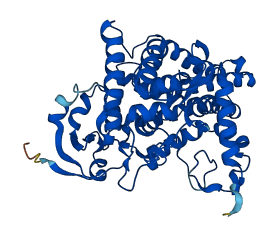
Descriptions
The autoinhibited protein was predicted that may have potential autoinhibitory elements via cis-regPred.
Autoinhibitory domains (AIDs)
Target domain |
|
Relief mechanism |
|
Assay |
cis-regPred |
Accessory elements
No accessory elements
Autoinhibited structure

Activated structure
1 structures for O74212
| Entry ID | Method | Resolution | Chain | Position | Source |
|---|---|---|---|---|---|
| AF-O74212-F1 | Predicted | AlphaFoldDB |
5 variants for O74212
| Variant ID(s) | Position | Change | Description | Diseaes Association | Provenance |
|---|---|---|---|---|---|
| 21 | G>D | strain: ATCC 32221 [UniProt] | No | ||
| 88 | V>I | strain: ATCC 32221 [UniProt] | No | ||
| 111 | D>N | strain: ATCC 32221 [UniProt] | No | ||
| 227 | F>S | strain: ATCC 32221 [UniProt] | No | ||
| 248 | D>H | strain: ATCC 32221 [UniProt] | No |
No associated diseases with O74212
Functions
| Description | ||
|---|---|---|
| EC Number | 1.14.19.30 | With oxidation of a pair of donors resulting in the reduction of molecular oxygen to two molecules of water |
| Subcellular Localization |
|
|
| PANTHER Family | ||
| PANTHER Subfamily | ||
| PANTHER Protein Class | ||
| PANTHER Pathway Category | No pathway information available | |
1 GO annotations of cellular component
| Name | Definition |
|---|---|
| integral component of membrane | The component of a membrane consisting of the gene products and protein complexes having at least some part of their peptide sequence embedded in the hydrophobic region of the membrane. |
3 GO annotations of molecular function
| Name | Definition |
|---|---|
| di-homo-gamma-linolenate delta5 desaturase activity | Catalysis of the reaction: all-cis-icosa-8,11,14-trienoate + O2 + a reduced electron acceptor <=> arachidonate + 2 H2O + an oxidized electron acceptor. |
| heme binding | Binding to a heme, a compound composed of iron complexed in a porphyrin (tetrapyrrole) ring. |
| metal ion binding | Binding to a metal ion. |
1 GO annotations of biological process
| Name | Definition |
|---|---|
| fatty acid biosynthetic process | The chemical reactions and pathways resulting in the formation of a fatty acid, any of the aliphatic monocarboxylic acids that can be liberated by hydrolysis from naturally occurring fats and oils. Fatty acids are predominantly straight-chain acids of 4 to 24 carbon atoms, which may be saturated or unsaturated; branched fatty acids and hydroxy fatty acids also occur, and very long chain acids of over 30 carbons are found in waxes. |
No homologous proteins in AiPD
| UniProt AC | Gene Name | Protein Name | Species | Evidence Code |
|---|---|---|---|---|
| No homologous proteins | ||||
| 10 | 20 | 30 | 40 | 50 | 60 |
| MGTDQGKTFT | WEELAAHNTK | GDLFLAIRGR | VYDVTKFLSR | HPGGVDTLLL | GAGRDVTPVF |
| 70 | 80 | 90 | 100 | 110 | 120 |
| EMYHAFGAAD | AIMKKYYVGT | LVSNELPVFP | EPTVFHKTIK | TRVEGYFTDR | DIDPKNRPEI |
| 130 | 140 | 150 | 160 | 170 | 180 |
| WGRYALIFGS | LIASYYAQLF | VPFVVERTWL | QVVFAIIMGF | ACAQVGLNPL | HDASHFSVTH |
| 190 | 200 | 210 | 220 | 230 | 240 |
| NPTVWKILGA | THDFFNGASY | LVWMYQHMLG | HHPYTNIAGA | DPDVSTFEPD | VRRIKPNQKW |
| 250 | 260 | 270 | 280 | 290 | 300 |
| FVNHINQDMF | VPFLYGLLAF | KVRIQDINIL | YFVKTNDAIR | VNPISTWHTV | MFWGGKAFFV |
| 310 | 320 | 330 | 340 | 350 | 360 |
| WYRLIVPLQY | LPLGKVLLLF | TVADMVSSYW | LALTFQANHV | VEEVQWPLPD | ENGIIQKDWA |
| 370 | 380 | 390 | 400 | 410 | 420 |
| AMQVETTQDY | AHDSHLWTSI | TGSLNYQAVH | HLFPNVSQHH | YPDILAIIKN | TCSEYKVPYL |
| 430 | 440 | ||||
| VKDTFWQAFA | SHLEHLRVLG | LRPKEE |