O73592
Gene name |
|
Protein name |
Homeobox protein MIXL1 |
Names |
Homeodomain protein MIX, cMIX, MIX1 homeobox-like protein 1, Mix.1 homeobox-like protein |
Species |
Gallus gallus (Chicken) |
KEGG Pathway |
gga:395838 |
EC number |
|
Protein Class |
|
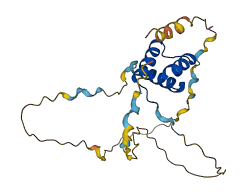
Descriptions
The autoinhibited protein was predicted that may have potential autoinhibitory elements via cis-regPred.
Autoinhibitory domains (AIDs)
Target domain |
|
Relief mechanism |
|
Assay |
cis-regPred |
Accessory elements
No accessory elements
Autoinhibited structure

Activated structure
1 structures for O73592
| Entry ID | Method | Resolution | Chain | Position | Source |
|---|---|---|---|---|---|
| AF-O73592-F1 | Predicted | AlphaFoldDB |
No variants for O73592
| Variant ID(s) | Position | Change | Description | Diseaes Association | Provenance |
|---|---|---|---|---|---|
| No variants for O73592 | |||||
6 associated diseases with O73592
[MIM: 108720]: Atelosteogenesis 1 (AO1)
A lethal chondrodysplasia characterized by distal hypoplasia of the humeri and femurs, hypoplasia of the mid-thoracic spine, occasionally complete lack of ossification of single hand bones, and the finding in cartilage of multiple degenerated chondrocytes which are encapsulated in fibrous tissue. {ECO:0000269|PubMed:14991055}. Note=The disease is caused by variants affecting the gene represented in this entry.
[MIM: 108721]: Atelosteogenesis 3 (AO3)
A short-limb lethal skeletal dysplasia with vertebral abnormalities, disharmonious skeletal maturation, poorly modeled long bones and joint dislocations. Recurrent respiratory insufficiency and/or infections usually result in early death. {ECO:0000269|PubMed:14991055}. Note=The disease is caused by variants affecting the gene represented in this entry.
[MIM: 112310]: Boomerang dysplasia (BOOMD)
A perinatal lethal osteochondrodysplasia characterized by absence or underossification of the limb bones and vertebrae. Patients manifest dwarfism with short, bowed, rigid limbs and characteristic facies. Boomerang dysplasia is distinguished from atelosteogenesis on the basis of a more severe defect in mineralization, with complete absence of ossification in some limb elements and vertebral segments. {ECO:0000269|PubMed:15994868}. Note=The disease is caused by variants affecting the gene represented in this entry.
[MIM: 150250]: Larsen syndrome (LRS)
An osteochondrodysplasia characterized by large-joint dislocations and characteristic craniofacial abnormalities. The cardinal features of the condition are dislocations of the hip, knee and elbow joints, with equinovarus or equinovalgus foot deformities. Spatula-shaped fingers, most marked in the thumb, are also present. Craniofacial anomalies include hypertelorism, prominence of the forehead, a depressed nasal bridge, and a flattened midface. Cleft palate and short stature are often associated features. Spinal anomalies include scoliosis and cervical kyphosis. Hearing loss is a well-recognized complication. {ECO:0000269|PubMed:14991055, ECO:0000269|PubMed:16801345}. Note=The disease is caused by variants affecting the gene represented in this entry.
[MIM: 272460]: Spondylocarpotarsal synostosis syndrome (SCT)
Disorder characterized by short stature and vertebral, carpal and tarsal fusions. {ECO:0000269|PubMed:14991055}. Note=The disease is caused by variants affecting the gene represented in this entry.
Without disease ID
- A lethal chondrodysplasia characterized by distal hypoplasia of the humeri and femurs, hypoplasia of the mid-thoracic spine, occasionally complete lack of ossification of single hand bones, and the finding in cartilage of multiple degenerated chondrocytes which are encapsulated in fibrous tissue. {ECO:0000269|PubMed:14991055}. Note=The disease is caused by variants affecting the gene represented in this entry.
- A short-limb lethal skeletal dysplasia with vertebral abnormalities, disharmonious skeletal maturation, poorly modeled long bones and joint dislocations. Recurrent respiratory insufficiency and/or infections usually result in early death. {ECO:0000269|PubMed:14991055}. Note=The disease is caused by variants affecting the gene represented in this entry.
- A perinatal lethal osteochondrodysplasia characterized by absence or underossification of the limb bones and vertebrae. Patients manifest dwarfism with short, bowed, rigid limbs and characteristic facies. Boomerang dysplasia is distinguished from atelosteogenesis on the basis of a more severe defect in mineralization, with complete absence of ossification in some limb elements and vertebral segments. {ECO:0000269|PubMed:15994868}. Note=The disease is caused by variants affecting the gene represented in this entry.
- An osteochondrodysplasia characterized by large-joint dislocations and characteristic craniofacial abnormalities. The cardinal features of the condition are dislocations of the hip, knee and elbow joints, with equinovarus or equinovalgus foot deformities. Spatula-shaped fingers, most marked in the thumb, are also present. Craniofacial anomalies include hypertelorism, prominence of the forehead, a depressed nasal bridge, and a flattened midface. Cleft palate and short stature are often associated features. Spinal anomalies include scoliosis and cervical kyphosis. Hearing loss is a well-recognized complication. {ECO:0000269|PubMed:14991055, ECO:0000269|PubMed:16801345}. Note=The disease is caused by variants affecting the gene represented in this entry.
- Disorder characterized by short stature and vertebral, carpal and tarsal fusions. {ECO:0000269|PubMed:14991055}. Note=The disease is caused by variants affecting the gene represented in this entry.
1 GO annotations of cellular component
| Name | Definition |
|---|---|
| nucleus | A membrane-bounded organelle of eukaryotic cells in which chromosomes are housed and replicated. In most cells, the nucleus contains all of the cell's chromosomes except the organellar chromosomes, and is the site of RNA synthesis and processing. In some species, or in specialized cell types, RNA metabolism or DNA replication may be absent. |
2 GO annotations of molecular function
| Name | Definition |
|---|---|
| DNA-binding transcription factor activity, RNA polymerase II-specific | A DNA-binding transcription factor activity that modulates the transcription of specific gene sets transcribed by RNA polymerase II. |
| RNA polymerase II cis-regulatory region sequence-specific DNA binding | Binding to a specific upstream regulatory DNA sequence (transcription factor recognition sequence or binding site) located in cis relative to the transcription start site (i.e., on the same strand of DNA) of a gene transcribed by RNA polymerase II. |
2 GO annotations of biological process
| Name | Definition |
|---|---|
| cell differentiation | The process in which relatively unspecialized cells, e.g. embryonic or regenerative cells, acquire specialized structural and/or functional features that characterize the cells, tissues, or organs of the mature organism or some other relatively stable phase of the organism's life history. Differentiation includes the processes involved in commitment of a cell to a specific fate and its subsequent development to the mature state. |
| regulation of transcription by RNA polymerase II | Any process that modulates the frequency, rate or extent of transcription mediated by RNA polymerase II. |
1 homologous proteins in AiPD
| UniProt AC | Gene Name | Protein Name | Species | Evidence Code |
|---|---|---|---|---|
| Q91994 | otx1b | Homeobox protein OTX1 B | Danio rerio (Zebrafish) (Brachydanio rerio) | PR |
| 10 | 20 | 30 | 40 | 50 | 60 |
| MAALRFGPPP | AELPAVPPSC | PPGRWLCGTA | GGSGGGPGAA | PAPLASLPPA | AEGAPSAQRR |
| 70 | 80 | 90 | 100 | 110 | 120 |
| KRTSFTAAQL | ETLELVFQDT | MYPDIYLRER | LADATQIPES | RIQVWFQNRR | AKSRRQRGPP |
| 130 | 140 | 150 | 160 | 170 | 180 |
| RPGAPAPPPP | PPQRSPCGAA | PLLRAREEHR | EWPPRAAGPP | GSALRPHGGS | GGAPAGPYPP |
| 190 | 200 | ||||
| RPAFPLPAGG | GFSELGTEWE | ENAIGAFRAL |