O67779
Gene name |
polA (aq_1967) |
Protein name |
DNA polymerase I |
Names |
POL I |
Species |
Aquifex aeolicus (strain VF5) |
KEGG Pathway |
aae:aq_1967 |
EC number |
2.7.7.7: Nucleotidyltransferases |
Protein Class |
|
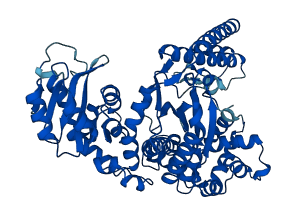
Descriptions
The autoinhibited protein was predicted that may have potential autoinhibitory elements via cis-regPred.
Autoinhibitory domains (AIDs)
Target domain |
|
Relief mechanism |
|
Assay |
cis-regPred |
Accessory elements
No accessory elements
Autoinhibited structure

Activated structure
1 structures for O67779
| Entry ID | Method | Resolution | Chain | Position | Source |
|---|---|---|---|---|---|
| AF-O67779-F1 | Predicted | AlphaFoldDB |
No variants for O67779
| Variant ID(s) | Position | Change | Description | Diseaes Association | Provenance |
|---|---|---|---|---|---|
| No variants for O67779 | |||||
No associated diseases with O67779
Functions
| Description | ||
|---|---|---|
| EC Number | 2.7.7.7 | Nucleotidyltransferases |
| Subcellular Localization |
|
|
| PANTHER Family | ||
| PANTHER Subfamily | ||
| PANTHER Protein Class | ||
| PANTHER Pathway Category | No pathway information available | |
No GO annotations of cellular component
| Name | Definition |
|---|---|
| No GO annotations for cellular component |
3 GO annotations of molecular function
| Name | Definition |
|---|---|
| 3'-5' exonuclease activity | Catalysis of the hydrolysis of ester linkages within nucleic acids by removing nucleotide residues from the 3' end. |
| DNA binding | Any molecular function by which a gene product interacts selectively and non-covalently with DNA (deoxyribonucleic acid). |
| DNA-directed DNA polymerase activity | Catalysis of the reaction: deoxynucleoside triphosphate + DNA(n) = diphosphate + DNA(n+1); the synthesis of DNA from deoxyribonucleotide triphosphates in the presence of a DNA template and a 3'hydroxyl group. |
2 GO annotations of biological process
| Name | Definition |
|---|---|
| DNA-templated DNA replication | A DNA replication process that uses parental DNA as a template for the DNA-dependent DNA polymerases that synthesize the new strands. |
| double-strand break repair | The repair of double-strand breaks in DNA via homologous and nonhomologous mechanisms to reform a continuous DNA helix. |
No homologous proteins in AiPD
| UniProt AC | Gene Name | Protein Name | Species | Evidence Code |
|---|---|---|---|---|
| No homologous proteins | ||||
| 10 | 20 | 30 | 40 | 50 | 60 |
| MDFEYVTGEE | GLKKAIKRLE | NSPYLYLDTE | TTGDRIRLVQ | IGDEENTYVI | DLYEIQDIEP |
| 70 | 80 | 90 | 100 | 110 | 120 |
| LRKLINERGI | VGHNLKFDLK | YLYRYGIFPS | ATFDTMIASY | LLGYERHSLN | HIVSNLLGYS |
| 130 | 140 | 150 | 160 | 170 | 180 |
| MDKSYQTSDW | GASVLSDAQL | KYAANDVIVL | RELFPKMRDM | LNELDAERGE | ELLKTRTAKI |
| 190 | 200 | 210 | 220 | 230 | 240 |
| FDLKSPVAIV | EMAFVREVAK | LEINGFPVDV | EELTNKLKAV | ERETQKRIQE | FYIKYRVDPL |
| 250 | 260 | 270 | 280 | 290 | 300 |
| SPKQLASLLT | KKFKLNLPKT | PKGNVSTDDK | ALTSYQDVEP | VKLVLEIRKL | KKIADKLKEL |
| 310 | 320 | 330 | 340 | 350 | 360 |
| KEHLKNGRVY | PEFKQIGAVT | GRMSSAHPNI | QNIHRDMRGI | FKAEEGNTFV | ISDFSQIELR |
| 370 | 380 | 390 | 400 | 410 | 420 |
| IAAEYVKDPL | MLDAFKKGKD | MHRYTASVVL | GKKEEEITKE | ERQLAKAINF | GLIYGISAKG |
| 430 | 440 | 450 | 460 | 470 | 480 |
| LAEYAKLGYG | VEISLEEAQV | LRERFFKNFK | AFKEWHDRVK | KELKEKGEVK | GHTLLGRRFS |
| 490 | 500 | 510 | 520 | 530 | 540 |
| ANTFNDAVNY | PIQGTGADLL | KLAVLLFDAN | LQKKGIDAKL | VNLVHDEIVV | ECEKEKAEEV |
| 550 | 560 | 570 | |||
| KEILEKSMKT | AGKIILKEVP | VEVESVINER | WTKD |