O67356
Gene name |
clpX |
Protein name |
ATP-dependent Clp protease ATP-binding subunit ClpX |
Names |
|
Species |
Aquifex aeolicus (strain VF5) |
KEGG Pathway |
aae:aq_1337 |
EC number |
|
Protein Class |
|
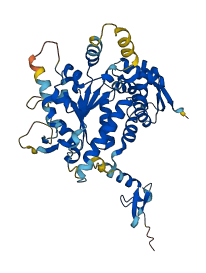
Descriptions
The autoinhibited protein was predicted that may have potential autoinhibitory elements via cis-regPred.
Autoinhibitory domains (AIDs)
Target domain |
|
Relief mechanism |
|
Assay |
cis-regPred |
Accessory elements
No accessory elements
Autoinhibited structure

Activated structure
1 structures for O67356
| Entry ID | Method | Resolution | Chain | Position | Source |
|---|---|---|---|---|---|
| AF-O67356-F1 | Predicted | AlphaFoldDB |
No variants for O67356
| Variant ID(s) | Position | Change | Description | Diseaes Association | Provenance |
|---|---|---|---|---|---|
| No variants for O67356 | |||||
No associated diseases with O67356
1 GO annotations of cellular component
| Name | Definition |
|---|---|
| HslUV protease complex | A protein complex that possesses ATP-dependent protease activity; consists of an ATPase large subunit with homology to other ClpX family ATPases and a peptidase small subunit related to the proteasomal beta-subunits of eukaryotes. In the E. coli complex, a double ring-shaped homohexamer of HslV is capped on each side by a ring-shaped HslU homohexamer. |
6 GO annotations of molecular function
| Name | Definition |
|---|---|
| ATP binding | Binding to ATP, adenosine 5'-triphosphate, a universally important coenzyme and enzyme regulator. |
| ATP hydrolysis activity | Catalysis of the reaction: ATP + H2O = ADP + H+ phosphate. ATP hydrolysis is used in some reactions as an energy source, for example to catalyze a reaction or drive transport against a concentration gradient. |
| ATP-dependent protein folding chaperone | Binding to a protein or a protein-containing complex to assist the protein folding process, driven by ATP hydrolysis. |
| protein dimerization activity | The formation of a protein dimer, a macromolecular structure consists of two noncovalently associated identical or nonidentical subunits. |
| unfolded protein binding | Binding to an unfolded protein. |
| zinc ion binding | Binding to a zinc ion (Zn). |
2 GO annotations of biological process
| Name | Definition |
|---|---|
| cell division | The process resulting in division and partitioning of components of a cell to form more cells; may or may not be accompanied by the physical separation of a cell into distinct, individually membrane-bounded daughter cells. |
| proteolysis involved in protein catabolic process | The hydrolysis of a peptide bond or bonds within a protein as part of the chemical reactions and pathways resulting in the breakdown of a protein by individual cells. |
No homologous proteins in AiPD
| UniProt AC | Gene Name | Protein Name | Species | Evidence Code |
|---|---|---|---|---|
| No homologous proteins | ||||
| 10 | 20 | 30 | 40 | 50 | 60 |
| MAVKVNKEFC | SFCGKRQDEV | LILIAGPNNT | YICDECVEKC | YQIVRENKKT | SYNFELKDIP |
| 70 | 80 | 90 | 100 | 110 | 120 |
| KPEQIKKILD | EYVIGQERAK | KILSVAVYNH | YKRIKAKEAG | LSLDDVELEK | SNILLIGPTG |
| 130 | 140 | 150 | 160 | 170 | 180 |
| SGKTLLARTL | AKILNVPFAI | ADATSLTEAG | YVGEDVENVL | VRLLQACDYD | VKAAQKGIVY |
| 190 | 200 | 210 | 220 | 230 | 240 |
| IDEIDKIAKK | SGINPSITRD | VSGEGVQQAL | LKIVEGSVVN | VPPQGGRKHP | HQEFIQVDTT |
| 250 | 260 | 270 | 280 | 290 | 300 |
| DILFICGGAF | VGLEDIIKQR | LGKSRVGFEA | EIKKVDKEQD | LLELVEPDDL | IRFGMIPEFI |
| 310 | 320 | 330 | 340 | 350 | 360 |
| GRFPVIATLR | ELTEDELVRI | LVEPKNALVK | QYQKLFELEG | VKLTFTEKAL | REIAKEAIRR |
| 370 | 380 | 390 | 400 | 410 | |
| KTGARGLRAI | MEDIMADIMF | EVPSLPGVKE | VIIDENVVKN | KEKPKLIFEQ | AV |