O67266
Gene name |
flhF (aq_1214) |
Protein name |
Flagellar biosynthesis protein FlhF |
Names |
Flagella-associated GTP-binding protein |
Species |
Aquifex aeolicus (strain VF5) |
KEGG Pathway |
aae:aq_1214 |
EC number |
|
Protein Class |
|
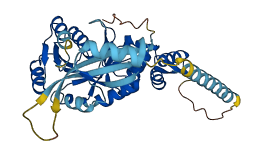
Descriptions
The autoinhibited protein was predicted that may have potential autoinhibitory elements via cis-regPred.
Autoinhibitory domains (AIDs)
Target domain |
|
Relief mechanism |
|
Assay |
cis-regPred |
Accessory elements
No accessory elements
Autoinhibited structure

Activated structure
1 structures for O67266
| Entry ID | Method | Resolution | Chain | Position | Source |
|---|---|---|---|---|---|
| AF-O67266-F1 | Predicted | AlphaFoldDB |
No variants for O67266
| Variant ID(s) | Position | Change | Description | Diseaes Association | Provenance |
|---|---|---|---|---|---|
| No variants for O67266 | |||||
No associated diseases with O67266
2 GO annotations of cellular component
| Name | Definition |
|---|---|
| membrane | A lipid bilayer along with all the proteins and protein complexes embedded in it an attached to it. |
| plasma membrane | The membrane surrounding a cell that separates the cell from its external environment. It consists of a phospholipid bilayer and associated proteins. |
3 GO annotations of molecular function
| Name | Definition |
|---|---|
| GTP binding | Binding to GTP, guanosine triphosphate. |
| GTPase activity | Catalysis of the reaction: GTP + H2O = GDP + H+ + phosphate. |
| signal recognition particle binding | Binding to a signal recognition particle. |
3 GO annotations of biological process
| Name | Definition |
|---|---|
| bacterial-type flagellum organization | A process that is carried out at the cellular level which results in the assembly, arrangement of constituent parts, or disassembly of a bacterial-type flagellum, a motor complex composed of an extracellular helical protein filament coupled to a rotary motor embedded in the cell envelope which functions in cell motility. |
| protein targeting | The process of targeting specific proteins to particular regions of the cell, typically membrane-bounded subcellular organelles. Usually requires an organelle specific protein sequence motif. |
| SRP-dependent cotranslational protein targeting to membrane | The targeting of proteins to a membrane that occurs during translation and is dependent upon two key components, the signal-recognition particle (SRP) and the SRP receptor. SRP is a cytosolic particle that transiently binds to the endoplasmic reticulum (ER) signal sequence in a nascent protein, to the large ribosomal unit, and to the SRP receptor in the ER membrane. |
No homologous proteins in AiPD
| UniProt AC | Gene Name | Protein Name | Species | Evidence Code |
|---|---|---|---|---|
| No homologous proteins | ||||
| 10 | 20 | 30 | 40 | 50 | 60 |
| MKIEKIEVNS | LQEAIEIVER | RFGENAVILS | SRVIRKNRFG | FLPIFRKKIL | EVTVGIREEE |
| 70 | 80 | 90 | 100 | 110 | 120 |
| DFRKEFERER | ELIKEIENLK | KIVNELINNG | EVKGEKIVEK | GSDTYAPRVK | RYLEKLVIKN |
| 130 | 140 | 150 | 160 | 170 | 180 |
| ISKNIAEKII | QDACGYDIDN | KIYDFKDEPY | TSLRESIEKN | IKLNEEFIQN | PPKVVALVGP |
| 190 | 200 | 210 | 220 | 230 | 240 |
| TGVGKTTTLA | KLAHLFKKNK | KKVGIISLDC | FRVGAFEQLK | AFAEVLEVPF | KLADSPRAFN |
| 250 | 260 | 270 | 280 | 290 | 300 |
| IQLLEMDDRD | VILVDTAGRS | HYDVIRLKEL | ETYFKVSDIS | VYLTLAANLS | ELVMYEAIMQ |
| 310 | 320 | 330 | 340 | 350 | 360 |
| FGMFSISGLI | FTKLDETPYP | GSMVNVAYRT | QYPVVCFTMG | QSIPEDIVVA | NYDYLVRLIL |
| 370 | |||||
| EDEDEVRPAT | QLA |