O64903
Gene name |
NDPK2 (At5g63310, MDC12.28) |
Protein name |
Nucleoside diphosphate kinase II, chloroplastic |
Names |
NDK II, NDP kinase II, NDPK II, NDPK Ia |
Species |
Arabidopsis thaliana (Mouse-ear cress) |
KEGG Pathway |
ath:AT5G63310 |
EC number |
2.7.4.6: Phosphotransferases with a phosphate group as acceptor |
Protein Class |
|
Descriptions
The autoinhibited protein was predicted that may have potential autoinhibitory elements via cis-regPred.
Autoinhibitory domains (AIDs)
Target domain |
|
Relief mechanism |
|
Assay |
cis-regPred |
Accessory elements
No accessory elements
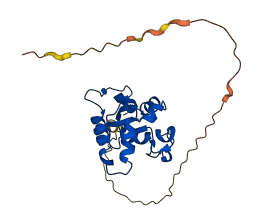
Autoinhibited structure

Activated structure
3 structures for O64903
| Entry ID | Method | Resolution | Chain | Position | Source |
|---|---|---|---|---|---|
| 1S57 | X-ray | 180 A | A/B/C/D/E/F | 79-231 | PDB |
| 1S59 | X-ray | 260 A | A/B/C/D/E/F | 79-231 | PDB |
| AF-O64903-F1 | Predicted | AlphaFoldDB |
22 variants for O64903
| Variant ID(s) | Position | Change | Description | Diseaes Association | Provenance |
|---|---|---|---|---|---|
| ENSVATH03468937 | 14 | C>Y | No | 1000Genomes | |
| ENSVATH03468936 | 18 | P>T | No | 1000Genomes | |
| tmp_5_25373783_G_T | 19 | P>Q | No | 1000Genomes | |
| ENSVATH07472224 | 29 | H>Y | No | 1000Genomes | |
| ENSVATH07472223 | 33 | A>S | No | 1000Genomes | |
| tmp_5_25373741_G_A | 33 | A>V | No | 1000Genomes | |
| ENSVATH00749195 | 36 | N>Y | No | 1000Genomes | |
| ENSVATH03468935 | 40 | A>E | No | 1000Genomes | |
| ENSVATH07472220 | 59 | R>S | No | 1000Genomes | |
| tmp_5_25373637_C_T | 68 | E>K | No | 1000Genomes | |
| tmp_5_25373366_C_G | 98 | G>A | No | 1000Genomes | |
| tmp_5_25373210_C_T | 102 | E>K | No | 1000Genomes | |
| tmp_5_25373206_A_G | 103 | I>T | No | 1000Genomes | |
| tmp_5_25373152_T_C | 121 | Q>R | No | 1000Genomes | |
| ENSVATH14646645 | 161 | G>D | No | 1000Genomes | |
| tmp_5_25372710_C_T | 164 | A>T | No | 1000Genomes | |
| tmp_5_25372695_G_C | 169 | L>V | No | 1000Genomes | |
| ENSVATH12916666 | 176 | L>H | No | 1000Genomes | |
| ENSVATH12916665 | 207 | R>H | No | 1000Genomes | |
| ENSVATH03468925 | 209 | I>N | No | 1000Genomes | |
| ENSVATH07472203 | 223 | S>L | No | 1000Genomes | |
| tmp_5_25372141_G_A | 226 | A>V | No | 1000Genomes |
No associated diseases with O64903
Functions
| Description | ||
|---|---|---|
| EC Number | 2.7.4.6 | Phosphotransferases with a phosphate group as acceptor |
| Subcellular Localization |
|
|
| PANTHER Family | ||
| PANTHER Subfamily | ||
| PANTHER Protein Class | ||
| PANTHER Pathway Category | No pathway information available | |
7 GO annotations of cellular component
| Name | Definition |
|---|---|
| chloroplast | A chlorophyll-containing plastid with thylakoids organized into grana and frets, or stroma thylakoids, and embedded in a stroma. |
| chloroplast envelope | The double lipid bilayer enclosing the chloroplast and separating its contents from the rest of the cytoplasm; includes the intermembrane space. |
| chloroplast stroma | The space enclosed by the double membrane of a chloroplast but excluding the thylakoid space. It contains DNA, ribosomes and some temporary products of photosynthesis. |
| cytoplasm | The contents of a cell excluding the plasma membrane and nucleus, but including other subcellular structures. |
| nucleus | A membrane-bounded organelle of eukaryotic cells in which chromosomes are housed and replicated. In most cells, the nucleus contains all of the cell's chromosomes except the organellar chromosomes, and is the site of RNA synthesis and processing. In some species, or in specialized cell types, RNA metabolism or DNA replication may be absent. |
| plastid | Any member of a family of organelles found in the cytoplasm of plants and some protists, which are membrane-bounded and contain DNA. Plant plastids develop from a common type, the proplastid. |
| thylakoid | A membranous cellular structure that bears the photosynthetic pigments in plants, algae, and cyanobacteria. In cyanobacteria thylakoids are of various shapes and are attached to, or continuous with, the plasma membrane. In eukaryotes they are flattened, membrane-bounded disk-like structures located in the chloroplasts; in the chloroplasts of higher plants the thylakoids form dense stacks called grana. Isolated thylakoid preparations can carry out photosynthetic electron transport and the associated phosphorylation. |
3 GO annotations of molecular function
| Name | Definition |
|---|---|
| ATP binding | Binding to ATP, adenosine 5'-triphosphate, a universally important coenzyme and enzyme regulator. |
| metal ion binding | Binding to a metal ion. |
| nucleoside diphosphate kinase activity | Catalysis of the reaction: ATP + nucleoside diphosphate = ADP + nucleoside triphosphate. |
8 GO annotations of biological process
| Name | Definition |
|---|---|
| auxin-activated signaling pathway | The series of molecular signals generated by the binding of the plant hormone auxin to a receptor, and ending with modulation of a downstream cellular process, e.g. transcription. |
| CTP biosynthetic process | The chemical reactions and pathways resulting in the formation of CTP, cytidine 5'-triphosphate. |
| GTP biosynthetic process | The chemical reactions and pathways resulting in the formation of GTP, guanosine triphosphate. |
| nucleoside diphosphate phosphorylation | The process of introducing a phosphate group into a nucleoside diphosphate to produce a nucleoside triphosphate. |
| red, far-red light phototransduction | The sequence of reactions within a cell required to convert absorbed photons from red or far-red light into a molecular signal; the red, far-red light range is defined as having a wavelength within the range 660-730 nm. |
| response to hydrogen peroxide | Any process that results in a change in state or activity of a cell or an organism (in terms of movement, secretion, enzyme production, gene expression, etc.) as a result of a hydrogen peroxide (H2O2) stimulus. |
| response to UV | Any process that results in a change in state or activity of a cell or an organism (in terms of movement, secretion, enzyme production, gene expression, etc.) as a result of an ultraviolet radiation (UV light) stimulus. Ultraviolet radiation is electromagnetic radiation with a wavelength in the range of 10 to 380 nanometers. |
| UTP biosynthetic process | The chemical reactions and pathways resulting in the formation of UTP, uridine (5'-)triphosphate. |
1 homologous proteins in AiPD
| UniProt AC | Gene Name | Protein Name | Species | Evidence Code |
|---|---|---|---|---|
| Q8N427 | NME8 | Thioredoxin domain-containing protein 3 | Homo sapiens (Human) | PR |
| 10 | 20 | 30 | 40 | 50 | 60 |
| MVGATVVSKW | TPLCVASPPE | RNSASLNPHC | SPARVNFRTA | LAAFRPQFRL | FSRNSASRRR |
| 70 | 80 | 90 | 100 | 110 | 120 |
| LRASSSAESG | IFLPHLVASM | EDVEETYIMV | KPDGIQRGLV | GEIISRFEKK | GFKLIGLKMF |
| 130 | 140 | 150 | 160 | 170 | 180 |
| QCPKELAEEH | YKDLSAKSFF | PNLIEYITSG | PVVCMAWEGV | GVVASARKLI | GKTDPLQAEP |
| 190 | 200 | 210 | 220 | 230 | |
| GTIRGDLAVQ | TGRNIVHGSD | SPENGKREIG | LWFKEGELCK | WDSALATWLR | E |