O61122
Gene name |
svkA (DDB_G0286359) |
Protein name |
Serine/threonine-protein kinase svkA |
Names |
Severin kinase A |
Species |
Dictyostelium discoideum (Slime mold) |
KEGG Pathway |
ddi:DDB_G0286359 |
EC number |
2.7.11.1: Protein-serine/threonine kinases |
Protein Class |
|
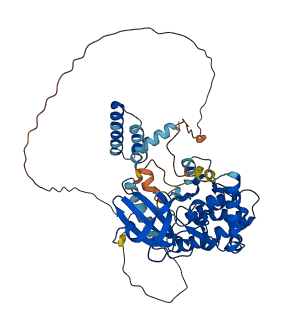
Descriptions
The autoinhibited protein was predicted that may have potential autoinhibitory elements via cis-regPred.
Autoinhibitory domains (AIDs)
Target domain |
|
Relief mechanism |
|
Assay |
cis-regPred |
Accessory elements
149-172 (Activation loop from InterPro)
Target domain |
12-262 (Protein kinase domain) |
Relief mechanism |
|
Assay |
|
Autoinhibited structure

Activated structure
1 structures for O61122
| Entry ID | Method | Resolution | Chain | Position | Source |
|---|---|---|---|---|---|
| AF-O61122-F1 | Predicted | AlphaFoldDB |
No variants for O61122
| Variant ID(s) | Position | Change | Description | Diseaes Association | Provenance |
|---|---|---|---|---|---|
| No variants for O61122 | |||||
No associated diseases with O61122
No regional properties for O61122
| Type | Name | Position | InterPro Accession |
|---|---|---|---|
| No domain, repeats, and functional sites for O61122 | |||
Functions
| Description | ||
|---|---|---|
| EC Number | 2.7.11.1 | Protein-serine/threonine kinases |
| Subcellular Localization |
|
|
| PANTHER Family | ||
| PANTHER Subfamily | ||
| PANTHER Protein Class | ||
| PANTHER Pathway Category | No pathway information available | |
7 GO annotations of cellular component
| Name | Definition |
|---|---|
| actin cytoskeleton | The part of the cytoskeleton (the internal framework of a cell) composed of actin and associated proteins. Includes actin cytoskeleton-associated complexes. |
| centrosome | A structure comprised of a core structure (in most organisms, a pair of centrioles) and peripheral material from which a microtubule-based structure, such as a spindle apparatus, is organized. Centrosomes occur close to the nucleus during interphase in many eukaryotic cells, though in animal cells it changes continually during the cell-division cycle. |
| cleavage furrow | The cleavage furrow is a plasma membrane invagination at the cell division site. The cleavage furrow begins as a shallow groove and eventually deepens to divide the cytoplasm. |
| cytoplasm | The contents of a cell excluding the plasma membrane and nucleus, but including other subcellular structures. |
| cytosol | The part of the cytoplasm that does not contain organelles but which does contain other particulate matter, such as protein complexes. |
| mitotic spindle | A spindle that forms as part of mitosis. Mitotic and meiotic spindles contain distinctive complements of proteins associated with microtubules. |
| nucleus | A membrane-bounded organelle of eukaryotic cells in which chromosomes are housed and replicated. In most cells, the nucleus contains all of the cell's chromosomes except the organellar chromosomes, and is the site of RNA synthesis and processing. In some species, or in specialized cell types, RNA metabolism or DNA replication may be absent. |
6 GO annotations of molecular function
| Name | Definition |
|---|---|
| actin binding | Binding to monomeric or multimeric forms of actin, including actin filaments. |
| ATP binding | Binding to ATP, adenosine 5'-triphosphate, a universally important coenzyme and enzyme regulator. |
| metal ion binding | Binding to a metal ion. |
| protein kinase activity | Catalysis of the phosphorylation of an amino acid residue in a protein, usually according to the reaction: a protein + ATP = a phosphoprotein + ADP. |
| protein serine kinase activity | Catalysis of the reactions: ATP + protein serine = ADP + protein serine phosphate. |
| protein serine/threonine kinase activity | Catalysis of the reactions: ATP + protein serine = ADP + protein serine phosphate, and ATP + protein threonine = ADP + protein threonine phosphate. |
10 GO annotations of biological process
| Name | Definition |
|---|---|
| cell cycle | The progression of biochemical and morphological phases and events that occur in a cell during successive cell replication or nuclear replication events. Canonically, the cell cycle comprises the replication and segregation of genetic material followed by the division of the cell, but in endocycles or syncytial cells nuclear replication or nuclear division may not be followed by cell division. |
| cell division | The process resulting in division and partitioning of components of a cell to form more cells; may or may not be accompanied by the physical separation of a cell into distinct, individually membrane-bounded daughter cells. |
| hippo signaling | The series of molecular signals mediated by the serine/threonine kinase Hippo or one of its orthologs. In Drosophila, Hippo in complex with the scaffold protein Salvador (Sav), phosphorylates and activates Warts (Wts), which in turn phosphorylates and inactivates the Yorkie (Yki) transcriptional activator. The core fly components hippo, sav, wts and mats are conserved in mammals as STK4/3 (MST1/2), SAV1/WW45, LATS1/2 and MOB1. |
| hyperosmotic response | Any process that results in a change in state or activity of a cell or an organism (in terms of movement, secretion, enzyme production, gene expression, etc.) as a result of detection of, or exposure to, a hyperosmotic environment, i.e. an environment with a higher concentration of solutes than the organism or cell. |
| positive regulation of cell division | Any process that activates or increases the frequency, rate or extent of cell division. |
| positive regulation of mitotic cytokinetic process | Any process that activates or increases the frequency, rate or extent of mitotic cytokinetic process. |
| protein autophosphorylation | The phosphorylation by a protein of one or more of its own amino acid residues (cis-autophosphorylation), or residues on an identical protein (trans-autophosphorylation). |
| protein phosphorylation | The process of introducing a phosphate group on to a protein. |
| regulation of actin cytoskeleton organization | Any process that modulates the frequency, rate or extent of the formation, arrangement of constituent parts, or disassembly of cytoskeletal structures comprising actin filaments and their associated proteins. |
| regulation of sorocarp development | Any process that modulates the frequency, rate or extent of sorocarp development. An example of this process is found in Dictyostelium discoideum. |
No homologous proteins in AiPD
| UniProt AC | Gene Name | Protein Name | Species | Evidence Code |
|---|---|---|---|---|
| No homologous proteins | ||||
| 10 | 20 | 30 | 40 | 50 | 60 |
| MASKKGDPEE | LYVRQEKIGK | GSFGEVFKGI | NKKTNETIAI | KTIDLEDAED | EIEDIQQEIN |
| 70 | 80 | 90 | 100 | 110 | 120 |
| VLSQCESPFV | TKYFGSFLKG | SKLWIIMEYL | AGGSVLDLMK | PGPFDEGYIA | IILRELLKGL |
| 130 | 140 | 150 | 160 | 170 | 180 |
| EYLHSEGKIH | RDIKAANVLL | SASGDVKLAD | FGVSGQLTDQ | MTKRNTFVGT | PFWMAPEVIK |
| 190 | 200 | 210 | 220 | 230 | 240 |
| QTGYDSKADI | WSMGITALEM | AKGEPPRADL | HPMRALFLIP | KDPPPTLEGN | FSKGFKEFCA |
| 250 | 260 | 270 | 280 | 290 | 300 |
| LCLNKDPNQR | PTAKDLLKHK | FIKAAKKTSS | LTDLIERRQK | WLQLNGNNAD | DENDDLDRDA |
| 310 | 320 | 330 | 340 | 350 | 360 |
| KSNEEDFGWE | FPTIKQKSPV | AVQEQQQTPQ | KPTVVSTPIK | EQQQQQQPTP | VTTPQQPVTT |
| 370 | 380 | 390 | 400 | 410 | 420 |
| TTTTPTTETK | VRSLSNSSQT | TPVKTTVAAT | TAPATTPASN | APTSTTPNGA | AVTQQQAPRA |
| 430 | 440 | 450 | 460 | 470 | |
| SALTSVIYPV | LSKLLKNTSD | ENVINALAQL | KMAFDNAEKA | KPGITHSLIA | QIIETLKR |