O60143
Gene name |
rpl701 (rpl7c, SPBC18H10.12c) |
Protein name |
60S ribosomal protein L7-C |
Names |
|
Species |
Schizosaccharomyces pombe (strain 972 / ATCC 24843) (Fission yeast) |
KEGG Pathway |
spo:SPBC18H10.12c |
EC number |
|
Protein Class |
|
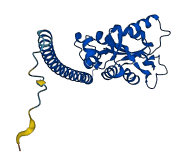
Descriptions
The autoinhibited protein was predicted that may have potential autoinhibitory elements via cis-regPred.
Autoinhibitory domains (AIDs)
Target domain |
|
Relief mechanism |
|
Assay |
cis-regPred |
Accessory elements
No accessory elements
Autoinhibited structure

Activated structure
1 structures for O60143
| Entry ID | Method | Resolution | Chain | Position | Source |
|---|---|---|---|---|---|
| AF-O60143-F1 | Predicted | AlphaFoldDB |
No variants for O60143
| Variant ID(s) | Position | Change | Description | Diseaes Association | Provenance |
|---|---|---|---|---|---|
| No variants for O60143 | |||||
No associated diseases with O60143
4 regional properties for O60143
| Type | Name | Position | InterPro Accession |
|---|---|---|---|
| domain | Ribosomal protein L30, N-terminal | 17 - 87 | IPR012988 |
| domain | Ribosomal protein L30, ferredoxin-like fold domain | 92 - 142 | IPR016082 |
| conserved_site | Ribosomal protein L30, conserved site | 110 - 142 | IPR018038 |
| domain | Ribosomal protein L7, eukaryotic/archaeal | 91 - 251 | IPR035808 |
4 GO annotations of cellular component
| Name | Definition |
|---|---|
| cytosolic large ribosomal subunit | The large subunit of a ribosome located in the cytosol. |
| nucleolus | A small, dense body one or more of which are present in the nucleus of eukaryotic cells. It is rich in RNA and protein, is not bounded by a limiting membrane, and is not seen during mitosis. Its prime function is the transcription of the nucleolar DNA into 45S ribosomal-precursor RNA, the processing of this RNA into 5.8S, 18S, and 28S components of ribosomal RNA, and the association of these components with 5S RNA and proteins synthesized outside the nucleolus. This association results in the formation of ribonucleoprotein precursors; these pass into the cytoplasm and mature into the 40S and 60S subunits of the ribosome. |
| nucleus | A membrane-bounded organelle of eukaryotic cells in which chromosomes are housed and replicated. In most cells, the nucleus contains all of the cell's chromosomes except the organellar chromosomes, and is the site of RNA synthesis and processing. In some species, or in specialized cell types, RNA metabolism or DNA replication may be absent. |
| ribonuclease MRP complex | A ribonucleoprotein complex that contains an RNA molecule of the snoRNA family, and cleaves the rRNA precursor as part of rRNA transcript processing. It also has other roles: In S. cerevisiae it is involved in cell cycle-regulated degradation of daughter cell-specific mRNAs, while in mammalian cells it also enters the mitochondria and processes RNAs to create RNA primers for DNA replication. |
2 GO annotations of molecular function
| Name | Definition |
|---|---|
| RNA binding | Binding to an RNA molecule or a portion thereof. |
| structural constituent of ribosome | The action of a molecule that contributes to the structural integrity of the ribosome. |
3 GO annotations of biological process
| Name | Definition |
|---|---|
| endonucleolytic cleavage in ITS1 to separate SSU-rRNA from 5.8S rRNA and LSU-rRNA from tricistronic rRNA transcript (SSU-rRNA, 5.8S rRNA, LSU-rRNA) | Endonucleolytic cleavage between the SSU-rRNA and the 5.8S rRNA of an rRNA molecule originally produced as a tricistronic rRNA transcript that contained the Small SubUnit (SSU) rRNA, the 5.8S rRNA, and the Large SubUnit (LSU) rRNA, in that order, from 5' to 3' along the primary transcript. |
| endonucleolytic cleavage involved in tRNA processing | Any endonucleolytic RNA phosphodiester bond hydrolysis that is involved in tRNA processing. |
| maturation of LSU-rRNA from tricistronic rRNA transcript (SSU-rRNA, 5.8S rRNA, LSU-rRNA) | Any process involved in the maturation of a precursor Large SubUnit (LSU) ribosomal RNA (rRNA) molecule into a mature LSU-rRNA molecule from the pre-rRNA molecule originally produced as a tricistronic rRNA transcript that contains the Small Subunit (SSU) rRNA, 5.8S rRNA, and Large Subunit (LSU) in that order from 5' to 3' along the primary transcript. |
No homologous proteins in AiPD
| UniProt AC | Gene Name | Protein Name | Species | Evidence Code |
|---|---|---|---|---|
| No homologous proteins | ||||
| 10 | 20 | 30 | 40 | 50 | 60 |
| MAVASSTVPS | KEQIFAPESL | LKKKKTQEQS | REQRVAAAAE | KKAAQQKKRE | LIAKRAESYD |
| 70 | 80 | 90 | 100 | 110 | 120 |
| AEYRKAEREQ | IELGRKARAE | GNYYVPDETK | LVFVIRIRGI | NNIPPKARKI | MQLLRLIQIN |
| 130 | 140 | 150 | 160 | 170 | 180 |
| NGVFVKFNKA | TKEMLQVVEP | YVTYGIPNLK | TVRELLYKRG | FGKVNKQRIA | LSDNAIIEAA |
| 190 | 200 | 210 | 220 | 230 | 240 |
| LGKYSILSIE | DLIHEIYTVG | PNFKQAANFI | WPFQLSSPLG | GWRDRKFKHF | IEGGDAGKRD |
| 250 | |||||
| EHINSLVRKM | L |