O60106
Gene name |
SPBC14F5.10c |
Protein name |
LON peptidase N-terminal domain and RING finger protein C14F5.10c |
Names |
|
Species |
Schizosaccharomyces pombe (strain 972 / ATCC 24843) (Fission yeast) |
KEGG Pathway |
spo:SPBC14F5.10c |
EC number |
|
Protein Class |
|
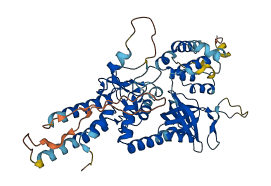
Descriptions
The autoinhibited protein was predicted that may have potential autoinhibitory elements via cis-regPred.
Autoinhibitory domains (AIDs)
Target domain |
|
Relief mechanism |
|
Assay |
cis-regPred |
Accessory elements
No accessory elements
Autoinhibited structure

Activated structure
1 structures for O60106
| Entry ID | Method | Resolution | Chain | Position | Source |
|---|---|---|---|---|---|
| AF-O60106-F1 | Predicted | AlphaFoldDB |
No variants for O60106
| Variant ID(s) | Position | Change | Description | Diseaes Association | Provenance |
|---|---|---|---|---|---|
| No variants for O60106 | |||||
No associated diseases with O60106
4 regional properties for O60106
| Type | Name | Position | InterPro Accession |
|---|---|---|---|
| domain | Zinc finger, RING-type | 19 - 61 | IPR001841-1 |
| domain | Zinc finger, RING-type | 169 - 207 | IPR001841-2 |
| domain | Lon protease, N-terminal domain | 249 - 470 | IPR003111 |
| conserved_site | Zinc finger, RING-type, conserved site | 184 - 193 | IPR017907 |
1 GO annotations of cellular component
| Name | Definition |
|---|---|
| cytosol | The part of the cytoplasm that does not contain organelles but which does contain other particulate matter, such as protein complexes. |
2 GO annotations of molecular function
| Name | Definition |
|---|---|
| ubiquitin protein ligase activity | Catalysis of the transfer of ubiquitin to a substrate protein via the reaction X-ubiquitin + S -> X + S-ubiquitin, where X is either an E2 or E3 enzyme, the X-ubiquitin linkage is a thioester bond, and the S-ubiquitin linkage is an amide bond: an isopeptide bond between the C-terminal glycine of ubiquitin and the epsilon-amino group of lysine residues in the substrate or, in the linear extension of ubiquitin chains, a peptide bond the between the C-terminal glycine and N-terminal methionine of ubiquitin residues. |
| zinc ion binding | Binding to a zinc ion (Zn). |
1 GO annotations of biological process
| Name | Definition |
|---|---|
| protein modification by small protein conjugation or removal | A protein modification process in which one or more groups of a small protein, such as ubiquitin or a ubiquitin-like protein, are covalently attached to or removed from a target protein. |
No homologous proteins in AiPD
| UniProt AC | Gene Name | Protein Name | Species | Evidence Code |
|---|---|---|---|---|
| No homologous proteins | ||||
| 10 | 20 | 30 | 40 | 50 | 60 |
| MRKERPGVLF | NKIRSYFICP | GCNCLPDWPV | TLPCGGTVCR | KCFRNAYSSE | SSGKVSPSRC |
| 70 | 80 | 90 | 100 | 110 | 120 |
| CFYNHKKPHY | SVETEVKDVI | ISKVVELIKT | TEFQISQQSL | VPLELKEEIC | HDDCLSSSPP |
| 130 | 140 | 150 | 160 | 170 | 180 |
| CTSALTEITL | LPPTFHNLIP | SSSSYETAVA | EFLHMEDLLQ | ENVSRELECQ | ICFGMLYDPV |
| 190 | 200 | 210 | 220 | 230 | 240 |
| VSPCGHTFCG | PCLMQALTQS | PQCPTCRFGL | PSPVVLEHAK | SHSITTFLRD | FYPDNWLERQ |
| 250 | 260 | 270 | 280 | 290 | 300 |
| KSWEEEKEQE | SWLPLFISML | AYPRMPTFLH | IFELRYHIMI | KKCLETSKRF | CIAMPLRARS |
| 310 | 320 | 330 | 340 | 350 | 360 |
| DGHNEHRELR | NARGQRLFCS | EYGTILEIIQ | VEPLIDGRSL | VEARGSYCVR | IIDFRADGLF |
| 370 | 380 | 390 | 400 | 410 | 420 |
| PRVKIEKHYD | TPLRATPLQF | PEPEYLLMYG | NLSNEELVER | IDAFYMNARR | TYVHWVVPLI |
| 430 | 440 | 450 | 460 | 470 | 480 |
| DIKMEARQSI | ADLSYKITNL | LPISELEKTR | ILQVDNPTDR | LVLVLIWLTQ | LQESWWYRVG |
| SACTIA |