O60032
Gene name |
hymA (AN3095) |
Protein name |
Conidiophore development protein hymA |
Names |
|
Species |
Emericella nidulans (strain FGSC A4 / ATCC 38163 / CBS 112.46 / NRRL 194 / M139) (Aspergillus nidulans) |
KEGG Pathway |
ani:AN3095.2 |
EC number |
|
Protein Class |
|
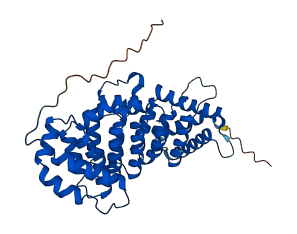
Descriptions
The autoinhibited protein was predicted that may have potential autoinhibitory elements via cis-regPred.
Autoinhibitory domains (AIDs)
Target domain |
|
Relief mechanism |
|
Assay |
cis-regPred |
Accessory elements
No accessory elements
Autoinhibited structure

Activated structure
1 structures for O60032
| Entry ID | Method | Resolution | Chain | Position | Source |
|---|---|---|---|---|---|
| AF-O60032-F1 | Predicted | AlphaFoldDB |
No variants for O60032
| Variant ID(s) | Position | Change | Description | Diseaes Association | Provenance |
|---|---|---|---|---|---|
| No variants for O60032 | |||||
No associated diseases with O60032
No regional properties for O60032
| Type | Name | Position | InterPro Accession |
|---|---|---|---|
| No domain, repeats, and functional sites for O60032 | |||
8 GO annotations of cellular component
| Name | Definition |
|---|---|
| cell division site | The eventual plane of cell division (also known as cell cleavage or cytokinesis) in a dividing cell. In Eukaryotes, the cleavage apparatus, composed of septin structures and the actomyosin contractile ring, forms along this plane, and the mitotic, or meiotic, spindle is aligned perpendicular to the division plane. In bacteria, the cell division site is generally located at mid-cell and is the site at which the cytoskeletal structure, the Z-ring, assembles. |
| cellular bud | A protuberance from a cell of an organism that reproduces by budding, which will grow larger and become a separate daughter cell after nuclear division, cytokinesis, and cell wall formation (when appropriate). The daughter cell may completely separate from the mother cell, or the mother and daughter cells may remain associated. |
| cytoplasm | The contents of a cell excluding the plasma membrane and nucleus, but including other subcellular structures. |
| incipient cellular bud site | The portion of the budding yeast plasma membrane where a daughter cell will emerge. The yeast marks this spot with bud-site selection proteins before bud emergence occurs. Actin is polarized to this spot just prior to and during bud emergence. |
| mating projection tip | The apex of the mating projection in unicellular fungi exposed to mating pheromone; site of polarized growth. |
| new mitotic spindle pole body | The spindle pole body that is formed by spindle pole body duplication, and to which proteins involved in mitotic exit signaling (for example, the septation initiation network in fission yeast) localize. |
| non-growing cell tip | A cell tip at which no growth takes place. For example, in fission yeast the cell end newly formed by cell division does not grow immediately upon its formation, and lacks actin cytoskeletal structures. |
| nucleus | A membrane-bounded organelle of eukaryotic cells in which chromosomes are housed and replicated. In most cells, the nucleus contains all of the cell's chromosomes except the organellar chromosomes, and is the site of RNA synthesis and processing. In some species, or in specialized cell types, RNA metabolism or DNA replication may be absent. |
1 GO annotations of molecular function
| Name | Definition |
|---|---|
| protein serine/threonine kinase activator activity | Binds to and increases the activity of a protein serine/threonine kinase. |
8 GO annotations of biological process
| Name | Definition |
|---|---|
| budding cell apical bud growth | Growth at the tip of a bud, in a cell that reproduces by budding. |
| conidium formation | The process of producing non-motile spores, called conidia, via mitotic asexual reproduction in higher fungi. Conidia are haploid cells genetically identical to their haploid parent. They are produced by conversion of hyphal elements, or are borne on sporogenous cells on or within specialized structures termed conidiophores, and participate in dispersal of the fungus. |
| hyphal growth | Growth of fungi as threadlike, tubular structures that may contain multiple nuclei and may or may not be divided internally by septa, or cross-walls. |
| intracellular signal transduction | The process in which a signal is passed on to downstream components within the cell, which become activated themselves to further propagate the signal and finally trigger a change in the function or state of the cell. |
| protein localization to medial cortex | A process in which a protein is transported to, or maintained in, the medial cortex. |
| regulation of DNA-templated transcription | Any process that modulates the frequency, rate or extent of cellular DNA-templated transcription. |
| regulation of establishment or maintenance of bipolar cell polarity regulating cell shape | Any process that modulates the frequency, rate or extent of establishment or maintenance of bipolar cell polarity regulating cell shape. |
| septum digestion after cytokinesis | The process of physically separating the septal cell wall material by enzymatic digestion, that occurs after daughter cells are separated by cytokinesis. |
No homologous proteins in AiPD
| UniProt AC | Gene Name | Protein Name | Species | Evidence Code |
|---|---|---|---|---|
| No homologous proteins | ||||
| 10 | 20 | 30 | 40 | 50 | 60 |
| MAFFFNRGRS | RQPSDVVRSI | KDLLLRLREP | STASKVEDEL | AKQLSQMKLM | VQGTQELEAS |
| 70 | 80 | 90 | 100 | 110 | 120 |
| TDQVHALVQA | MLHEDLLYEL | AVALHNLPFE | ARKDTQTIFS | HILRFKPPHG | NSPDPPVISY |
| 130 | 140 | 150 | 160 | 170 | 180 |
| IVHNRPEIII | ELCRGYEHSQ | SAMPCGTILR | EALKFDVIAA | IILYDQSKEG | EPAIRLTEVQ |
| 190 | 200 | 210 | 220 | 230 | 240 |
| PNVPQRGTGV | FWRFFHWIDR | GTFELSADAF | TTFREILTRH | KSLVTGYLAT | NFDYFFAQFN |
| 250 | 260 | 270 | 280 | 290 | 300 |
| TFLVQSESYV | TKRQSIKLLG | EILLDRANYS | VMMRYVESGE | NLKLCMKLLR | DDRKMVQYEG |
| 310 | 320 | 330 | 340 | 350 | 360 |
| FHVFKVFVAN | PDKSVAVQRI | LINNRDRLLR | FLPKFLEDRT | DDDQFTDEKS | FLVRQIELLP |
| 370 | 380 | ||||
| KEPIEPSRSA | REPSRSTANT | TTVA |