O59833
Gene name |
SPCC965.13 |
Protein name |
Uncharacterized transporter C965.13 |
Names |
|
Species |
Schizosaccharomyces pombe (strain 972 / ATCC 24843) (Fission yeast) |
KEGG Pathway |
spo:SPCC965.13 |
EC number |
|
Protein Class |
|
Descriptions
The autoinhibited protein was predicted that may have potential autoinhibitory elements via cis-regPred.
Autoinhibitory domains (AIDs)
Target domain |
|
Relief mechanism |
|
Assay |
cis-regPred |
Accessory elements
No accessory elements
Autoinhibited structure

Activated structure
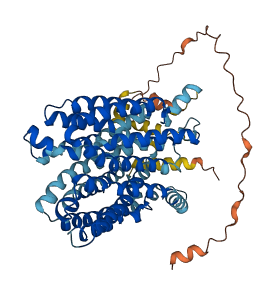
1 structures for O59833
| Entry ID | Method | Resolution | Chain | Position | Source |
|---|---|---|---|---|---|
| AF-O59833-F1 | Predicted | AlphaFoldDB |
No variants for O59833
| Variant ID(s) | Position | Change | Description | Diseaes Association | Provenance |
|---|---|---|---|---|---|
| No variants for O59833 | |||||
No associated diseases with O59833
5 GO annotations of cellular component
| Name | Definition |
|---|---|
| cell division site | The eventual plane of cell division (also known as cell cleavage or cytokinesis) in a dividing cell. In Eukaryotes, the cleavage apparatus, composed of septin structures and the actomyosin contractile ring, forms along this plane, and the mitotic, or meiotic, spindle is aligned perpendicular to the division plane. In bacteria, the cell division site is generally located at mid-cell and is the site at which the cytoskeletal structure, the Z-ring, assembles. |
| cell tip | The region at the end of the longest axis of a cylindrical or elongated cell. |
| endoplasmic reticulum | The irregular network of unit membranes, visible only by electron microscopy, that occurs in the cytoplasm of many eukaryotic cells. The membranes form a complex meshwork of tubular channels, which are often expanded into slitlike cavities called cisternae. The ER takes two forms, rough (or granular), with ribosomes adhering to the outer surface, and smooth (with no ribosomes attached). |
| Golgi apparatus | A membrane-bound cytoplasmic organelle of the endomembrane system that further processes the core oligosaccharides (e.g. N-glycans) added to proteins in the endoplasmic reticulum and packages them into membrane-bound vesicles. The Golgi apparatus operates at the intersection of the secretory, lysosomal, and endocytic pathways. |
| integral component of plasma membrane | The component of the plasma membrane consisting of the gene products and protein complexes having at least some part of their peptide sequence embedded in the hydrophobic region of the membrane. |
4 GO annotations of molecular function
| Name | Definition |
|---|---|
| pyridoxal transmembrane transporter activity | Enables the transfer of pyridoxal from one side of a membrane to the other. Pyridoxal, 3-hydroxy-5-(hydroxymethyl)-2-methyl-4-pyridinecarboxaldehyde, is one of the vitamin B6 compounds. Pyridoxal, pyridoxamine and pyridoxine are collectively known as vitamin B6, and are efficiently converted to the biologically active form of vitamin B6, pyridoxal phosphate. |
| pyridoxamine transmembrane transporter activity | Enables the transfer of pyridoxamine from one side of a membrane to the other. Pyridoxamine, 4-(aminomethyl)-5-(hydroxymethyl)-2-methylpyridin-3-ol, is one of the vitamin B6 compounds. Pyridoxal, pyridoxamine and pyridoxine are collectively known as vitamin B6, and are efficiently converted to the biologically active form of vitamin B6, pyridoxal phosphate. |
| pyridoxine transmembrane transporter activity | Enables the transfer of pyridoxine from one side of a membrane to the other. Pyridoxine, 2-methyl-3-hydroxy-4,5-bis(hydroxymethyl)pyridine, is one of the vitamin B6 compounds. Pyridoxal, pyridoxamine and pyridoxine are collectively known as vitamin B6, and are efficiently converted to the biologically active form of vitamin B6, pyridoxal phosphate. |
| transmembrane transporter activity | Enables the transfer of a substance, usually a specific substance or a group of related substances, from one side of a membrane to the other. |
4 GO annotations of biological process
| Name | Definition |
|---|---|
| pyridoxal transmembrane transport | The process in which pyridoxal is transported across a membrane. |
| pyridoxamine transmembrane transport | The process in which pyridoxamine is transported across a membrane. |
| pyridoxine transmembrane transport | The process in which pyridoxine is transported across a membrane. |
| transmembrane transport | The process in which a solute is transported across a lipid bilayer, from one side of a membrane to the other. |
No homologous proteins in AiPD
| UniProt AC | Gene Name | Protein Name | Species | Evidence Code |
|---|---|---|---|---|
| No homologous proteins | ||||
| 10 | 20 | 30 | 40 | 50 | 60 |
| MSILNVIRSH | HDVEPQNVEE | EPPLTGQTIV | TEDKLETSAK | DKKHESPSMS | EDEEGSVENV |
| 70 | 80 | 90 | 100 | 110 | 120 |
| DAWDLTKALM | SIDPNHPAHP | HKWPLWKKLF | VATVYTFLEV | YVIWSSTACI | NFFDIYQTNW |
| 130 | 140 | 150 | 160 | 170 | 180 |
| HCSIQVSYLV | QSLFIVGNAF | GPMLLGPMSD | IFGRKWVYVG | SLILYIIFQI | PQALAYNLPM |
| 190 | 200 | 210 | 220 | 230 | 240 |
| MAINSAIAGA | FGSSALANVA | SSMCDIFTPE | TVGFGISLFV | WGANAGASIG | SPIGEALYDH |
| 250 | 260 | 270 | 280 | 290 | 300 |
| WRWFYWMNMI | VGGFFVILCV | LCPETLPVIN | IMNYSSTTGE | KTVQVSTLAK | AKSAVVRTKF |
| 310 | 320 | 330 | 340 | 350 | 360 |
| VLSTAFKLLC | TEPIIMALGL | YNGFAYGLIF | LYLDGLFPVF | VDNYKMGYMG | ANLTYLNFLV |
| 370 | 380 | 390 | 400 | 410 | 420 |
| GVTIVVMLQP | IQNWLYRWDK | RRHGGVARPE | ARFLISLLTV | WFFPAGLFWF | AFTSDGRISW |
| 430 | 440 | 450 | 460 | 470 | 480 |
| VSPLIAGGVL | GVGDPQLWLA | MINYITDSYP | SVAGSAIAAF | TLPSFAIAAV | LVHLGIIMFD |
| 490 | 500 | 510 | 520 | 530 | |
| NMTTTWAMAT | LAFISLSLVA | TIYVIYFFGH | LIRKHSRLAV | TQQALQEAHD | AKVLPEV |