O59825
Gene name |
thp1 (SPCC965.05c) |
Protein name |
G/U mismatch-specific uracil DNA glycosylase |
Names |
Uracil mismatch repair protein |
Species |
Schizosaccharomyces pombe (strain 972 / ATCC 24843) (Fission yeast) |
KEGG Pathway |
spo:SPCC965.05c |
EC number |
3.2.2.28: Hydrolyzing N-glycosyl compounds |
Protein Class |
|
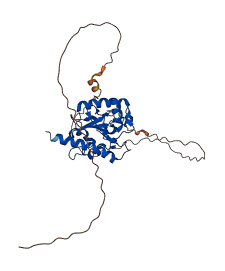
Descriptions
The autoinhibited protein was predicted that may have potential autoinhibitory elements via cis-regPred.
Autoinhibitory domains (AIDs)
Target domain |
|
Relief mechanism |
|
Assay |
cis-regPred |
Accessory elements
No accessory elements
Autoinhibited structure

Activated structure
1 structures for O59825
| Entry ID | Method | Resolution | Chain | Position | Source |
|---|---|---|---|---|---|
| AF-O59825-F1 | Predicted | AlphaFoldDB |
No variants for O59825
| Variant ID(s) | Position | Change | Description | Diseaes Association | Provenance |
|---|---|---|---|---|---|
| No variants for O59825 | |||||
No associated diseases with O59825
No regional properties for O59825
| Type | Name | Position | InterPro Accession |
|---|---|---|---|
| No domain, repeats, and functional sites for O59825 | |||
Functions
| Description | ||
|---|---|---|
| EC Number | 3.2.2.28 | Hydrolyzing N-glycosyl compounds |
| Subcellular Localization |
|
|
| PANTHER Family | ||
| PANTHER Subfamily | ||
| PANTHER Protein Class | ||
| PANTHER Pathway Category | No pathway information available | |
1 GO annotations of cellular component
| Name | Definition |
|---|---|
| nucleus | A membrane-bounded organelle of eukaryotic cells in which chromosomes are housed and replicated. In most cells, the nucleus contains all of the cell's chromosomes except the organellar chromosomes, and is the site of RNA synthesis and processing. In some species, or in specialized cell types, RNA metabolism or DNA replication may be absent. |
5 GO annotations of molecular function
| Name | Definition |
|---|---|
| hypoxanthine DNA N-glycosylase activity | DNA N-glycosylase activity acting on deaminated adenine (hypoxanthine). |
| oxanine DNA N-glycosylase activity | DNA N-glycosylase activity acting on deaminated guanine where the resulting base (oxanine) is generated by NO- or HNO2-induced nitrosative deamination. |
| pyrimidine-specific mismatch base pair DNA N-glycosylase activity | Catalysis of the removal of mismatched pyrimidine bases in DNA. Enzymes with this activity recognize and remove pyrimidines present in mismatches by cleaving the N-C1' glycosidic bond between the target damaged DNA base and the deoxyribose sugar. The reaction releases a free base and leaves an apyrimidinic (AP) site. |
| uracil DNA N-glycosylase activity | Catalysis of the cleavage of the N-C1' glycosidic bond between the damaged DNA base and the deoxyribose sugar, releasing a free base and leaving an apyrimidinic (AP) site. Enzymes with this activity recognize and remove uracil bases in DNA that result from the deamination of cytosine or the misincorporation of dUTP opposite an adenine. |
| xanthine DNA N-glycosylase activity | DNA N-glycosylase activity acting on deaminated guanine (xanthine). |
1 GO annotations of biological process
| Name | Definition |
|---|---|
| base-excision repair, AP site formation | The formation of an AP site, a deoxyribose sugar with a missing base, by DNA glycosylase which recognizes an altered base in DNA and catalyzes its hydrolytic removal. This sugar phosphate is the substrate recognized by the AP endonuclease, which cuts the DNA phosphodiester backbone at the 5' side of the altered site to leave a gap which is subsequently repaired. |
No homologous proteins in AiPD
| UniProt AC | Gene Name | Protein Name | Species | Evidence Code |
|---|---|---|---|---|
| No homologous proteins | ||||
| 10 | 20 | 30 | 40 | 50 | 60 |
| MNDIETRDTG | TKNDNSSEFN | LSVKSHKRKR | SFDDENLELE | ESREETSGGI | LKKAKTQSFS |
| 70 | 80 | 90 | 100 | 110 | 120 |
| ESLERFRFAH | AGSNNEYRKT | DVVKNSDTDN | GLLKSAVETI | TLENGLRNRR | VNVTKKSTLK |
| 130 | 140 | 150 | 160 | 170 | 180 |
| ASVKKSTLKK | KNEVDPALLQ | GVPDYICENP | YAIIVGLNPG | ITSSLKGHAF | ASPSNRFWKM |
| 190 | 200 | 210 | 220 | 230 | 240 |
| LNKSKLLEGN | AEFTYLNDKD | LPAHGLGITN | LCARPSSSGA | DLRKEEMQDG | ARILYEKVKR |
| 250 | 260 | 270 | 280 | 290 | 300 |
| YRPQVGLFIS | GKGIWEEMYK | MLTGKKLPKT | FVFGWQPEKF | GDANVFVGIS | SSGRAAGYSD |
| 310 | 320 | ||||
| EKKQNLWNLF | AEEVNRHREI | VKHAV |