O59790
Gene name |
ark1 (sex1, SPCC320.13c, SPCC330.16) |
Protein name |
Serine/threonine-protein kinase ark1 |
Names |
Aurora-related kinase 1 |
Species |
Schizosaccharomyces pombe (strain 972 / ATCC 24843) (Fission yeast) |
KEGG Pathway |
spo:SPCC320.13c |
EC number |
|
Protein Class |
|
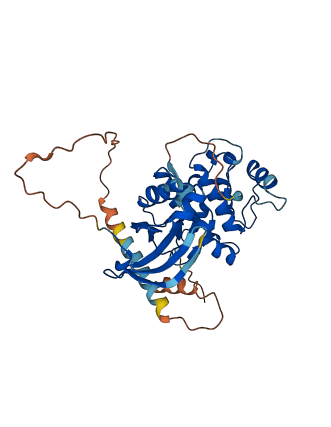
Descriptions
The autoinhibited protein was predicted that may have potential autoinhibitory elements via cis-regPred.
Autoinhibitory domains (AIDs)
Target domain |
|
Relief mechanism |
|
Assay |
cis-regPred |
Accessory elements
229-250 (Activation loop from InterPro)
Target domain |
89-340 (Protein kinase domain) |
Relief mechanism |
|
Assay |
|
Autoinhibited structure

Activated structure
1 structures for O59790
| Entry ID | Method | Resolution | Chain | Position | Source |
|---|---|---|---|---|---|
| AF-O59790-F1 | Predicted | AlphaFoldDB |
No variants for O59790
| Variant ID(s) | Position | Change | Description | Diseaes Association | Provenance |
|---|---|---|---|---|---|
| No variants for O59790 | |||||
No associated diseases with O59790
12 GO annotations of cellular component
| Name | Definition |
|---|---|
| chromosome passenger complex | A eukaryotically conserved protein complex that localizes to kinetochores in early mitosis, the spindle mid-zone in anaphase B and to the telophase midbody. It has been proposed that the passenger complex coordinates various events based on its location to different structures during the course of mitosis. Complex members include the BIR-domain-containing protein Survivin, Aurora kinase, INCENP and Borealin. |
| chromosome, centromeric region | The region of a chromosome that includes the centromeric DNA and associated proteins. In monocentric chromosomes, this region corresponds to a single area of the chromosome, whereas in holocentric chromosomes, it is evenly distributed along the chromosome. |
| chromosome, telomeric region | The end of a linear chromosome, required for the integrity and maintenance of the end. A chromosome telomere usually includes a region of telomerase-encoded repeats the length of which rarely exceeds 20 bp each and that permits the formation of a telomeric loop (T-loop). The telomeric repeat region is usually preceded by a sub-telomeric region that is gene-poor but rich in repetitive elements. Some telomeres only consist of the latter part (for eg. D. melanogaster telomeres). |
| cytoplasm | The contents of a cell excluding the plasma membrane and nucleus, but including other subcellular structures. |
| inner kinetochore | The region of a kinetochore closest to centromeric DNA; in mammals the CREST antigens (CENP proteins) are found in this layer; this layer may help define underlying centromeric chromatin structure and position of the kinetochore on the chromosome. |
| kinetochore | A multisubunit complex that is located at the centromeric region of DNA and provides an attachment point for the spindle microtubules. |
| meiotic spindle | A spindle that forms as part of meiosis. Several proteins, such as budding yeast Spo21p, fission yeast Spo2 and Spo13, and C. elegans mei-1, localize specifically to the meiotic spindle and are absent from the mitotic spindle. |
| meiotic spindle midzone | The area in the center of the meiotic spindle where the spindle microtubules from opposite poles overlap. |
| mitotic spindle midzone | The area in the center of the anaphase spindle consisting of microtubules, microtubule bundling factors and kinesin motors where the spindle microtubules from opposite poles overlap in an antiparallel manner. |
| nucleolar ring | Ring-like structures located at the nucleolar periphery where several nuclear factors are reversibly aggregated and sequestered during acute heat stress. |
| spindle microtubule | Any microtubule that is part of a mitotic or meiotic spindle; anchored at one spindle pole. |
| spindle midzone | The area in the center of the spindle where the spindle microtubules from opposite poles overlap. |
5 GO annotations of molecular function
| Name | Definition |
|---|---|
| ATP binding | Binding to ATP, adenosine 5'-triphosphate, a universally important coenzyme and enzyme regulator. |
| histone kinase activity (H3-S10 specific) | Catalysis of the transfer of a phosphate group to the serine-10 residue of the N-terminal tail of histone H3. |
| histone serine kinase activity | Catalysis of the transfer of a phosphate group to a serine residue of a histone. |
| protein serine kinase activity | Catalysis of the reactions: ATP + protein serine = ADP + protein serine phosphate. |
| protein serine/threonine kinase activity | Catalysis of the reactions: ATP + protein serine = ADP + protein serine phosphate, and ATP + protein threonine = ADP + protein threonine phosphate. |
20 GO annotations of biological process
| Name | Definition |
|---|---|
| attachment of spindle microtubules to kinetochore involved in meiotic chromosome segregation | The cell cycle process in which spindle microtubules become physically associated with the proteins making up the kinetochore complex contributing to meiotic chromosome segregation. |
| interphase mitotic telomere clustering | The process whereby the mitotic telomeres are gathered together during, or prior to, attachment to the nuclear envelope. |
| meiotic spindle assembly checkpoint signaling | A signal transduction process that contributes to a meiotic spindle assembly checkpoint, that delays the metaphase/anaphase transition of a meiotic cell cycle until the spindle is correctly assembled and chromosomes are attached to the spindle. |
| mitotic sister chromatid biorientation | The mitotic cell cycle process in which sister chromatids establish stable, end-on attachments to the plus ends of microtubules emanating from opposite spindle poles, oriented such that separation can proceed. This is the final step in metaphase plate congression. |
| mitotic sister chromatid segregation | The cell cycle process in which replicated homologous chromosomes are organized and then physically separated and apportioned to two sets during the mitotic cell cycle. Each replicated chromosome, composed of two sister chromatids, aligns at the cell equator, paired with its homologous partner. One homolog of each morphologic type goes into each of the resulting chromosome sets. |
| mitotic spindle assembly checkpoint signaling | A signal transduction process that contributes to a mitotic cell cycle spindle assembly checkpoint, that delays the metaphase/anaphase transition of a mitotic nuclear division until the spindle is correctly assembled and chromosomes are attached to the spindle. |
| mitotic spindle organization | A process that is carried out at the cellular level which results in the assembly, arrangement of constituent parts, or disassembly of the microtubule spindle during a mitotic cell cycle. |
| positive regulation of G2/M transition of mitotic cell cycle | Any signalling pathway that activates or increases the activity of a cell cycle cyclin-dependent protein kinase to modulate the switch from G2 phase to M phase of the mitotic cell cycle. |
| positive regulation of kinetochore assembly | Any process that activates or increases the frequency, rate or extent of kinetochore assembly. |
| positive regulation of mitotic cell cycle spindle assembly checkpoint | Any process that increases the rate, frequency, or extent of the mitotic cell cycle spindle assembly checkpoint, a cell cycle checkpoint that delays the metaphase/anaphase transition of a mitotic nuclear division until the spindle is correctly assembled and chromosomes are attached to the spindle. |
| positive regulation of mitotic chromosome condensation | Any process that activates or increases the frequency, rate or extent of mitotic chromosome condensation. |
| positive regulation of mitotic sister chromatid arm separation | Any process that activates or increases the frequency, rate or extent of mitotic sister chromatid arm separation. |
| positive regulation of mitotic sister chromatid biorientation | Any process that activates or increases the frequency, rate or extent of mitotic sister chromatid biorientation, the mitotic cell cycle process in which sister chromatids establish stable, end-on attachments to the plus ends of microtubules emanating from opposite spindle poles, oriented such that separation can proceed. |
| protein localization to kinetochore | Any process in which a protein is transported to, or maintained at, the kinetochore. |
| protein localization to nucleolar rDNA repeats | Any process in which a protein is transported to, or maintained at, the rDNA repeats on a chromosome in the nucleolus. |
| protein phosphorylation | The process of introducing a phosphate group on to a protein. |
| regulation of cytokinesis | Any process that modulates the frequency, rate or extent of the division of the cytoplasm of a cell and its separation into two daughter cells. |
| regulation of mitotic cytokinesis | Any process that modulates the frequency, rate or extent of mitotic cytokinesis. |
| regulation of monopolar spindle attachment to meiosis I kinetochore | Any process that modulates the frequency, rate or extent of attachment of spindle microtubules to kinetochore involved in homologous chromosome segregation. |
| repair of mitotic kinetochore microtubule attachment defect | The mitotic cell cycle process where kinetochore microtubule attachment defects are corrected. |
No homologous proteins in AiPD
| UniProt AC | Gene Name | Protein Name | Species | Evidence Code |
|---|---|---|---|---|
| No homologous proteins | ||||
| 10 | 20 | 30 | 40 | 50 | 60 |
| MSDSKLADSL | NCLSVSTPST | TANPGRQQLL | RLAVSNQRQV | NNVSLANGKE | NKRTSNSKFN |
| 70 | 80 | 90 | 100 | 110 | 120 |
| SSLRKIEEPI | AGVPSSAGPQ | WREFHIGMFE | IGKPLGKGKF | GRVYLAKEKK | TGFIVALKTL |
| 130 | 140 | 150 | 160 | 170 | 180 |
| HKSELVQSKI | EKQVRREIEI | QSNLRHKNIL | RLYGHFHDEK | RIYLILEFAG | RGELYQHLRR |
| 190 | 200 | 210 | 220 | 230 | 240 |
| AKRFSEEVAS | KYIFQMANAL | SYLHKKHVIH | RDIKPENILL | GIDGEIKLSD | FGWSVHAPSN |
| 250 | 260 | 270 | 280 | 290 | 300 |
| RRTTLCGTLD | YLPPEMVEGK | EHTEKVDLWS | LGVLTYEFLV | GAPPFEDMSG | HSATYKRIAK |
| 310 | 320 | 330 | 340 | 350 | |
| VDLKIPSFVP | PDARDLISRL | LQHNPEKRMS | LEQVMRHPWI | VKYKDSWTRK | SSESS |