O59671
Gene name |
pof4 (ela1, SPBC29A3.08) |
Protein name |
Elongin-A |
Names |
Protein pof4 |
Species |
Schizosaccharomyces pombe (strain 972 / ATCC 24843) (Fission yeast) |
KEGG Pathway |
spo:SPBC29A3.08 |
EC number |
|
Protein Class |
|
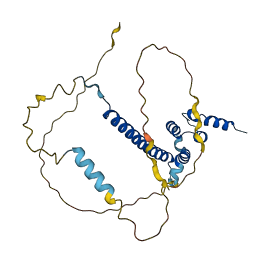
Descriptions
The autoinhibited protein was predicted that may have potential autoinhibitory elements via cis-regPred.
Autoinhibitory domains (AIDs)
Target domain |
|
Relief mechanism |
|
Assay |
cis-regPred |
Accessory elements
No accessory elements
Autoinhibited structure

Activated structure
1 structures for O59671
| Entry ID | Method | Resolution | Chain | Position | Source |
|---|---|---|---|---|---|
| AF-O59671-F1 | Predicted | AlphaFoldDB |
No variants for O59671
| Variant ID(s) | Position | Change | Description | Diseaes Association | Provenance |
|---|---|---|---|---|---|
| No variants for O59671 | |||||
No associated diseases with O59671
No regional properties for O59671
| Type | Name | Position | InterPro Accession |
|---|---|---|---|
| No domain, repeats, and functional sites for O59671 | |||
1 GO annotations of cellular component
| Name | Definition |
|---|---|
| elongin complex | A transcription elongation factor complex that suppresses RNA polymerase II pausing, and may act by promoting proper alignment of the 3'-end of nascent transcripts with the polymerase catalytic site. Consists of a transcriptionally active Elongin A subunit (about 100 kDa) and two smaller Elongin B (about 18 kDa) and Elongin C (about 15 kDa) subunits. |
2 GO annotations of molecular function
| Name | Definition |
|---|---|
| RNA polymerase II general transcription initiation factor activity | A general transcription initiation factor activity that contributes to transcription start site selection and transcription initiation of genes transcribed by RNA polymerase II. The general transcription factors for RNA polymerase II include TFIIB, TFIID, TFIIE, TFIIF, TFIIH and TATA-binding protein (TBP). In most species, RNA polymerase II transcribes all messenger RNAs (mRNAs), most untranslated regulatory RNAs, the majority of the snoRNAs, four of the five snRNAs (U1, U2, U4, and U5), and other small noncoding RNAs. For some small RNAs there is variability between species as to whether it is transcribed by RNA polymerase II or RNA polymerase III. However there are also rare exceptions, such as Trypanosoma brucei, where RNA polymerase I transcribes certain mRNAs in addition to its normal role in rRNA transcription. |
| transcription elongation factor activity | A molecular function that stimulates the elongation properties of the RNA polymerase during the elongation phase of transcription. A subclass of transcription elongation factors enable the transition from transcription initiation to elongation, while another class rescue stalled RNA polymerases. |
2 GO annotations of biological process
| Name | Definition |
|---|---|
| transcription elongation by RNA polymerase II promoter | The extension of an RNA molecule after transcription initiation and promoter clearance at an RNA polymerase II promoter by the addition of ribonucleotides catalyzed by RNA polymerase II. |
| transcription initiation at RNA polymerase II promoter | A transcription initiation process that takes place at a RNA polymerase II gene promoter. Messenger RNAs (mRNA) genes, as well as some non-coding RNAs, are transcribed by RNA polymerase II. |
No homologous proteins in AiPD
| UniProt AC | Gene Name | Protein Name | Species | Evidence Code |
|---|---|---|---|---|
| No homologous proteins | ||||
| 10 | 20 | 30 | 40 | 50 | 60 |
| MYSLKDLCIQ | VAQKHVHDID | DIGDCPFELV | KPILEKARPE | HLIDLEEKSP | HLKVDTQPLW |
| 70 | 80 | 90 | 100 | 110 | 120 |
| KDHVLRDFGL | ELQKRTILNN | IDDWRGLYGK | LKKKRNAHYN | VASAKLRSAY | TKLEQSKQNK |
| 130 | 140 | 150 | 160 | 170 | 180 |
| RIVPLEREPR | AARPPKRPRP | MSNYCPKSSL | MARAKSDFLK | KASATRHIVS | ATSSSRSFPQ |
| 190 | 200 | 210 | 220 | 230 | 240 |
| LHPLGRSSSN | ATNTSTKRPL | TSNTYPSIPL | PPKSFTSQNF | KSFNAVKTQP | SSSSSPSISR |
| 250 | 260 | ||||
| PTSFPMSFFP | NPSRFSSQVP | KRI |