O57932
Gene name |
amyA (PH0193) |
Protein name |
Alpha-amylase |
Names |
|
Species |
Pyrococcus horikoshii (strain ATCC 700860 / DSM 12428 / JCM 9974 / NBRC 100139 / OT-3) |
KEGG Pathway |
pho:PH0193 |
EC number |
3.2.1.1: Glycosidases, ie enzymes hydrolyzing O- and S-glycosyl compounds |
Protein Class |
|
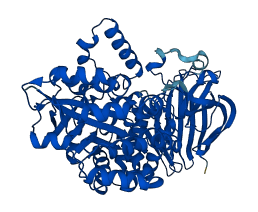
Descriptions
The autoinhibited protein was predicted that may have potential autoinhibitory elements via cis-regPred.
Autoinhibitory domains (AIDs)
Target domain |
|
Relief mechanism |
|
Assay |
cis-regPred |
Accessory elements
No accessory elements
Autoinhibited structure

Activated structure
1 structures for O57932
| Entry ID | Method | Resolution | Chain | Position | Source |
|---|---|---|---|---|---|
| AF-O57932-F1 | Predicted | AlphaFoldDB |
No variants for O57932
| Variant ID(s) | Position | Change | Description | Diseaes Association | Provenance |
|---|---|---|---|---|---|
| No variants for O57932 | |||||
No associated diseases with O57932
3 regional properties for O57932
Functions
| Description | ||
|---|---|---|
| EC Number | 3.2.1.1 | Glycosidases, ie enzymes hydrolyzing O- and S-glycosyl compounds |
| Subcellular Localization |
|
|
| PANTHER Family | ||
| PANTHER Subfamily | ||
| PANTHER Protein Class | ||
| PANTHER Pathway Category | No pathway information available | |
No GO annotations of cellular component
| Name | Definition |
|---|---|
| No GO annotations for cellular component |
2 GO annotations of molecular function
| Name | Definition |
|---|---|
| alpha-amylase activity | Catalysis of the endohydrolysis of (1->4)-alpha-D-glucosidic linkages in polysaccharides containing three or more alpha-(1->4)-linked D-glucose units. |
| carbohydrate binding | Binding to a carbohydrate, which includes monosaccharides, oligosaccharides and polysaccharides as well as substances derived from monosaccharides by reduction of the carbonyl group (alditols), by oxidation of one or more hydroxy groups to afford the corresponding aldehydes, ketones, or carboxylic acids, or by replacement of one or more hydroxy group(s) by a hydrogen atom. Cyclitols are generally not regarded as carbohydrates. |
1 GO annotations of biological process
| Name | Definition |
|---|---|
| carbohydrate metabolic process | The chemical reactions and pathways involving carbohydrates, any of a group of organic compounds based of the general formula Cx(H2O)y. |
No homologous proteins in AiPD
| UniProt AC | Gene Name | Protein Name | Species | Evidence Code |
|---|---|---|---|---|
| No homologous proteins | ||||
| 10 | 20 | 30 | 40 | 50 | 60 |
| MPRINFIFGV | HNHQPLGNFE | WIIKRAYEKA | YRPFLETLEE | YPNMKVAVHI | SGVLVEWLER |
| 70 | 80 | 90 | 100 | 110 | 120 |
| NRPEYIDLLK | SLIKKGQVEL | VVAGFYEPIL | VAIPEEDRVE | QIKLSKGWAR | KMGYEARGLW |
| 130 | 140 | 150 | 160 | 170 | 180 |
| LTERVWEPEL | VKTLREAGIE | YVILDDYHFM | SAGLSKEELF | WPYYTENGGE | AIVVFPIDEK |
| 190 | 200 | 210 | 220 | 230 | 240 |
| LRYLIPFRPV | NETLEYLHSL | ADEDESKVAV | FHDDGEKFGA | WPGTHELVYE | RGWLKEFFDR |
| 250 | 260 | 270 | 280 | 290 | 300 |
| ISSDDKINLM | LYSEYLSKFR | PKGLVYLPIA | SYFEMSEWSL | PARQAKLFFE | FIKKLKELNL |
| 310 | 320 | 330 | 340 | 350 | 360 |
| FEKYRIFVRG | GIWKNFLYKY | PEGNYMHKRM | LMLSKLLRNN | PTARIFVLRA | QCNDAYWHGV |
| 370 | 380 | 390 | 400 | 410 | 420 |
| FGGIYLPHIR | RAVWRNLIKA | HSYLEPENRV | FDLDFDGGEE | IMLENENFIL | VVKPHYGGAI |
| 430 | 440 | 450 | 460 | 470 | 480 |
| FEMSSKKKYV | NYLDVVARRW | EHYHSLKDIP | EGMKRELSYD | KWPRGMLQDH | FLLPTEVLDN |
| 490 | 500 | 510 | 520 | 530 | 540 |
| YMLSKYRELG | DFLMSSYHYQ | IEDKLRLWRS | GKVKGISVEV | EKVLRLNKDG | FTTEYRIVSK |
| 550 | 560 | 570 | 580 | 590 | 600 |
| EELGLMFGVE | INLAVQGTVE | YPAEFMSKEI | EVKDIFGKVK | IESEKEAKIW | KFPIKTLSQS |
| 610 | 620 | 630 | |||
| ESGWDFVQQG | VSYTFLYPIE | KMLNIKLKFK | ESM |