O50313
Gene name |
bchD (Cpar_0726) |
Protein name |
Magnesium-chelatase 67 kDa subunit |
Names |
Mg-chelatase subunit D, Mg-protoporphyrin IX chelatase |
Species |
Chlorobaculum parvum (strain DSM 263 / NCIMB 8327) (Chlorobium vibrioforme subsp. thiosulfatophilum) |
KEGG Pathway |
cpc:Cpar_0726 |
EC number |
6.6.1.1: Forming coordination complexes |
Protein Class |
|
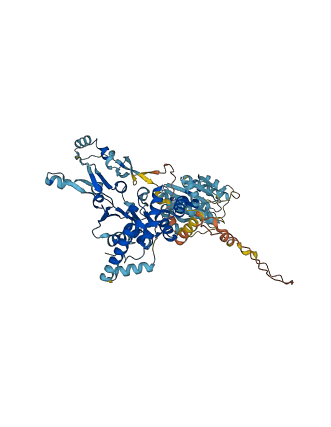
Descriptions
The autoinhibited protein was predicted that may have potential autoinhibitory elements via cis-regPred.
Autoinhibitory domains (AIDs)
Target domain |
|
Relief mechanism |
|
Assay |
cis-regPred |
Accessory elements
No accessory elements
Autoinhibited structure

Activated structure
1 structures for O50313
| Entry ID | Method | Resolution | Chain | Position | Source |
|---|---|---|---|---|---|
| AF-O50313-F1 | Predicted | AlphaFoldDB |
No variants for O50313
| Variant ID(s) | Position | Change | Description | Diseaes Association | Provenance |
|---|---|---|---|---|---|
| No variants for O50313 | |||||
No associated diseases with O50313
5 regional properties for O50313
| Type | Name | Position | InterPro Accession |
|---|---|---|---|
| domain | Magnesium chelatase ChlI-like, catalytic domain | 76 - 148 | IPR000523 |
| domain | von Willebrand factor, type A | 429 - 619 | IPR002035 |
| domain | AAA+ ATPase domain | 25 - 165 | IPR003593 |
| domain | ChlI/MoxR, AAA lid domain | 222 - 285 | IPR041628 |
| domain | Magnesium-chelatase BchD/ChlD, VWA domain | 430 - 619 | IPR041702 |
Functions
| Description | ||
|---|---|---|
| EC Number | 6.6.1.1 | Forming coordination complexes |
| Subcellular Localization |
|
|
| PANTHER Family | ||
| PANTHER Subfamily | ||
| PANTHER Protein Class | ||
| PANTHER Pathway Category | No pathway information available | |
No GO annotations of cellular component
| Name | Definition |
|---|---|
| No GO annotations for cellular component |
2 GO annotations of molecular function
| Name | Definition |
|---|---|
| ATP binding | Binding to ATP, adenosine 5'-triphosphate, a universally important coenzyme and enzyme regulator. |
| magnesium chelatase activity | Catalysis of the reaction: ATP + H2O + Mg2+ + protoporphyrin IX = ADP + 3 H+ + Mg-protoporphyrin IX + phosphate. |
2 GO annotations of biological process
| Name | Definition |
|---|---|
| bacteriochlorophyll biosynthetic process | The chemical reactions and pathways resulting in the formation of a bacteriochlorophyll, any of the chlorophylls of photosynthetic bacteria. They differ structurally from the chlorophylls of higher plants. |
| photosynthesis | The synthesis by organisms of organic chemical compounds, especially carbohydrates, from carbon dioxide (CO2) using energy obtained from light rather than from the oxidation of chemical compounds. |
No homologous proteins in AiPD
| UniProt AC | Gene Name | Protein Name | Species | Evidence Code |
|---|---|---|---|---|
| No homologous proteins | ||||
| 10 | 20 | 30 | 40 | 50 | 60 |
| MIAFTDIVGM | DLAKQALMLL | AVDPSLGGVV | IPSTVGSGKS | TLARAFADIL | PEGTPFVELP |
| 70 | 80 | 90 | 100 | 110 | 120 |
| LNVTEDRLIG | GVDLEATLAS | GQRVVQHGVL | SKAHKGVLYV | DSLSLLDSSA | VSHIMDAMSR |
| 130 | 140 | 150 | 160 | 170 | 180 |
| GAVIVEREGL | SEVHPADFML | VGTYDPSDGE | VRMGLLDRIG | IIVPFTPVND | YRARKQIVSL |
| 190 | 200 | 210 | 220 | 230 | 240 |
| VMGTRNEEDT | QDELRMLRGI | IGAAREQLHH | VSITNEQIKG | LIQTAISLGV | EGNRVDIFAI |
| 250 | 260 | 270 | 280 | 290 | 300 |
| RAALANAALG | QRTEVDDEDL | KLAVKLVLVP | RATRMPEREP | SEEEMQQEEP | PPPEEQPEQE |
| 310 | 320 | 330 | 340 | 350 | 360 |
| GEDENAPPDE | TDSDADEEQE | ETPDMIEELM | MDAIETDLPE | NILNISLASK | KKAKSGSRGE |
| 370 | 380 | 390 | 400 | 410 | 420 |
| ALNNKRGRFV | RSQPGEIKSG | KVALIPTLIS | AAPWQAARKA | EKAKKGIKTG | ALVISTDDVK |
| 430 | 440 | 450 | 460 | 470 | 480 |
| IKRFRDKSGT | LFIFMVDASG | SMALNRMRQA | KGAVASLLQN | AYVHRDQVSL | ISFRGKQAQV |
| 490 | 500 | 510 | 520 | 530 | 540 |
| LLPPSQSVDR | AKRELDVLPT | GGGTPLASAL | LTGWETAKQA | RTKGITQIMF | VMITDGRGNI |
| 550 | 560 | 570 | 580 | 590 | 600 |
| PLAAAVDPAA | AKAPKEELEK | EVEALALSIQ | SDGIASIVVD | TQMNYLSRGE | APKLAQKLGG |
| 610 | |||||
| RYFYLPNAKA | EQIVEAALS |