O50078
Gene name |
aceA |
Protein name |
Isocitrate lyase |
Names |
ICL, Isocitrase, Isocitratase |
Species |
Hyphomicrobium methylovorum |
KEGG Pathway |
|
EC number |
4.1.3.1: Oxo-acid-lyases |
Protein Class |
|
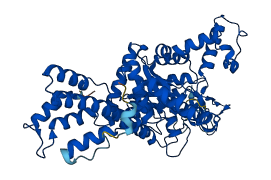
Descriptions
The autoinhibited protein was predicted that may have potential autoinhibitory elements via cis-regPred.
Autoinhibitory domains (AIDs)
Target domain |
|
Relief mechanism |
|
Assay |
cis-regPred |
Accessory elements
No accessory elements
Autoinhibited structure

Activated structure
1 structures for O50078
| Entry ID | Method | Resolution | Chain | Position | Source |
|---|---|---|---|---|---|
| AF-O50078-F1 | Predicted | AlphaFoldDB |
No variants for O50078
| Variant ID(s) | Position | Change | Description | Diseaes Association | Provenance |
|---|---|---|---|---|---|
| No variants for O50078 | |||||
No associated diseases with O50078
Functions
| Description | ||
|---|---|---|
| EC Number | 4.1.3.1 | Oxo-acid-lyases |
| Subcellular Localization |
|
|
| PANTHER Family | ||
| PANTHER Subfamily | ||
| PANTHER Protein Class | ||
| PANTHER Pathway Category | No pathway information available | |
No GO annotations of cellular component
| Name | Definition |
|---|---|
| No GO annotations for cellular component |
3 GO annotations of molecular function
| Name | Definition |
|---|---|
| isocitrate lyase activity | Catalysis of the reaction: isocitrate = glyoxylate + succinate. |
| magnesium ion binding | Binding to a magnesium (Mg) ion. |
| transition metal ion binding | Binding to a transition metal ions; a transition metal is an element whose atom has an incomplete d-subshell of extranuclear electrons, or which gives rise to a cation or cations with an incomplete d-subshell. Transition metals often have more than one valency state. Biologically relevant transition metals include vanadium, manganese, iron, copper, cobalt, nickel, molybdenum and silver. |
2 GO annotations of biological process
| Name | Definition |
|---|---|
| glyoxylate cycle | A modification of the TCA cycle occurring in some plants and microorganisms, in which isocitrate is cleaved to glyoxylate and succinate. Glyoxylate can then react with acetyl-CoA to form malate. |
| tricarboxylic acid cycle | A nearly universal metabolic pathway in which the acetyl group of acetyl coenzyme A is effectively oxidized to two CO2 and four pairs of electrons are transferred to coenzymes. The acetyl group combines with oxaloacetate to form citrate, which undergoes successive transformations to isocitrate, 2-oxoglutarate, succinyl-CoA, succinate, fumarate, malate, and oxaloacetate again, thus completing the cycle. In eukaryotes the tricarboxylic acid is confined to the mitochondria. See also glyoxylate cycle. |
No homologous proteins in AiPD
| UniProt AC | Gene Name | Protein Name | Species | Evidence Code |
|---|---|---|---|---|
| No homologous proteins | ||||
| 10 | 20 | 30 | 40 | 50 | 60 |
| MAHKKTYSQL | RSELLARYPV | GLTKGGVSID | DIVQLRLQSP | YESHLDVARA | MASVMRADMA |
| 70 | 80 | 90 | 100 | 110 | 120 |
| AYDRDTGKFT | QSLGCWSGFH | AQQMIKAVKR | LRGTTKGAYV | YLSGWMVAGL | RNRWGHLPDQ |
| 130 | 140 | 150 | 160 | 170 | 180 |
| SMHEKTSVVD | LIEEIYVSLR | QADEVALNDL | FNELKDARAK | GATNKACEEI | ISRIDGFESH |
| 190 | 200 | 210 | 220 | 230 | 240 |
| VVPIIADIDA | GFGNEHATYL | LAKEMIKAGA | CCLQIENQVS | DAKQCGHQDG | KVTVPREDFI |
| 250 | 260 | 270 | 280 | 290 | 300 |
| EKLRACRLAF | EELGVDDGVI | VARTDSLGAS | LTQKIPVSQQ | AGDFASSYIK | WLKTEPITDA |
| 310 | 320 | 330 | 340 | 350 | 360 |
| NPLSEGELAI | WQSGNFARPI | RMPNGLFSFR | EGTGRARVIE | DCIASLKDGD | ADLIWIETDT |
| 370 | 380 | 390 | 400 | 410 | 420 |
| PNVDEIASMV | AEIRKQVPDA | KLVYNNSPSF | NWTLNLRKQV | RAQWISEGKI | AEADYPDGTA |
| 430 | 440 | 450 | 460 | 470 | 480 |
| LMSAQYDTSE | LGREADDRLR | QFQVDISARA | GVFHNLITLP | TFHLTAKSTD | ELSHGYFGED |
| 490 | 500 | 510 | 520 | 530 | |
| RMLAYVATVQ | REEIRRSISA | VRHQHEVGSD | LGDTFKEMVS | GDRALKAGGA | HNTMNQFAAE |