O44476
Gene name |
hoe-1 |
Protein name |
Zinc phosphodiesterase ELAC protein 2 homolog |
Names |
Homolog of ELAC2 protein, tRNA 3 endonuclease 2, tRNase Z 2 |
Species |
Caenorhabditis elegans |
KEGG Pathway |
cel:CELE_E04A4.4 |
EC number |
3.1.26.11: Endoribonucleases producing 5'-phosphomonoesters |
Protein Class |
|
Descriptions
The autoinhibited protein was predicted that may have potential autoinhibitory elements via cis-regPred.
Autoinhibitory domains (AIDs)
Target domain |
|
Relief mechanism |
|
Assay |
cis-regPred |
Accessory elements
No accessory elements
Autoinhibited structure

Activated structure
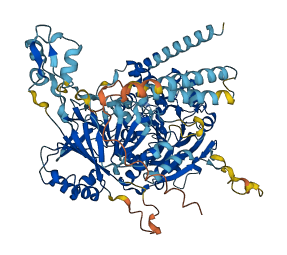
1 structures for O44476
| Entry ID | Method | Resolution | Chain | Position | Source |
|---|---|---|---|---|---|
| AF-O44476-F1 | Predicted | AlphaFoldDB |
No variants for O44476
| Variant ID(s) | Position | Change | Description | Diseaes Association | Provenance |
|---|---|---|---|---|---|
| No variants for O44476 | |||||
No associated diseases with O44476
1 regional properties for O44476
| Type | Name | Position | InterPro Accession |
|---|---|---|---|
| domain | Metallo-beta-lactamase | 509 - 756 | IPR001279 |
Functions
| Description | ||
|---|---|---|
| EC Number | 3.1.26.11 | Endoribonucleases producing 5'-phosphomonoesters |
| Subcellular Localization |
|
|
| PANTHER Family | ||
| PANTHER Subfamily | ||
| PANTHER Protein Class | ||
| PANTHER Pathway Category | No pathway information available | |
2 GO annotations of cellular component
| Name | Definition |
|---|---|
| mitochondrion | A semiautonomous, self replicating organelle that occurs in varying numbers, shapes, and sizes in the cytoplasm of virtually all eukaryotic cells. It is notably the site of tissue respiration. |
| nucleus | A membrane-bounded organelle of eukaryotic cells in which chromosomes are housed and replicated. In most cells, the nucleus contains all of the cell's chromosomes except the organellar chromosomes, and is the site of RNA synthesis and processing. In some species, or in specialized cell types, RNA metabolism or DNA replication may be absent. |
2 GO annotations of molecular function
| Name | Definition |
|---|---|
| 3'-tRNA processing endoribonuclease activity | Catalysis of the endonucleolytic cleavage of RNA, removing extra 3' nucleotides from tRNA precursor, generating 3' termini of tRNAs. A 3'-hydroxy group is left at the tRNA terminus and a 5'-phosphoryl group is left at the trailer molecule. |
| metal ion binding | Binding to a metal ion. |
5 GO annotations of biological process
| Name | Definition |
|---|---|
| germ cell development | The process whose specific outcome is the progression of an immature germ cell over time, from its formation to the mature structure (gamete). A germ cell is any reproductive cell in a multicellular organism. |
| meiotic cell cycle | Progression through the phases of the meiotic cell cycle, in which canonically a cell replicates to produce four offspring with half the chromosomal content of the progenitor cell via two nuclear divisions. |
| mitochondrial tRNA 3'-trailer cleavage, endonucleolytic | Endonucleolytic cleavage of the 3'-end of the pre-tRNA as part of the process of generating the mature 3'-end of the tRNA in the mitochondrion. |
| nematode larval development | The process whose specific outcome is the progression of the nematode larva over time, from its formation to the mature structure. Nematode larval development begins with the newly hatched first-stage larva (L1) and ends with the end of the last larval stage (for example the fourth larval stage (L4) in C. elegans). Each stage of nematode larval development is characterized by proliferation of specific cell lineages and an increase in body size without alteration of the basic body plan. Nematode larval stages are separated by molts in which each stage-specific exoskeleton, or cuticle, is shed and replaced anew. |
| positive regulation of vulval development | Any process that activates or increases the frequency, rate or extent of development of the vulva. Vulval development is the process whose specific outcome is the progression of the egg-laying organ of female and hermaphrodite nematodes over time, from its formation to the mature structure. In nematodes, the vulva is formed from ventral epidermal cells during larval stages to give rise to a fully formed vulva in the adult. |
No homologous proteins in AiPD
| UniProt AC | Gene Name | Protein Name | Species | Evidence Code |
|---|---|---|---|---|
| No homologous proteins | ||||
| 10 | 20 | 30 | 40 | 50 | 60 |
| MLGAIARKTV | ENRILVSRHL | ISSTSCLFKD | NNEELLESIK | ERIARNRRIL | QKHSSSHLKA |
| 70 | 80 | 90 | 100 | 110 | 120 |
| REVNASISNL | RQSMAAVQKK | QKAAHEPPAN | SIVNIPSQVS | IEVLGNGTGL | LRACFILRTP |
| 130 | 140 | 150 | 160 | 170 | 180 |
| LKTYMFNCPE | NACRFLWQLR | IRSSSVVDLF | ITSANWDNIA | GISSILLSKE | SNALSTRLHG |
| 190 | 200 | 210 | 220 | 230 | 240 |
| AMNIKHFLEC | IRPFQDSDYG | SCKYPSQVEE | RPYTMENYED | AGLKVTYIPL | SPPLNIGSNN |
| 250 | 260 | 270 | 280 | 290 | 300 |
| EKSKNVKVNN | VDIAFLIEMK | EAARRIDTMK | LMELKVPKGP | LIGKLKSGEA | VTLPDGRTIQ |
| 310 | 320 | 330 | 340 | 350 | 360 |
| PDQVFSSDKV | EGDKPLLLVT | ECTTEDHVKA | LIDSSSLQPF | LNGEKQLDYM | VHISDDAVIN |
| 370 | 380 | 390 | 400 | 410 | 420 |
| TPTYRHLMEK | LNNPSITHLL | INGGNPVIPA | VESVYKHTRL | LRSIAPSLFP | ALHPIDWSGI |
| 430 | 440 | 450 | 460 | 470 | 480 |
| ITQNEELSQR | QDQFIRVAPM | QRYWMRRGAS | FNEEPIVNNL | LAAEPELSDK | AKELIKEYQK |
| 490 | 500 | 510 | 520 | 530 | 540 |
| LEKENKMDCE | FPKLTFFGTS | SAVPSKYRNV | TGYLVEASEN | SAILIDVGEG | TYGQMRAVFG |
| 550 | 560 | 570 | 580 | 590 | 600 |
| EDGCKQLLVN | LNCVLITHAH | QDHMNGLYTI | IARRKEAFES | LGAPYRPLVL | VCNRNVLKPM |
| 610 | 620 | 630 | 640 | 650 | 660 |
| KTYSICFENI | EHLLEIVDIS | RYPLTPPGSP | GGPPGKRPRL | PSPHLPPSRD | VLQDMSSSFD |
| 670 | 680 | 690 | 700 | 710 | 720 |
| KKAWKLDELK | AVQVHHTRMA | NGFVMRVAGK | RIVFSGDTKP | CDLLVEEGKD | ADVLVHESTF |
| 730 | 740 | 750 | 760 | 770 | 780 |
| EDGHEADAMR | KRHSTMGQAV | DVGKRMNAKH | IILTHFSARY | PKVPVLPEYL | DKENIGVAMD |
| 790 | 800 | 810 | 820 | 830 | |
| MLRVRFDHLP | LVSKLLPIFR | EVFVAELFEL | TIKKEQRVLK | DKELSEKRGQ | LKA |