O43133
Gene name |
TBP1 (TBP, CAALFM_C110660WA, CaO19.1837, CaO19.9395) |
Protein name |
TATA-box-binding protein |
Names |
TATA sequence-binding protein, TBP, TATA-binding factor, TATA-box factor, Transcription initiation factor TFIID TBP subunit |
Species |
Candida albicans (strain SC5314 / ATCC MYA-2876) (Yeast) |
KEGG Pathway |
cal:CAALFM_C110660WA |
EC number |
|
Protein Class |
|
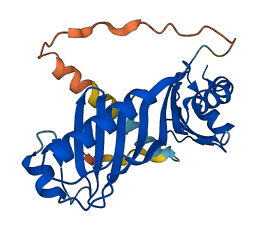
Descriptions
The autoinhibited protein was predicted that may have potential autoinhibitory elements via cis-regPred.
Autoinhibitory domains (AIDs)
Target domain |
|
Relief mechanism |
|
Assay |
cis-regPred |
Accessory elements
No accessory elements
Autoinhibited structure

Activated structure
1 structures for O43133
| Entry ID | Method | Resolution | Chain | Position | Source |
|---|---|---|---|---|---|
| AF-O43133-F1 | Predicted | AlphaFoldDB |
No variants for O43133
| Variant ID(s) | Position | Change | Description | Diseaes Association | Provenance |
|---|---|---|---|---|---|
| No variants for O43133 | |||||
No associated diseases with O43133
1 regional properties for O43133
| Type | Name | Position | InterPro Accession |
|---|---|---|---|
| conserved_site | TATA-box binding protein, conserved site | 183 - 232 | IPR030491 |
3 GO annotations of cellular component
| Name | Definition |
|---|---|
| RNA polymerase I transcription regulator complex | A transcription factor complex that acts at a regulatory region of a gene transcribed by RNA polymerase I. |
| transcription factor TFIID complex | A complex composed of TATA binding protein (TBP) and TBP associated factors (TAFs); the total mass is typically about 800 kDa. Most of the TAFs are conserved across species. In TATA-containing promoters for RNA polymerase II (Pol II), TFIID is believed to recognize at least two distinct elements, the TATA element and a downstream promoter element. TFIID is also involved in recognition of TATA-less Pol II promoters. Binding of TFIID to DNA is necessary but not sufficient for transcription initiation from most RNA polymerase II promoters. |
| transcription regulator complex | A protein complex that is capable of associating with DNA by direct binding, or via other DNA-binding proteins or complexes, and regulating transcription. |
6 GO annotations of molecular function
| Name | Definition |
|---|---|
| DNA binding | Any molecular function by which a gene product interacts selectively and non-covalently with DNA (deoxyribonucleic acid). |
| DNA-binding transcription factor activity | A transcription regulator activity that modulates transcription of gene sets via selective and non-covalent binding to a specific double-stranded genomic DNA sequence (sometimes referred to as a motif) within a cis-regulatory region. Regulatory regions include promoters (proximal and distal) and enhancers. Genes are transcriptional units, and include bacterial operons. |
| general transcription initiation factor activity | A molecular function required for core promoter activity that mediates the assembly of the RNA polymerase holoenzyme at promoter DNA to form the pre-initiation complex (PIC). General transcription factors (GTFs) bind to and open promoter DNA, initiate RNA synthesis and stimulate the escape of the polymerase from the promoter. Not all subunits of the general transcription factor are necessarily present at all promoters to initiate transcription. GTFs act at each promoter, although the exact subunit composition at individual promoters may vary. |
| RNA polymerase II core promoter sequence-specific DNA binding | Binding to a DNA sequence that is part of the core promoter of a RNA polymerase II-transcribed gene. |
| RNA polymerase II general transcription initiation factor activity | A general transcription initiation factor activity that contributes to transcription start site selection and transcription initiation of genes transcribed by RNA polymerase II. The general transcription factors for RNA polymerase II include TFIIB, TFIID, TFIIE, TFIIF, TFIIH and TATA-binding protein (TBP). In most species, RNA polymerase II transcribes all messenger RNAs (mRNAs), most untranslated regulatory RNAs, the majority of the snoRNAs, four of the five snRNAs (U1, U2, U4, and U5), and other small noncoding RNAs. For some small RNAs there is variability between species as to whether it is transcribed by RNA polymerase II or RNA polymerase III. However there are also rare exceptions, such as Trypanosoma brucei, where RNA polymerase I transcribes certain mRNAs in addition to its normal role in rRNA transcription. |
| RNA polymerase III type 3 promoter sequence-specific DNA binding | Binding to a sequence of DNA that is a part of a type 3 promoter that controls transcription by RNA polymerase III (Pol III). A type 3 Pol III promoter is composed of elements upstream of the transcription start site, including a TATA box. The human U6 snRNA gene has a type 3 promoter. Type 3 Pol III promoters have not been observed in S. cerevisiae. |
3 GO annotations of biological process
| Name | Definition |
|---|---|
| DNA-templated transcription initiation | The initial step of transcription, consisting of the assembly of the RNA polymerase preinitiation complex (PIC) at a gene promoter, as well as the formation of the first few bonds of the RNA transcript. Transcription initiation includes abortive initiation events, which occur when the first few nucleotides are repeatedly synthesized and then released, and ends when promoter clearance takes place. |
| transcription initiation at RNA polymerase I promoter | A transcription initiation process that takes place at a RNA polymerase I gene promoter. Ribosomal RNAs (rRNA) genes are transcribed by RNA polymerase I. |
| transcription initiation at RNA polymerase II promoter | A transcription initiation process that takes place at a RNA polymerase II gene promoter. Messenger RNAs (mRNA) genes, as well as some non-coding RNAs, are transcribed by RNA polymerase II. |
No homologous proteins in AiPD
| UniProt AC | Gene Name | Protein Name | Species | Evidence Code |
|---|---|---|---|---|
| No homologous proteins | ||||
| 10 | 20 | 30 | 40 | 50 | 60 |
| MDLKLPPTNP | TNPQQAKTFM | KSIEEDEKNK | AEDLDIIKKE | DIDEPKQEDT | TDGNGGGGIG |
| 70 | 80 | 90 | 100 | 110 | 120 |
| IVPTLQNIVA | TVNLDCRLDL | KTIALHARNA | EYNPKRFAAV | IMRIRDPKTT | ALIFASGKMV |
| 130 | 140 | 150 | 160 | 170 | 180 |
| VTGAKSEDDS | KLASRKYARI | IQKLGFNAKF | CDFKIQNIVG | STDVKFAIRL | EGLAFAHGTF |
| 190 | 200 | 210 | 220 | 230 | |
| SSYEPELFPG | LIYRMVKPKI | VLLIFVSGKI | VLTGAKKREE | IYDAFESIYP | VLNEFRKN |