O43090
Gene name |
SPBC947.15c |
Protein name |
Probable NADH-ubiquinone oxidoreductase C947.15c, mitochondrial |
Names |
|
Species |
Schizosaccharomyces pombe (strain 972 / ATCC 24843) (Fission yeast) |
KEGG Pathway |
spo:SPBC947.15c |
EC number |
1.6.5.9: With a quinone or similar compound as acceptor |
Protein Class |
|
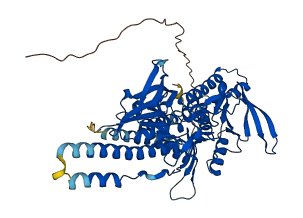
Descriptions
The autoinhibited protein was predicted that may have potential autoinhibitory elements via cis-regPred.
Autoinhibitory domains (AIDs)
Target domain |
|
Relief mechanism |
|
Assay |
cis-regPred |
Accessory elements
No accessory elements
Autoinhibited structure

Activated structure
1 structures for O43090
| Entry ID | Method | Resolution | Chain | Position | Source |
|---|---|---|---|---|---|
| AF-O43090-F1 | Predicted | AlphaFoldDB |
No variants for O43090
| Variant ID(s) | Position | Change | Description | Diseaes Association | Provenance |
|---|---|---|---|---|---|
| No variants for O43090 | |||||
No associated diseases with O43090
1 regional properties for O43090
| Type | Name | Position | InterPro Accession |
|---|---|---|---|
| domain | FAD/NAD(P)-binding domain | 92 - 426 | IPR023753 |
Functions
| Description | ||
|---|---|---|
| EC Number | 1.6.5.9 | With a quinone or similar compound as acceptor |
| Subcellular Localization |
|
|
| PANTHER Family | ||
| PANTHER Subfamily | ||
| PANTHER Protein Class | ||
| PANTHER Pathway Category | No pathway information available | |
2 GO annotations of cellular component
| Name | Definition |
|---|---|
| mitochondrial matrix | The gel-like material, with considerable fine structure, that lies in the matrix space, or lumen, of a mitochondrion. It contains the enzymes of the tricarboxylic acid cycle and, in some organisms, the enzymes concerned with fatty acid oxidation. |
| mitochondrion | A semiautonomous, self replicating organelle that occurs in varying numbers, shapes, and sizes in the cytoplasm of virtually all eukaryotic cells. It is notably the site of tissue respiration. |
1 GO annotations of molecular function
| Name | Definition |
|---|---|
| NADH dehydrogenase (ubiquinone) activity | Catalysis of the reaction: NADH + ubiquinone + 5 H(+)(in) <=> NAD(+) + ubiquinol + 4 H(+)(out). |
2 GO annotations of biological process
| Name | Definition |
|---|---|
| mitochondrial electron transport, NADH to ubiquinone | The transfer of electrons from NADH to ubiquinone that occurs during oxidative phosphorylation. |
| NADH oxidation | A metabolic process that results in the oxidation of reduced nicotinamide adenine dinucleotide, NADH, to the oxidized form, NAD. |
No homologous proteins in AiPD
| UniProt AC | Gene Name | Protein Name | Species | Evidence Code |
|---|---|---|---|---|
| No homologous proteins | ||||
| 10 | 20 | 30 | 40 | 50 | 60 |
| MSVSKARLQS | VVRLSRTVPY | SKTMVRSFHV | SCAVKNSGNV | PTPRNKSFFS | RALEMAEVTS |
| 70 | 80 | 90 | 100 | 110 | 120 |
| SLSMLGAVAL | FQSLRRLNNS | SPKGKSGVPK | KNIVVLGSGW | GAVAAIKNLD | PSLYNITLVS |
| 130 | 140 | 150 | 160 | 170 | 180 |
| PRDHFLFTPM | LPSCTVGTLR | LPSITEPIVA | LFKGKIDPSN | IHQAECTAID | TSAKKVTIRG |
| 190 | 200 | 210 | 220 | 230 | 240 |
| TTEANEGKEA | VIPYDTLVFA | IGAGNQTFGI | QGVRDHGCFL | KEAGDAKKVF | NRIFEILEQV |
| 250 | 260 | 270 | 280 | 290 | 300 |
| RFNKDLSPEE | RARLLHITVV | GGGPTGMEFA | AEMQDFIDND | VKDMFPELQK | DIHVTLIEAA |
| 310 | 320 | 330 | 340 | 350 | 360 |
| PGVLPMFTKS | LITYTENLFK | NLNIKIMTKT | VVKDVNEKNL | IVQKTNPDGS | KAMQEIPYGM |
| 370 | 380 | 390 | 400 | 410 | 420 |
| LVWAAGITAR | PLTRTLMSSI | PEQSGARKGL | IVDEFFRVKG | VPEMYAVGDC | AFSGLPATAQ |
| 430 | 440 | 450 | 460 | 470 | 480 |
| VANQQGAWLA | KNLNVEGKKF | ALHERIQALE | KQLGEKEAPS | QVAGLKQQVE | QLKLEPFKYH |
| 490 | 500 | 510 | 520 | 530 | 540 |
| HQGALAYVGD | EKAIADLKLP | FMKKMLPLQG | IVGHTFWRLA | YLNELISARS | QFMVLIDWLK |
| 550 | |||||
| TRLFGRYDAK | V |