O43070
Gene name |
nbs1 (SPBC6B1.09c) |
Protein name |
DNA repair and telomere maintenance protein nbs1 |
Names |
|
Species |
Schizosaccharomyces pombe (strain 972 / ATCC 24843) (Fission yeast) |
KEGG Pathway |
spo:SPBC6B1.09c |
EC number |
|
Protein Class |
|
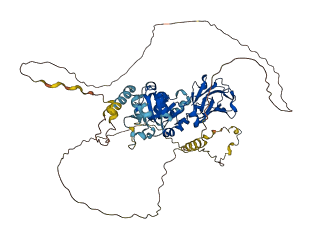
Descriptions
The autoinhibited protein was predicted that may have potential autoinhibitory elements via cis-regPred.
Autoinhibitory domains (AIDs)
Target domain |
|
Relief mechanism |
|
Assay |
cis-regPred |
Accessory elements
No accessory elements
Autoinhibited structure

Activated structure
8 structures for O43070
| Entry ID | Method | Resolution | Chain | Position | Source |
|---|---|---|---|---|---|
| 3HUE | X-ray | 280 A | A | 1-330 | PDB |
| 3HUF | X-ray | 215 A | A/B/C | 1-321 | PDB |
| 3I0M | X-ray | 260 A | A | 1-324 | PDB |
| 3I0N | X-ray | 230 A | A/B | 1-324 | PDB |
| 4FBK | X-ray | 238 A | A/B | 474-531 | PDB |
| 4FBQ | X-ray | 250 A | A/B | 474-531 | PDB |
| 4FBW | X-ray | 220 A | C/D | 474-531 | PDB |
| AF-O43070-F1 | Predicted | AlphaFoldDB |
No variants for O43070
| Variant ID(s) | Position | Change | Description | Diseaes Association | Provenance |
|---|---|---|---|---|---|
| No variants for O43070 | |||||
No associated diseases with O43070
No regional properties for O43070
| Type | Name | Position | InterPro Accession |
|---|---|---|---|
| No domain, repeats, and functional sites for O43070 | |||
4 GO annotations of cellular component
| Name | Definition |
|---|---|
| chromosome, telomeric repeat region | A complex of DNA and protein that seals the end of a chromosome. The telomeric repeat DNA consists of simple tandemly repeated sequences specific for each species. Typically one strand is G-rich and the other C-rich. The G-rich strand forms a 3'-terminal overhang, the length of which varies with species. The single strand overhang is bound by a variety of proteins, including telomere capping proteins that bind to the single-stranded DNA and seal the telomeric loop. |
| Mre11 complex | Trimeric protein complex that possesses endonuclease activity; involved in meiotic recombination, DNA repair and checkpoint signaling. In Saccharomyces cerevisiae, the complex comprises Mre11p, Rad50p, and Xrs2p; complexes identified in other species generally contain proteins orthologous to the Saccharomyces cerevisiae proteins. |
| nucleus | A membrane-bounded organelle of eukaryotic cells in which chromosomes are housed and replicated. In most cells, the nucleus contains all of the cell's chromosomes except the organellar chromosomes, and is the site of RNA synthesis and processing. In some species, or in specialized cell types, RNA metabolism or DNA replication may be absent. |
| site of double-strand break | A region of a chromosome at which a DNA double-strand break has occurred. DNA damage signaling and repair proteins accumulate at the lesion to respond to the damage and repair the DNA to form a continuous DNA helix. |
2 GO annotations of molecular function
| Name | Definition |
|---|---|
| damaged DNA binding | Binding to damaged DNA. |
| molecular adaptor activity | The binding activity of a molecule that brings together two or more molecules through a selective, non-covalent, often stoichiometric interaction, permitting those molecules to function in a coordinated way. |
12 GO annotations of biological process
| Name | Definition |
|---|---|
| DNA duplex unwinding | The process in which interchain hydrogen bonds between two strands of DNA are broken or 'melted', generating a region of unpaired single strands. |
| DNA repair | The process of restoring DNA after damage. Genomes are subject to damage by chemical and physical agents in the environment (e.g. UV and ionizing radiations, chemical mutagens, fungal and bacterial toxins, etc.) and by free radicals or alkylating agents endogenously generated in metabolism. DNA is also damaged because of errors during its replication. A variety of different DNA repair pathways have been reported that include direct reversal, base excision repair, nucleotide excision repair, photoreactivation, bypass, double-strand break repair pathway, and mismatch repair pathway. |
| double-strand break repair | The repair of double-strand breaks in DNA via homologous and nonhomologous mechanisms to reform a continuous DNA helix. |
| double-strand break repair via homologous recombination | The error-free repair of a double-strand break in DNA in which the broken DNA molecule is repaired using homologous sequences. A strand in the broken DNA searches for a homologous region in an intact chromosome to serve as the template for DNA synthesis. The restoration of two intact DNA molecules results in the exchange, reciprocal or nonreciprocal, of genetic material between the intact DNA molecule and the broken DNA molecule. |
| double-strand break repair via nonhomologous end joining | The repair of a double-strand break in DNA in which the two broken ends are rejoined with little or no sequence complementarity. Information at the DNA ends may be lost due to the modification of broken DNA ends. This term covers instances of separate pathways, called classical (or canonical) and alternative nonhomologous end joining (C-NHEJ and A-NHEJ). These in turn may further branch into sub-pathways, but evidence is still unclear. |
| meiotic DNA double-strand break clipping | The process by which SPO11/Rec12-oligonucleotide complexes are removed from 5' DNA double-strand breaks induced during meiosis. Proteins involved in this process include the MRX/MRN complex and Sae2/Ctp1/RBBP8(CtIP). |
| mitotic G2 DNA damage checkpoint signaling | A mitotic cell cycle checkpoint that detects and negatively regulates progression through the G2/M transition of the cell cycle in response to DNA damage. |
| mitotic intra-S DNA damage checkpoint signaling | A mitotic cell cycle checkpoint that slows DNA synthesis in response to DNA damage by the prevention of new origin firing and the stabilization of slow replication fork progression. |
| protein localization to chromosome, telomeric region | Any process in which a protein is transported to, or maintained at, the telomeric region of a chromosome. |
| protein localization to site of double-strand break | Any process in which a protein is transported to, or maintained at, a region of a chromosome at which a DNA double-strand break has occurred. |
| telomere maintenance | Any process that contributes to the maintenance of proper telomeric length and structure by affecting and monitoring the activity of telomeric proteins, the length of telomeric DNA and the replication and repair of the DNA. These processes includes those that shorten, lengthen, replicate and repair the telomeric DNA sequences. |
| telomere maintenance via recombination | Any recombinational process that contributes to the maintenance of proper telomeric length. |
No homologous proteins in AiPD
| UniProt AC | Gene Name | Protein Name | Species | Evidence Code |
|---|---|---|---|---|
| No homologous proteins | ||||
| 10 | 20 | 30 | 40 | 50 | 60 |
| MWIIEAEGDI | LKGKSRILFP | GTYIVGRNVS | DDSSHIQVIS | KSISKRHARF | TILTPSEKDY |
| 70 | 80 | 90 | 100 | 110 | 120 |
| FTGGPCEFEV | KDLDTKFGTK | VNEKVVGQNG | DSYKEKDLKI | QLGKCPFTIN | AYWRSMCIQF |
| 130 | 140 | 150 | 160 | 170 | 180 |
| DNPEMLSQWA | SNLNLLGIPT | GLRDSDATTH | FVMNRQAGSS | ITVGTMYAFL | KKTVIIDDSY |
| 190 | 200 | 210 | 220 | 230 | 240 |
| LQYLSTVKES | VIEDASLMPD | ALECFKNIIK | NNDQFPSSPE | DCINSLEGFS | CAMLNTSSES |
| 250 | 260 | 270 | 280 | 290 | 300 |
| HHLLELLGLR | ISTFMSLGDI | DKELISKTDF | VVLNNAVYDS | EKISFPEGIF | CLTIEQLWKI |
| 310 | 320 | 330 | 340 | 350 | 360 |
| IIERNSRELI | SKEIERLKYA | TASNSTPQKI | IQPQRHIQKN | IVDDLFSVKK | PLPCSPKSKR |
| 370 | 380 | 390 | 400 | 410 | 420 |
| VKTLENLSIM | DFVQPKQMFG | KEPEGYLSNQ | SNNGSAQNKK | SGDNSEKTKN | SLKSSSKKSA |
| 430 | 440 | 450 | 460 | 470 | 480 |
| NTGSGQGKTK | VEYVSYNSVD | KGNSSPFKPL | ELNVVGEKKA | NAEVDSLPSE | NVQESEDDKA |
| 490 | 500 | 510 | 520 | 530 | 540 |
| FEENRRLRNL | GSVEYIRIMS | SEKSNANSRH | TSKYYSGRKN | FKKFQKKASQ | KAPLQAFLSL |
| 550 | 560 | 570 | 580 | 590 | 600 |
| SEHKKTEVFD | QDDTDLEPVP | RLMSKVESIP | AGASSDKSGK | SSISKKSSNS | FKELSPKTNN |
| 610 | |||||
| DEDDEFNDLK | FHF |