O42940
Gene name |
pho88 |
Protein name |
SRP-independent targeting protein 3 homolog |
Names |
Inorganic phosphate transport protein pho88, Phosphate metabolism protein pho88 |
Species |
Schizosaccharomyces pombe (strain 972 / ATCC 24843) (Fission yeast) |
KEGG Pathway |
spo:SPBC16H5.04 |
EC number |
|
Protein Class |
|
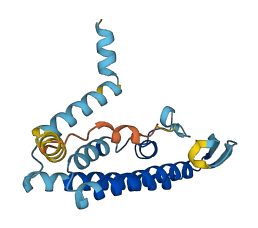
Descriptions
The autoinhibited protein was predicted that may have potential autoinhibitory elements via cis-regPred.
Autoinhibitory domains (AIDs)
Target domain |
|
Relief mechanism |
|
Assay |
cis-regPred |
Accessory elements
No accessory elements
Autoinhibited structure

Activated structure
1 structures for O42940
| Entry ID | Method | Resolution | Chain | Position | Source |
|---|---|---|---|---|---|
| AF-O42940-F1 | Predicted | AlphaFoldDB |
No variants for O42940
| Variant ID(s) | Position | Change | Description | Diseaes Association | Provenance |
|---|---|---|---|---|---|
| No variants for O42940 | |||||
No associated diseases with O42940
7 regional properties for O42940
| Type | Name | Position | InterPro Accession |
|---|---|---|---|
| domain | Protein kinase domain | 11 - 273 | IPR000719 |
| domain | PASTA domain | 352 - 418 | IPR005543-1 |
| domain | PASTA domain | 419 - 486 | IPR005543-2 |
| domain | PASTA domain | 487 - 553 | IPR005543-3 |
| domain | PASTA domain | 554 - 622 | IPR005543-4 |
| active_site | Serine/threonine-protein kinase, active site | 134 - 146 | IPR008271 |
| binding_site | Protein kinase, ATP binding site | 17 - 40 | IPR017441 |
1 GO annotations of cellular component
| Name | Definition |
|---|---|
| integral component of endoplasmic reticulum membrane | The component of the endoplasmic reticulum membrane consisting of the gene products and protein complexes having at least some part of their peptide sequence embedded in the hydrophobic region of the membrane. |
No GO annotations of molecular function
| Name | Definition |
|---|---|
| No GO annotations for molecular function |
3 GO annotations of biological process
| Name | Definition |
|---|---|
| phosphate ion transport | The directed movement of phosphate into, out of or within a cell, or between cells, by means of some agent such as a transporter or pore. |
| protein insertion into ER membrane | The process that results in incorporation of a protein into an endoplasmic reticulum (ER) membrane. It depends on specific topogenic sequences of amino acids that ensure that a protein acquires the proper orientation during its insertion into the ER membrane. |
| protein targeting to ER | The process of directing proteins towards the endoplasmic reticulum (ER) using signals contained within the protein. One common mechanism uses a 16- to 30-residue signal sequence, typically located at the N-terminus of the protein and containing positively charged amino acids followed by a continuous stretch of hydrophobic residues, which directs the ribosome to the ER membrane and initiates transport of the growing polypeptide across the ER membrane. |
No homologous proteins in AiPD
| UniProt AC | Gene Name | Protein Name | Species | Evidence Code |
|---|---|---|---|---|
| No homologous proteins | ||||
| 10 | 20 | 30 | 40 | 50 | 60 |
| MVSRWEKLKN | NPQTKSIGIS | IFLMMITRVI | DFSRPSLLWP | LRILYATVNI | VQIGIFLYTK |
| 70 | 80 | 90 | 100 | 110 | 120 |
| IIIEKKNDLT | VLKYVEPATP | MSGREHSKFV | ATTVRDYDLS | KLLTSFKQML | VTIATTLFMH |
| 130 | 140 | 150 | 160 | 170 | 180 |
| LYMGYAPPLL | LQSVSAARGL | FDNSEVQIHV | QNKPAIDELR | RPFKSSGGLL | GSFGQVLTDK |
| 190 | |||||
| KSVDEAELTK | LKPT |