O42861
Gene name |
fft3 (snf2SR, SPAC25A8.01c) |
Protein name |
ATP-dependent helicase fft3 |
Names |
Fun thirty-related protein 3 |
Species |
Schizosaccharomyces pombe (strain 972 / ATCC 24843) (Fission yeast) |
KEGG Pathway |
spo:SPAC25A8.01c |
EC number |
3.6.4.12: Acting on ATP; involved in cellular and subcellular movement |
Protein Class |
|
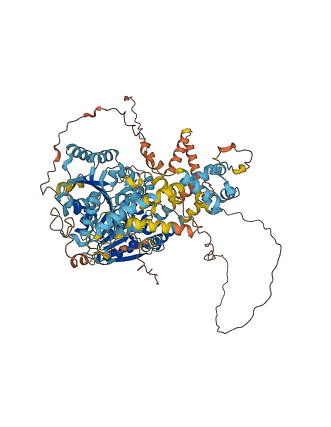
Descriptions
The autoinhibited protein was predicted that may have potential autoinhibitory elements via cis-regPred.
Autoinhibitory domains (AIDs)
Target domain |
|
Relief mechanism |
|
Assay |
cis-regPred |
Accessory elements
No accessory elements
Autoinhibited structure

Activated structure
5 structures for O42861
| Entry ID | Method | Resolution | Chain | Position | Source |
|---|---|---|---|---|---|
| 7XWY | X-ray | 225 A | A | 232-620 | PDB |
| 7XXE | X-ray | 420 A | A/B | 626-903 | PDB |
| 7XYF | EM | 430 A | K | 232-903 | PDB |
| 7XYG | EM | 540 A | K | 1-922 | PDB |
| AF-O42861-F1 | Predicted | AlphaFoldDB |
2 variants for O42861
| Variant ID(s) | Position | Change | Description | Diseaes Association | Provenance |
|---|---|---|---|---|---|
| I_2100671_C_T | 127 | A>T | No | Jeffares_SNPs | |
| I_2099756_T_G | 432 | K>Q | No | Jeffares_SNPs |
No associated diseases with O42861
Functions
| Description | ||
|---|---|---|
| EC Number | 3.6.4.12 | Acting on ATP; involved in cellular and subcellular movement |
| Subcellular Localization |
|
|
| PANTHER Family | ||
| PANTHER Subfamily | ||
| PANTHER Protein Class | ||
| PANTHER Pathway Category | No pathway information available | |
3 GO annotations of cellular component
| Name | Definition |
|---|---|
| chromatin | The ordered and organized complex of DNA, protein, and sometimes RNA, that forms the chromosome. |
| heterochromatin | A compact and highly condensed form of chromatin that is refractory to transcription. |
| nucleus | A membrane-bounded organelle of eukaryotic cells in which chromosomes are housed and replicated. In most cells, the nucleus contains all of the cell's chromosomes except the organellar chromosomes, and is the site of RNA synthesis and processing. In some species, or in specialized cell types, RNA metabolism or DNA replication may be absent. |
8 GO annotations of molecular function
| Name | Definition |
|---|---|
| ATP binding | Binding to ATP, adenosine 5'-triphosphate, a universally important coenzyme and enzyme regulator. |
| ATP hydrolysis activity | Catalysis of the reaction: ATP + H2O = ADP + H+ phosphate. ATP hydrolysis is used in some reactions as an energy source, for example to catalyze a reaction or drive transport against a concentration gradient. |
| ATP-dependent activity, acting on DNA | Catalytic activity that acts to modify DNA, driven by ATP hydrolysis. |
| ATP-dependent chromatin remodeler activity | An activity, driven by ATP hydrolysis, that modulates the contacts between histones and DNA, resulting in a change in chromosome architecture within the nucleosomal array, leading to chromatin remodeling. |
| chromatin binding | Binding to chromatin, the network of fibers of DNA, protein, and sometimes RNA, that make up the chromosomes of the eukaryotic nucleus during interphase. |
| damaged DNA binding | Binding to damaged DNA. |
| DNA binding | Any molecular function by which a gene product interacts selectively and non-covalently with DNA (deoxyribonucleic acid). |
| DNA helicase activity | Unwinding of a DNA helix, driven by ATP hydrolysis. |
4 GO annotations of biological process
| Name | Definition |
|---|---|
| attachment of telomeric heterochromatin to nuclear envelope | The process in which physical connections are formed between sub-telomeric heterochromatin and the nuclear envelope facilitating bouquet formation. |
| chromatin remodeling | A dynamic process of chromatin reorganization resulting in changes to chromatin structure. These changes allow DNA metabolic processes such as transcriptional regulation, DNA recombination, DNA repair, and DNA replication. |
| positive regulation of DNA strand resection involved in replication fork processing | Any process that activates or increases the frequency, rate or extent of DNA strand resection involved in replication fork processing. |
| replication fork processing | The process in which a DNA replication fork that has stalled is restored to a functional state and replication is restarted. The stalling may be due to DNA damage, DNA secondary structure, bound proteins, dNTP shortage, or other causes. |
No homologous proteins in AiPD
| UniProt AC | Gene Name | Protein Name | Species | Evidence Code |
|---|---|---|---|---|
| No homologous proteins | ||||
| 10 | 20 | 30 | 40 | 50 | 60 |
| MDGKRKIEHT | ADGTHYDATS | NVKRKPIFPP | FIADSLSEAT | EKANVMGGGM | NSRLQILSEM |
| 70 | 80 | 90 | 100 | 110 | 120 |
| SKRVQATAPI | SSLEHFKQLS | DISPSFTSSA | NSINQPYNYS | GSLENLVPTP | SAGTPSQFMD |
| 130 | 140 | 150 | 160 | 170 | 180 |
| AQNPYGAVYN | ALSQFSETEP | KMPSYMDDEE | ASDSLPLSLS | SQSLSSQVTN | QKPAPHRLTM |
| 190 | 200 | 210 | 220 | 230 | 240 |
| RERYAANNLT | NGLQFTLPLS | SRKTYEPEAD | DDSNDDMYSD | DDSNADRWAS | RIDTAALKEE |
| 250 | 260 | 270 | 280 | 290 | 300 |
| VLKYMNRCST | QDLADMTGCT | LAEAEFMVAK | RPFPDLESAL | VVKQPRPVIP | KGRRGRREKT |
| 310 | 320 | 330 | 340 | 350 | 360 |
| PLGPRLVGIC | MEIMRGYFVV | DALIRQCEQL | GGKIQRGIEA | WGLSNTATSD | EGETSLVNFD |
| 370 | 380 | 390 | 400 | 410 | 420 |
| QMKSFGTPAN | SSFITTPPAS | FSPDIKLQDY | QIIGINWLYL | LYELKLAGIL | ADEMGLGKTC |
| 430 | 440 | 450 | 460 | 470 | 480 |
| QTIAFFSLLM | DKNINGPHLV | IAPASTMENW | LREFAKFCPK | LKIELYYGSQ | VEREEIRERI |
| 490 | 500 | 510 | 520 | 530 | 540 |
| NSNKDSYNVM | LTTYRLAATS | KADRLFLRNQ | KFNVCVYDEG | HYLKNRASER | YRHLMSIPAD |
| 550 | 560 | 570 | 580 | 590 | 600 |
| FRVLLTGTPL | QNNLKELISL | LAFILPHVFD | YGLKSLDVIF | TMKKSPESDF | ERALLSEQRV |
| 610 | 620 | 630 | 640 | 650 | 660 |
| SRAKMMMAPF | VLRRKKSQVL | DALPKKTRII | EFCEFSEEER | RRYDDFASKQ | SVNSLLDENV |
| 670 | 680 | 690 | 700 | 710 | 720 |
| MKTNLDTNAN | LAKKKSTAGF | VLVQLRKLAD | HPMLFRIHYK | DDILRQMAKA | IMNEPQYKKA |
| 730 | 740 | 750 | 760 | 770 | 780 |
| NELYIFEDMQ | YMSDIELHNL | CCKFPSINSF | QLKDEPWMDA | TKVRKLKKLL | TNAVENGDRV |
| 790 | 800 | 810 | 820 | 830 | 840 |
| VLFSQFTQVL | DILQLVMKSL | NLKFLRFDGS | TQVDFRQDLI | DQFYADESIN | VFLLSTKAGG |
| 850 | 860 | 870 | 880 | 890 | 900 |
| FGINLACANM | VILYDVSFNP | FDDLQAEDRA | HRVGQKKEVT | VYKFVVKDTI | EEHIQRLANA |
| 910 | 920 | ||||
| KIALDATLSG | NAETVEAEDD | DD |