O42825
Gene name |
RHO1 (CAALFM_CR02860WA, CaO19.10362, CaO19.2843) |
Protein name |
GTP-binding protein RHO1 |
Names |
|
Species |
Candida albicans (strain SC5314 / ATCC MYA-2876) (Yeast) |
KEGG Pathway |
cal:CAALFM_CR02860WA |
EC number |
|
Protein Class |
|
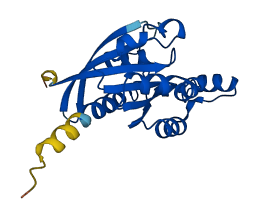
Descriptions
The autoinhibited protein was predicted that may have potential autoinhibitory elements via cis-regPred.
Autoinhibitory domains (AIDs)
Target domain |
|
Relief mechanism |
|
Assay |
cis-regPred |
Accessory elements
No accessory elements
Autoinhibited structure

Activated structure
1 structures for O42825
| Entry ID | Method | Resolution | Chain | Position | Source |
|---|---|---|---|---|---|
| AF-O42825-F1 | Predicted | AlphaFoldDB |
No variants for O42825
| Variant ID(s) | Position | Change | Description | Diseaes Association | Provenance |
|---|---|---|---|---|---|
| No variants for O42825 | |||||
1 associated diseases with O42825
[MIM: 610612]: Leber congenital amaurosis 12 (LCA12)
A severe dystrophy of the retina, typically becoming evident in the first years of life. Visual function is usually poor and often accompanied by nystagmus, sluggish or near-absent pupillary responses, photophobia, high hyperopia and keratoconus. {ECO:0000269|PubMed:17186464}. Note=The disease is caused by variants affecting the gene represented in this entry.
Without disease ID
- A severe dystrophy of the retina, typically becoming evident in the first years of life. Visual function is usually poor and often accompanied by nystagmus, sluggish or near-absent pupillary responses, photophobia, high hyperopia and keratoconus. {ECO:0000269|PubMed:17186464}. Note=The disease is caused by variants affecting the gene represented in this entry.
7 GO annotations of cellular component
| Name | Definition |
|---|---|
| cell cortex | The region of a cell that lies just beneath the plasma membrane and often, but not always, contains a network of actin filaments and associated proteins. |
| cell projection | A prolongation or process extending from a cell, e.g. a flagellum or axon. |
| cytoplasmic vesicle | A vesicle found in the cytoplasm of a cell. |
| cytoskeleton | A cellular structure that forms the internal framework of eukaryotic and prokaryotic cells. The cytoskeleton includes intermediate filaments, microfilaments, microtubules, the microtrabecular lattice, and other structures characterized by a polymeric filamentous nature and long-range order within the cell. The various elements of the cytoskeleton not only serve in the maintenance of cellular shape but also have roles in other cellular functions, including cellular movement, cell division, endocytosis, and movement of organelles. |
| extracellular vesicle | Any vesicle that is part of the extracellular region. |
| hyphal tip | The end, or tip, of a fungal hypha, where polarized growth occurs during hyphal elongation. |
| plasma membrane | The membrane surrounding a cell that separates the cell from its external environment. It consists of a phospholipid bilayer and associated proteins. |
3 GO annotations of molecular function
| Name | Definition |
|---|---|
| GTP binding | Binding to GTP, guanosine triphosphate. |
| GTPase activity | Catalysis of the reaction: GTP + H2O = GDP + H+ + phosphate. |
| protein kinase binding | Binding to a protein kinase, any enzyme that catalyzes the transfer of a phosphate group, usually from ATP, to a protein substrate. |
9 GO annotations of biological process
| Name | Definition |
|---|---|
| (1->3)-beta-D-glucan biosynthetic process | The chemical reactions and pathways resulting in the formation of (1->3)-beta-D-glucans, compounds composed of glucose residues linked by (1->3)-beta-D-glucosidic bonds. |
| actin filament organization | A process that is carried out at the cellular level which results in the assembly, arrangement of constituent parts, or disassembly of cytoskeletal structures comprising actin filaments. Includes processes that control the spatial distribution of actin filaments, such as organizing filaments into meshworks, bundles, or other structures, as by cross-linking. |
| cortical cytoskeleton organization | A process that is carried out at the cellular level which results in the assembly, arrangement of constituent parts, or disassembly of cytoskeletal structures in the cell cortex, i.e. just beneath the plasma membrane. |
| establishment or maintenance of cell polarity | Any cellular process that results in the specification, formation or maintenance of anisotropic intracellular organization or cell growth patterns. |
| negative regulation of phenotypic switching | Any process that stops, prevents or reduces the frequency, rate or extent of phenotypic switching. |
| regulation of actin cytoskeleton organization | Any process that modulates the frequency, rate or extent of the formation, arrangement of constituent parts, or disassembly of cytoskeletal structures comprising actin filaments and their associated proteins. |
| regulation of cell shape | Any process that modulates the surface configuration of a cell. |
| Rho protein signal transduction | The series of molecular signals within the cell that are mediated by a member of the Rho family of proteins switching to a GTP-bound active state. |
| small GTPase mediated signal transduction | The series of molecular signals in which a small monomeric GTPase relays a signal. |
No homologous proteins in AiPD
| UniProt AC | Gene Name | Protein Name | Species | Evidence Code |
|---|---|---|---|---|
| No homologous proteins | ||||
| 10 | 20 | 30 | 40 | 50 | 60 |
| MVNGPAELRR | KLVIVGDGAC | GKTCLLIVFS | KGTFPEVYVP | TVFENYVADV | EVDGRKVELA |
| 70 | 80 | 90 | 100 | 110 | 120 |
| LWDTAGQEDY | DRLRPLSYPD | SNVILICFSV | DSPDSLDNVL | EKWISEVLHF | CQGVPIILVG |
| 130 | 140 | 150 | 160 | 170 | 180 |
| CKSDLRDDPH | TIEALRQQQQ | QPVSTSEGQQ | VAQRIGAADY | LECSAKTGRG | VREVFEAATR |
| 190 | |||||
| ASLRVKEKKE | KKKKCVVL |