O42819
Gene name |
SEC4 (CAGL0F02123g) |
Protein name |
Ras-related protein SEC4 |
Names |
|
Species |
Candida glabrata (strain ATCC 2001 / CBS 138 / JCM 3761 / NBRC 0622 / NRRL Y-65) (Yeast) (Torulopsis glabrata) |
KEGG Pathway |
cgr:CAGL0F02123g |
EC number |
|
Protein Class |
|
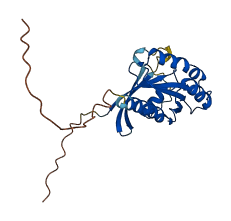
Descriptions
The autoinhibited protein was predicted that may have potential autoinhibitory elements via cis-regPred.
Autoinhibitory domains (AIDs)
Target domain |
|
Relief mechanism |
|
Assay |
cis-regPred |
Accessory elements
No accessory elements
Autoinhibited structure

Activated structure
1 structures for O42819
| Entry ID | Method | Resolution | Chain | Position | Source |
|---|---|---|---|---|---|
| AF-O42819-F1 | Predicted | AlphaFoldDB |
No variants for O42819
| Variant ID(s) | Position | Change | Description | Diseaes Association | Provenance |
|---|---|---|---|---|---|
| No variants for O42819 | |||||
No associated diseases with O42819
1 regional properties for O42819
| Type | Name | Position | InterPro Accession |
|---|---|---|---|
| domain | Small GTP-binding protein domain | 19 - 173 | IPR005225 |
5 GO annotations of cellular component
| Name | Definition |
|---|---|
| fungal biofilm matrix | An extracellular matrix lying external to fungal cells. The fungal biofilm matrix consists of polysaccharides, proteins, lipids, and nucleic acids. Fungal biofilms mediate adherence to host tissues, and provide protection from host immune defenses. |
| incipient cellular bud site | The portion of the budding yeast plasma membrane where a daughter cell will emerge. The yeast marks this spot with bud-site selection proteins before bud emergence occurs. Actin is polarized to this spot just prior to and during bud emergence. |
| mating projection tip | The apex of the mating projection in unicellular fungi exposed to mating pheromone; site of polarized growth. |
| plasma membrane | The membrane surrounding a cell that separates the cell from its external environment. It consists of a phospholipid bilayer and associated proteins. |
| transport vesicle membrane | The lipid bilayer surrounding a transport vesicle. |
2 GO annotations of molecular function
| Name | Definition |
|---|---|
| GTP binding | Binding to GTP, guanosine triphosphate. |
| GTPase activity | Catalysis of the reaction: GTP + H2O = GDP + H+ + phosphate. |
7 GO annotations of biological process
| Name | Definition |
|---|---|
| ascospore-type prospore assembly | During ascospore formation, the process in which each haploid nucleus becomes encapsulated by a double membrane. |
| autophagy | The cellular catabolic process in which cells digest parts of their own cytoplasm; allows for both recycling of macromolecular constituents under conditions of cellular stress and remodeling the intracellular structure for cell differentiation. |
| exocytosis | A process of secretion by a cell that results in the release of intracellular molecules (e.g. hormones, matrix proteins) contained within a membrane-bounded vesicle. Exocytosis can occur either by full fusion, when the vesicle collapses into the plasma membrane, or by a kiss-and-run mechanism that involves the formation of a transient contact, a pore, between a granule (for exemple of chromaffin cells) and the plasma membrane. The latter process most of the time leads to only partial secretion of the granule content. Exocytosis begins with steps that prepare vesicles for fusion with the membrane (tethering and docking) and ends when molecules are secreted from the cell. |
| Golgi to plasma membrane transport | The directed movement of substances from the Golgi to the plasma membrane in transport vesicles that move from the trans-Golgi network to the plasma membrane, where they fuse and release their contents by exocytosis. |
| membrane addition at site of cytokinesis | Any process involved in the net addition of membrane at the site of cytokinesis; includes vesicle recruitment and fusion, local lipid synthesis and insertion. |
| protein transport | The directed movement of proteins into, out of or within a cell, or between cells, by means of some agent such as a transporter or pore. |
| vesicle fusion | Fusion of the membrane of a transport vesicle with its target membrane. |
No homologous proteins in AiPD
| UniProt AC | Gene Name | Protein Name | Species | Evidence Code |
|---|---|---|---|---|
| No homologous proteins | ||||
| 10 | 20 | 30 | 40 | 50 | 60 |
| MSALRTVSGS | SGNGKSYDSI | MKILLIGDSG | VGKSCLLVRF | VEDKFNPSFI | TTIGIDFKIK |
| 70 | 80 | 90 | 100 | 110 | 120 |
| TVDINGKKVK | LQLWDTAGQE | RFRTITTAYY | RGAMGIILVY | DVTDERTFAN | IKQWFKTVNE |
| 130 | 140 | 150 | 160 | 170 | 180 |
| HANDEAQLLL | VGNKSDMDTR | VVTYEQGEAL | AKELGLPFIE | SSAKNDDNVN | EIFFTLARLI |
| 190 | 200 | 210 | |||
| QEKIDSNKLS | GPNSGKDGNI | SINANKGDSS | KSNCC |