O35633
Gene name |
Slc32a1 |
Protein name |
Vesicular inhibitory amino acid transporter |
Names |
Solute carrier family 32 member 1, Vesicular GABA and glycine transporter, Vesicular GABA transporter, mVGAT, mVIAAT |
Species |
Mus musculus (Mouse) |
KEGG Pathway |
mmu:22348 |
EC number |
|
Protein Class |
|
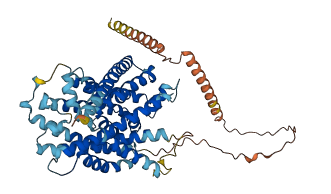
Descriptions
The autoinhibited protein was predicted that may have potential autoinhibitory elements via cis-regPred.
Autoinhibitory domains (AIDs)
Target domain |
|
Relief mechanism |
|
Assay |
cis-regPred |
Accessory elements
No accessory elements
Autoinhibited structure

Activated structure
1 structures for O35633
| Entry ID | Method | Resolution | Chain | Position | Source |
|---|---|---|---|---|---|
| AF-O35633-F1 | Predicted | AlphaFoldDB |
23 variants for O35633
| Variant ID(s) | Position | Change | Description | Diseaes Association | Provenance |
|---|---|---|---|---|---|
| rs265965342 | 56 | Q>E | No | EVA | |
| rs3392477096 | 146 | Y>* | No | EVA | |
| rs3392485320 | 152 | I>N | No | EVA | |
| rs3388601072 | 162 | T>I | No | EVA | |
| rs3388610904 | 181 | R>* | No | EVA | |
| rs3388608863 | 190 | A>G | No | EVA | |
| rs3388593248 | 205 | V>M | No | EVA | |
| rs3388608686 | 240 | Q>R | No | EVA | |
| rs3388604879 | 261 | K>M | No | EVA | |
| rs3388601085 | 263 | V>M | No | EVA | |
| rs3388610977 | 287 | S>F | No | EVA | |
| rs3388593246 | 330 | M>I | No | EVA | |
| rs3388603746 | 342 | W>* | No | EVA | |
| rs3388593243 | 366 | T>I | No | EVA | |
| rs3411153013 | 378 | I>M | No | EVA | |
| rs3388605907 | 382 | V>F | No | EVA | |
| rs3388609801 | 383 | N>H | No | EVA | |
| rs3388605004 | 420 | A>S | No | EVA | |
| rs3388607817 | 437 | C>R | No | EVA | |
| rs3388603730 | 441 | V>D | No | EVA | |
| rs3388605028 | 454 | A>G | No | EVA | |
| rs3388604985 | 471 | L>Q | No | EVA | |
| rs3392450345 | 482 | W>* | No | EVA |
No associated diseases with O35633
1 regional properties for O35633
| Type | Name | Position | InterPro Accession |
|---|---|---|---|
| domain | Amino acid transporter, transmembrane domain | 115 - 510 | IPR013057 |
Functions
17 GO annotations of cellular component
| Name | Definition |
|---|---|
| cell surface | The external part of the cell wall and/or plasma membrane. |
| cell tip | The region at the end of the longest axis of a cylindrical or elongated cell. |
| cone cell pedicle | A specialized axon terminus which is produced by retinal cone cells. Pedicles are large, conical, flat end-feet (8-10 micrometers diameter) of the retinal cone axon that lie more or less side by side on the same plane at the outer edge of the outer plexiform layer (OPL). |
| dendrite | A neuron projection that has a short, tapering, morphology. Dendrites receive and integrate signals from other neurons or from sensory stimuli, and conduct nerve impulses towards the axon or the cell body. In most neurons, the impulse is conveyed from dendrites to axon via the cell body, but in some types of unipolar neuron, the impulse does not travel via the cell body. |
| dendrite terminus | A structure at the distal end of a dendrite adapted to carry out a specific function, e.g. dendriole. |
| GABA-ergic synapse | A synapse that uses GABA as a neurotransmitter. These synapses are typically inhibitory. |
| inhibitory synapse | A synapse in which an action potential in the presynaptic cell reduces the probability of an action potential occurring in the postsynaptic cell. |
| integral component of plasma membrane | The component of the plasma membrane consisting of the gene products and protein complexes having at least some part of their peptide sequence embedded in the hydrophobic region of the membrane. |
| integral component of synaptic vesicle membrane | The component of the synaptic vesicle membrane consisting of the gene products and protein complexes having at least some part of their peptide sequence embedded in the hydrophobic region of the membrane. |
| intracellular organelle | Organized structure of distinctive morphology and function, occurring within the cell. Includes the nucleus, mitochondria, plastids, vacuoles, vesicles, ribosomes and the cytoskeleton. Excludes the plasma membrane. |
| membrane | A lipid bilayer along with all the proteins and protein complexes embedded in it an attached to it. |
| neuron projection | A prolongation or process extending from a nerve cell, e.g. an axon or dendrite. |
| neuron projection terminus | The specialized, terminal region of a neuron projection such as an axon or a dendrite. |
| presynapse | The part of a synapse that is part of the presynaptic cell. |
| presynaptic active zone | A specialized region of the plasma membrane and cell cortex of a presynaptic neuron; encompasses a region of the plasma membrane where synaptic vesicles dock and fuse, and a specialized cortical cytoskeletal matrix. |
| synapse | The junction between an axon of one neuron and a dendrite of another neuron, a muscle fiber or a glial cell. As the axon approaches the synapse it enlarges into a specialized structure, the presynaptic terminal bouton, which contains mitochondria and synaptic vesicles. At the tip of the terminal bouton is the presynaptic membrane; facing it, and separated from it by a minute cleft (the synaptic cleft) is a specialized area of membrane on the receiving cell, known as the postsynaptic membrane. In response to the arrival of nerve impulses, the presynaptic terminal bouton secretes molecules of neurotransmitters into the synaptic cleft. These diffuse across the cleft and transmit the signal to the postsynaptic membrane. |
| synaptic vesicle | A secretory organelle, typically 50 nm in diameter, of presynaptic nerve terminals; accumulates in high concentrations of neurotransmitters and secretes these into the synaptic cleft by fusion with the 'active zone' of the presynaptic plasma membrane. |
6 GO annotations of molecular function
| Name | Definition |
|---|---|
| amino acid transmembrane transporter activity | Enables the transfer of amino acids from one side of a membrane to the other. Amino acids are organic molecules that contain an amino group and a carboxyl group. |
| gamma-aminobutyric acid transmembrane transporter activity | Enables the transfer of gamma-aminobutyric acid from one side of a membrane to the other. Gamma-aminobutyric acid is 4-aminobutyrate (GABA). |
| gamma-aminobutyric acid:proton antiporter activity | Enables the transfer of a solute or solutes from one side of a membrane to the other according to the reaction: 4-aminobutanoate(out) + n H+(in) = 4-aminobutanoate(in) + n H+(out). |
| gamma-aminobutyric acid:proton symporter activity | Enables the transfer of a solute or solutes from one side of a membrane to the other according to the reaction: gamma-aminobutyric acid(out) + H+(out) = gamma-aminobutyric acid(in) + H+(in). |
| glycine transmembrane transporter activity | Enables the transfer of glycine from one side of a membrane to the other. Glycine is aminoethanoic acid. |
| glycine:proton antiporter activity | Enables the transfer of a solute or solutes from one side of a membrane to the other according to the reaction: glycine(out) + n H(+)(in) = glycine(in) + n H(+)(out). |
8 GO annotations of biological process
| Name | Definition |
|---|---|
| aging | A developmental process that is a deterioration and loss of function over time. Aging includes loss of functions such as resistance to disease, homeostasis, and fertility, as well as wear and tear. Aging includes cellular senescence, but is more inclusive. May precede death and may succeed developmental maturation (GO:0021700). |
| amino acid transmembrane transport | The process in which an amino acid is transported across a membrane. |
| beta-alanine transport | The directed movement of beta-alanine, 3-aminopropanoic acid, into, out of or within a cell, or between cells, by means of some agent such as a transporter or pore. |
| gamma-aminobutyric acid import | The directed movement of gamma-aminobutyric acid (GABA, 4-aminobutyrate) into a cell or organelle. |
| gamma-aminobutyric acid transport | The directed movement of gamma-aminobutyric acid (GABA, 4-aminobutyrate), an amino acid which acts as a neurotransmitter in some organisms, into, out of or within a cell, or between cells, by means of some agent such as a transporter or pore. |
| glycine transport | The directed movement of glycine, aminoethanoic acid, into, out of or within a cell, or between cells, by means of some agent such as a transporter or pore. |
| hippocampus development | The progression of the hippocampus over time from its initial formation until its mature state. |
| neurotransmitter loading into synaptic vesicle | The active transport of neurotransmitters into a synaptic vesicle. This import is fuelled by an electrochemical gradient across the vesicle membrane, established by the action of proton pumps. |
1 homologous proteins in AiPD
| UniProt AC | Gene Name | Protein Name | Species | Evidence Code |
|---|---|---|---|---|
| Q9H598 | SLC32A1 | Vesicular inhibitory amino acid transporter | Homo sapiens (Human) | PR |
| 10 | 20 | 30 | 40 | 50 | 60 |
| MATLLRSKLT | NVATSVSNKS | QAKVSGMFAR | MGFQAATDEE | AVGFAHCDDL | DFEHRQGLQM |
| 70 | 80 | 90 | 100 | 110 | 120 |
| DILKSEGEPC | GDEGAEAPVE | GDIHYQRGGA | PLPPSGSKDQ | AVGAGGEFGG | HDKPKITAWE |
| 130 | 140 | 150 | 160 | 170 | 180 |
| AGWNVTNAIQ | GMFVLGLPYA | ILHGGYLGLF | LIIFAAVVCC | YTGKILIACL | YEENEDGEVV |
| 190 | 200 | 210 | 220 | 230 | 240 |
| RVRDSYVAIA | NACCAPRFPT | LGGRVVNVAQ | IIELVMTCIL | YVVVSGNLMY | NSFPGLPVSQ |
| 250 | 260 | 270 | 280 | 290 | 300 |
| KSWSIIATAV | LLPCAFLKNL | KAVSKFSLLC | TLAHFVINIL | VIAYCLSRAR | DWAWEKVKFY |
| 310 | 320 | 330 | 340 | 350 | 360 |
| IDVKKFPISI | GIIVFSYTSQ | IFLPSLEGNM | QQPSEFHCMM | NWTHIAACVL | KGLFALVAYL |
| 370 | 380 | 390 | 400 | 410 | 420 |
| TWADETKEVI | TDNLPGSIRA | VVNLFLVAKA | LLSYPLPFFA | AVEVLEKSLF | QEGSRAFFPA |
| 430 | 440 | 450 | 460 | 470 | 480 |
| CYGGDGRLKS | WGLTLRCALV | VFTLLMAIYV | PHFALLMGLT | GSLTGAGLCF | LLPSLFHLRL |
| 490 | 500 | 510 | 520 | ||
| LWRKLLWHQV | FFDVAIFVIG | GICSVSGFVH | SLEGLIEAYR | TNAED |