O35245
Gene name |
Pkd2 |
Protein name |
Polycystin-2 |
Names |
Polycystic kidney disease 2 protein homolog, Transient receptor potential cation channel subfamily P member 2 |
Species |
Mus musculus (Mouse) |
KEGG Pathway |
mmu:18764 |
EC number |
|
Protein Class |
|
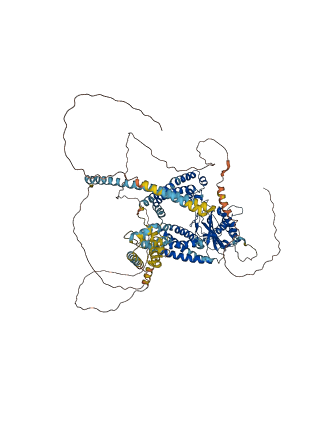
Descriptions
The autoinhibited protein was predicted that may have potential autoinhibitory elements via cis-regPred.
Autoinhibitory domains (AIDs)
Target domain |
|
Relief mechanism |
|
Assay |
cis-regPred |
Accessory elements
No accessory elements
Autoinhibited structure

Activated structure
1 structures for O35245
| Entry ID | Method | Resolution | Chain | Position | Source |
|---|---|---|---|---|---|
| AF-O35245-F1 | Predicted | AlphaFoldDB |
41 variants for O35245
| Variant ID(s) | Position | Change | Description | Diseaes Association | Provenance |
|---|---|---|---|---|---|
| rs263997740 | 21 | P>S | No | EVA | |
| rs257003833 | 147 | H>Q | No | EVA | |
| rs225548231 | 179 | E>V | No | EVA | |
| rs47324387 | 209 | A>G | No | EVA | |
| rs260112423 | 230 | V>I | No | EVA | |
| rs3395984831 | 245 | Y>F | No | EVA | |
| rs3388774669 | 253 | Q>* | No | EVA | |
| rs3395987658 | 258 | T>YE* | No | EVA | |
| rs3395905881 | 259 | P>L | No | EVA | |
| rs48573151 | 348 | V>I | No | EVA | |
| rs3396088802 | 364 | W>* | No | EVA | |
| rs49788352 | 365 | M>I | No | EVA | |
| rs48970352 | 370 | K>R | No | EVA | |
| rs3388771644 | 387 | A>S | No | EVA | |
| rs3388775104 | 398 | E>G | No | EVA | |
| rs3395724777 | 404 | L>H | No | EVA | |
| rs3388760682 | 519 | A>D | No | EVA | |
| rs3388775465 | 523 | N>S | No | EVA | |
| rs51835614 | 560 | S>G | No | EVA | |
| rs46352854 | 560 | S>T | No | EVA | |
| rs3388771609 | 572 | F>V | No | EVA | |
| rs3388772570 | 579 | R>K | No | EVA | |
| rs3388763259 | 602 | F>L | No | EVA | |
| rs3388760633 | 621 | V>I | No | EVA | |
| rs3388771600 | 626 | T>N | No | EVA | |
| rs3388775110 | 634 | Q>R | No | EVA | |
| rs3388781330 | 654 | L>M | No | EVA | |
| rs3388770334 | 659 | F>Y | No | EVA | |
| rs3388771687 | 719 | T>I | No | EVA | |
| rs3388777737 | 748 | H>Y | No | EVA | |
| rs3388771643 | 750 | D>A | No | EVA | |
| rs3388778927 | 755 | A>T | No | EVA | |
| rs3388770286 | 756 | I>T | No | EVA | |
| rs3388775109 | 789 | L>S | No | EVA | |
| rs3388755600 | 838 | Q>R | No | EVA | |
| rs3388768069 | 859 | D>G | No | EVA | |
| rs3412992100 | 862 | I>N | No | EVA | |
| rs3388746382 | 866 | E>K | No | EVA | |
| rs3661637 | 942 | P>S | No | EVA | |
| rs3395987667 | 961 | S>R | No | EVA | |
| rs46393837 | 963 | N>K | No | EVA |
No associated diseases with O35245
Functions
23 GO annotations of cellular component
| Name | Definition |
|---|---|
| basal cortex | The region that lies just beneath the plasma membrane on the basal edge of a cell. |
| basal plasma membrane | The region of the plasma membrane located at the basal end of the cell. Often used in reference to animal polarized epithelial membranes, where the basal membrane is the part attached to the extracellular matrix, or in plant cells, where the basal membrane is defined with respect to the zygotic axis. |
| basolateral plasma membrane | The region of the plasma membrane that includes the basal end and sides of the cell. Often used in reference to animal polarized epithelial membranes, where the basal membrane is the part attached to the extracellular matrix, or in plant cells, where the basal membrane is defined with respect to the zygotic axis. |
| cation channel complex | An ion channel complex through which cations pass. |
| ciliary basal body | A membrane-tethered, short cylindrical array of microtubules and associated proteins found at the base of a eukaryotic cilium (also called flagellum) that is similar in structure to a centriole and derives from it. The cilium basal body is the site of assembly and remodelling of the cilium and serves as a nucleation site for axoneme growth. As well as anchoring the cilium, it is thought to provide a selective gateway regulating the entry of ciliary proteins and vesicles by intraflagellar transport. |
| ciliary membrane | The portion of the plasma membrane surrounding a cilium. |
| cilium | A specialized eukaryotic organelle that consists of a filiform extrusion of the cell surface and of some cytoplasmic parts. Each cilium is largely bounded by an extrusion of the cytoplasmic (plasma) membrane, and contains a regular longitudinal array of microtubules, anchored to a basal body. |
| cytoplasm | The contents of a cell excluding the plasma membrane and nucleus, but including other subcellular structures. |
| cytoplasmic vesicle membrane | The lipid bilayer surrounding a cytoplasmic vesicle. |
| cytosol | The part of the cytoplasm that does not contain organelles but which does contain other particulate matter, such as protein complexes. |
| endoplasmic reticulum | The irregular network of unit membranes, visible only by electron microscopy, that occurs in the cytoplasm of many eukaryotic cells. The membranes form a complex meshwork of tubular channels, which are often expanded into slitlike cavities called cisternae. The ER takes two forms, rough (or granular), with ribosomes adhering to the outer surface, and smooth (with no ribosomes attached). |
| endoplasmic reticulum membrane | The lipid bilayer surrounding the endoplasmic reticulum. |
| Golgi apparatus | A membrane-bound cytoplasmic organelle of the endomembrane system that further processes the core oligosaccharides (e.g. N-glycans) added to proteins in the endoplasmic reticulum and packages them into membrane-bound vesicles. The Golgi apparatus operates at the intersection of the secretory, lysosomal, and endocytic pathways. |
| integral component of cytoplasmic side of endoplasmic reticulum membrane | The component of the endoplasmic reticulum membrane consisting of the gene products that penetrate only the cytoplasmic side of the membrane. |
| integral component of lumenal side of endoplasmic reticulum membrane | The component of the endoplasmic reticulum membrane consisting of the gene products that penetrate only the lumenal side of the membrane. |
| integral component of plasma membrane | The component of the plasma membrane consisting of the gene products and protein complexes having at least some part of their peptide sequence embedded in the hydrophobic region of the membrane. |
| lamellipodium | A thin sheetlike process extended by the leading edge of a migrating cell or extending cell process; contains a dense meshwork of actin filaments. |
| membrane | A lipid bilayer along with all the proteins and protein complexes embedded in it an attached to it. |
| mitotic spindle | A spindle that forms as part of mitosis. Mitotic and meiotic spindles contain distinctive complements of proteins associated with microtubules. |
| motile cilium | A cilium which may have a variable arrangement of axonemal microtubules and also contains molecular motors. It may beat with a whip-like pattern that promotes cell motility or transport of fluids and other cells across a cell surface, such as on epithelial cells that line the lumenal ducts of various tissues; or they may display a distinct twirling motion that directs fluid flow asymmetrically across the cellular surface to affect asymmetric body plan organization. Motile cilia can be found in single as well as multiple copies per cell. |
| non-motile cilium | A cilium which may have a variable array of axonemal microtubules but does not contain molecular motors. |
| plasma membrane | The membrane surrounding a cell that separates the cell from its external environment. It consists of a phospholipid bilayer and associated proteins. |
| polycystin complex | A stable heterodimeric complex composed of polycystin-1 and polycystin-2. |
23 GO annotations of molecular function
| Name | Definition |
|---|---|
| actinin binding | Binding to actinin, any member of a family of proteins that crosslink F-actin. |
| alpha-actinin binding | Binding to alpha-actinin, one of a family of proteins that cross-link F-actin as antiparallel homodimers. Alpha-actinin has a molecular mass of 93-103 KDa; at the N-terminus there are two calponin homology domains, at the C-terminus there are two EF-hands. These two domains are connected by the rod domain. This domain is formed by triple-helical spectrin repeats. |
| ATPase binding | Binding to an ATPase, any enzyme that catalyzes the hydrolysis of ATP. |
| calcium channel activity | Enables the facilitated diffusion of a calcium ion (by an energy-independent process) involving passage through a transmembrane aqueous pore or channel without evidence for a carrier-mediated mechanism. |
| calcium ion binding | Binding to a calcium ion (Ca2+). |
| calcium-induced calcium release activity | Enables transmembrane transfer of calcium ions from an intracellular store to the cytosol on induction by increased calcium concentration. |
| cation channel activity | Enables the energy-independent passage of cations across a lipid bilayer down a concentration gradient. |
| channel activity | Enables the energy-independent facilitated diffusion, mediated by passage of a solute through a transmembrane aqueous pore or channel. Stereospecificity is not exhibited but this transport may be specific for a particular molecular species or class of molecules. |
| cytoskeletal protein binding | Binding to a protein component of a cytoskeleton (actin, microtubule, or intermediate filament cytoskeleton). |
| HLH domain binding | Binding to a Helix Loop Helix domain, a domain of 40-50 residues that occurs in specific DNA-binding proteins that act as transcription factors. The domain is formed of two amphipathic helices joined by a variable length linker region that can form a loop and it mediates protein dimerization. |
| identical protein binding | Binding to an identical protein or proteins. |
| muscle alpha-actinin binding | Binding to muscle isoforms of actinin. Muscle alpha-actinin isoforms are found in skeletal and cardiac muscle and are localized to the Z-disc. |
| outward rectifier potassium channel activity | Enables the transmembrane transfer of a potassium ion by an outwardly-rectifying voltage-gated channel. An outwardly rectifying current-voltage relation is one where at any given driving force the outward flow of K+ ions exceeds the inward flow for the opposite driving force. |
| phosphoprotein binding | Binding to a phosphorylated protein. |
| potassium channel activity | Enables the facilitated diffusion of a potassium ion (by an energy-independent process) involving passage through a transmembrane aqueous pore or channel without evidence for a carrier-mediated mechanism. |
| protein homodimerization activity | Binding to an identical protein to form a homodimer. |
| signaling receptor binding | Binding to one or more specific sites on a receptor molecule, a macromolecule that undergoes combination with a hormone, neurotransmitter, drug or intracellular messenger to initiate a change in cell function. |
| transmembrane transporter binding | Binding to a transmembrane transporter, a protein or protein complex that enables the transfer of a substance, usually a specific substance or a group of related substances, from one side of a membrane to the other. |
| voltage-gated calcium channel activity | Enables the transmembrane transfer of a calcium ion by a voltage-gated channel. A voltage-gated channel is a channel whose open state is dependent on the voltage across the membrane in which it is embedded. |
| voltage-gated cation channel activity | Enables the transmembrane transfer of a cation by a voltage-gated channel. A cation is a positively charged ion. A voltage-gated channel is a channel whose open state is dependent on the voltage across the membrane in which it is embedded. |
| voltage-gated ion channel activity | Enables the transmembrane transfer of an ion by a voltage-gated channel. An ion is an atom or group of atoms carrying an electric charge by virtue of having gained or lost one or more electrons. A voltage-gated channel is a channel whose open state is dependent on the voltage across the membrane in which it is embedded. |
| voltage-gated potassium channel activity | Enables the transmembrane transfer of a potassium ion by a voltage-gated channel. A voltage-gated channel is a channel whose open state is dependent on the voltage across the membrane in which it is embedded. |
| voltage-gated sodium channel activity | Enables the transmembrane transfer of a sodium ion by a voltage-gated channel. A voltage-gated channel is a channel whose open state is dependent on the voltage across the membrane in which it is embedded. |
57 GO annotations of biological process
| Name | Definition |
|---|---|
| aorta development | The progression of the aorta over time, from its initial formation to the mature structure. An aorta is an artery that carries blood from the heart to other parts of the body. |
| branching involved in ureteric bud morphogenesis | The process in which the branching structure of the ureteric bud is generated and organized. The ureteric bud is an epithelial tube that grows out from the metanephric duct. The bud elongates and branches to give rise to the ureter and kidney collecting tubules. |
| calcium ion transmembrane transport | A process in which a calcium ion is transported from one side of a membrane to the other by means of some agent such as a transporter or pore. |
| calcium ion transport | The directed movement of calcium (Ca) ions into, out of or within a cell, or between cells, by means of some agent such as a transporter or pore. |
| cell-cell signaling by wnt | Any process that mediates the transfer of information from one cell to another, medaited by a wnt family protein ligand. This process includes wnt signal transduction in the receiving cell, release of wnt ligand from a secreting cell as well as any processes that actively facilitate wnt transport and presentation to receptor on the recieving cell. |
| cellular calcium ion homeostasis | Any process involved in the maintenance of an internal steady state of calcium ions at the level of a cell. |
| cellular response to calcium ion | Any process that results in a change in state or activity of a cell (in terms of movement, secretion, enzyme production, gene expression, etc.) as a result of a calcium ion stimulus. |
| cellular response to cAMP | Any process that results in a change in state or activity of a cell (in terms of movement, secretion, enzyme production, gene expression, etc.) as a result of a cAMP (cyclic AMP, adenosine 3',5'-cyclophosphate) stimulus. |
| cellular response to fluid shear stress | Any process that results in a change in state or activity of a cell (in terms of movement, secretion, enzyme production, gene expression, etc.) as a result of a fluid shear stress stimulus. Fluid shear stress is the force acting on an object in a system where the fluid is moving across a solid surface. |
| cellular response to hydrostatic pressure | Any process that results in a change in state or activity of a cell (in terms of movement, secretion, enzyme production, gene expression, etc.) as a result of a hydrostatic pressure stimulus. Hydrostatic pressure is the force acting on an object in a system where the fluid is at rest (as opposed to moving). The weight of the fluid above the object creates pressure on it. |
| cellular response to osmotic stress | Any process that results in a change in state or activity of a cell (in terms of movement, secretion, enzyme production, gene expression, etc.) as a result of a stimulus indicating an increase or decrease in the concentration of solutes outside the organism or cell. |
| cilium organization | A process that is carried out at the cellular level which results in the assembly, arrangement of constituent parts, or disassembly of a cilium, a specialized eukaryotic organelle that consists of a filiform extrusion of the cell surface. Each cilium is bounded by an extrusion of the cytoplasmic membrane, and contains a regular longitudinal array of microtubules, anchored basally in a centriole. |
| cytoplasmic sequestering of transcription factor | The selective interaction of a transcription factor with specific molecules in the cytoplasm, thereby inhibiting its translocation into the nucleus. |
| detection of mechanical stimulus | The series of events by which a mechanical stimulus is received and converted into a molecular signal. |
| detection of nodal flow | The series of events by which an endogenous stimulus is received by a cilium on a cell and converted to a molecular signal contributing to left/right asymmetry. |
| determination of left/right symmetry | The establishment of an organism's body plan or part of an organism with respect to the left and right halves. The pattern can either be symmetric, such that the halves are mirror images, or asymmetric where the pattern deviates from this symmetry. |
| determination of liver left/right asymmetry | Determination of the asymmetric location of the liver with respect to the left and right halves of the organism. |
| embryonic placenta development | The embryonically driven process whose specific outcome is the progression of the placenta over time, from its formation to the mature structure. The placenta is an organ of metabolic interchange between fetus and mother, partly of embryonic origin and partly of maternal origin. |
| establishment of localization in cell | Any process, occuring in a cell, that localizes a substance or cellular component. This may occur via movement, tethering or selective degradation. |
| heart development | The process whose specific outcome is the progression of the heart over time, from its formation to the mature structure. The heart is a hollow, muscular organ, which, by contracting rhythmically, keeps up the circulation of the blood. |
| heart looping | The tube morphogenesis process in which the primitive heart tube loops asymmetrically. This looping brings the primitive heart chambers into alignment preceding their future integration. Heart looping begins with dextral-looping and ends when the main regional divisions of the mature heart and primordium of the great arterial trunks become established preceeding septation. |
| inorganic cation transmembrane transport | A process in which an inorganic cation is transported from one side of a membrane to the other by means of some agent such as a transporter or pore. |
| kidney development | The process whose specific outcome is the progression of the kidney over time, from its formation to the mature structure. The kidney is an organ that filters the blood and/or excretes the end products of body metabolism in the form of urine. |
| liver development | The process whose specific outcome is the progression of the liver over time, from its formation to the mature structure. The liver is an exocrine gland which secretes bile and functions in metabolism of protein and carbohydrate and fat, synthesizes substances involved in the clotting of the blood, synthesizes vitamin A, detoxifies poisonous substances, stores glycogen, and breaks down worn-out erythrocytes. |
| mesonephric duct development | The process whose specific outcome is the progression of a mesonephric duct over time, from its initial formation to a mature structure. A mesonephric duct is a tube drains the mesonephros. |
| metanephric ascending thin limb development | The process whose specific outcome is the progression of a metanephric ascending thin limb over time, from its formation to the mature structure. The metanephric ascending thin limb is a segment of a nephron tubule in the metanephros lying in the inner medulla that is permeable to ions but not to water and has a simple epithelium; active transepithelial solute transport is absent. |
| metanephric cortex development | The process whose specific outcome is the progression of the metanephric cortex over time, from its formation to the mature structure. The metanephric cortex is the outer region of the metanephros. |
| metanephric cortical collecting duct development | The process whose specific outcome is the progression of the metanephric cortical collecting duct over time, from its formation to the mature structure. The metanephric cortical collecting duct is the portion of the metanephric collecting duct that resides in the renal cortex. |
| metanephric distal tubule development | The process whose specific outcome is the progression of the metanephric distal tubule over time, from its formation to the mature structure. The metanephric distal tubule is a metanephric nephron tubule that begins at the metanephric macula densa and extends to the metanephric connecting tubule. |
| metanephric mesenchyme development | The biological process whose specific outcome is the progression of a metanephric mesenchyme from an initial condition to its mature state. This process begins with the formation of metanephric mesenchyme and ends with the mature structure. Metanephric mesenchyme is the tissue made up of loosely connected mesenchymal cells in the metanephros. |
| metanephric part of ureteric bud development | The development of the portion of the ureteric bud tube that contributes to the morphogenesis of the metanephros. |
| metanephric S-shaped body morphogenesis | The process in which the metanephric S-shaped body is generated and organized. The metanephric S-shaped body is the successor of the metanephric comma-shaped body that contributes to the morphogenesis of a nephron in the metanephros. |
| metanephric smooth muscle tissue development | The process whose specific outcome is the progression of smooth muscle in the metanephros over time, from its formation to the mature structure. |
| negative regulation of G1/S transition of mitotic cell cycle | Any signalling pathway that decreases or inhibits the activity of a cell cycle cyclin-dependent protein kinase to modulate the switch from G1 phase to S phase of the mitotic cell cycle. |
| negative regulation of ryanodine-sensitive calcium-release channel activity | Any process that decreases the activity of a ryanodine-sensitive calcium-release channel. The ryanodine-sensitive calcium-release channel catalyzes the transmembrane transfer of a calcium ion by a channel that opens when a ryanodine class ligand has been bound by the channel complex or one of its constituent parts. |
| neural tube development | The process whose specific outcome is the progression of the neural tube over time, from its formation to the mature structure. The mature structure of the neural tube exists when the tube has been segmented into the forebrain, midbrain, hindbrain and spinal cord regions. In addition neural crest has budded away from the epithelium. |
| placenta blood vessel development | The process whose specific outcome is the progression of a blood vessel of the placenta over time, from its formation to the mature structure. |
| positive regulation of cyclin-dependent protein serine/threonine kinase activity | Any process that activates or increases the frequency, rate or extent of CDK activity. |
| positive regulation of cytosolic calcium ion concentration | Any process that increases the concentration of calcium ions in the cytosol. |
| positive regulation of gene expression | Any process that increases the frequency, rate or extent of gene expression. Gene expression is the process in which a gene's coding sequence is converted into a mature gene product (protein or RNA). |
| positive regulation of inositol 1,4,5-trisphosphate-sensitive calcium-release channel activity | Any process that activates or increases the frequency, rate or extent of the activity of the inositol 1,4,5-trisphosphate-sensitive calcium-release channel. |
| positive regulation of nitric oxide biosynthetic process | Any process that activates or increases the frequency, rate or extent of the chemical reactions and pathways resulting in the formation of nitric oxide. |
| positive regulation of transcription by RNA polymerase II | Any process that activates or increases the frequency, rate or extent of transcription from an RNA polymerase II promoter. |
| potassium ion transmembrane transport | A process in which a potassium ion is transported from one side of a membrane to the other. |
| protein heterotetramerization | The formation of a protein heterotetramer, a macromolecular structure consisting of four noncovalently associated subunits, of which not all are identical. |
| protein homotetramerization | The formation of a protein homotetramer, a macromolecular structure consisting of four noncovalently associated identical subunits. |
| protein tetramerization | The formation of a protein tetramer, a macromolecular structure consisting of four noncovalently associated identical or nonidentical subunits. |
| receptor signaling pathway via JAK-STAT | Any process in which STAT proteins (Signal Transducers and Activators of Transcription) and JAK (Janus Activated Kinase) proteins convey a signal to trigger a change in the activity or state of a cell. The receptor signaling pathway via JAK-STAT begins with activation of a receptor and proceeeds through STAT protein activation by members of the JAK family of tyrosine kinases. STAT proteins dimerize and subsequently translocate to the nucleus. The pathway ends with regulation of target gene expression by STAT proteins. |
| regulation of calcium ion import | Any process that modulates the rate, frequency, or extent of the directed movement of calcium ions into a cell or organelle. |
| regulation of cell cycle | Any process that modulates the rate or extent of progression through the cell cycle. |
| regulation of cell population proliferation | Any process that modulates the frequency, rate or extent of cell proliferation. |
| release of sequestered calcium ion into cytosol | The process in which calcium ions sequestered in the endoplasmic reticulum, Golgi apparatus or mitochondria are released into the cytosolic compartment. |
| renal artery morphogenesis | The process in which the anatomical structure of a renal artery is generated and organized. Renal arteries supply the kidneys with blood. |
| renal tubule morphogenesis | The process in which the renal tubule is generated by specification of cell fate, through the maintenance of cell polarity, regulated cell proliferation and morphogenetic cell rearrangements, shape changes and growth. A renal tubule is a tube that filters, re-absorbs and secretes substances to rid an organism of waste and to play a role in fluid homeostasis. |
| sodium ion transmembrane transport | A process in which a sodium ion is transported from one side of a membrane to the other by means of some agent such as a transporter or pore. |
| spinal cord development | The process whose specific outcome is the progression of the spinal cord over time, from its formation to the mature structure. The spinal cord primarily conducts sensory and motor nerve impulses between the brain and the peripheral nervous tissues. |
| Wnt signaling pathway | The series of molecular signals initiated by binding of a Wnt protein to a frizzled family receptor on the surface of the target cell and ending with a change in cell state. |
1 homologous proteins in AiPD
| UniProt AC | Gene Name | Protein Name | Species | Evidence Code |
|---|---|---|---|---|
| Q7Z443 | PKD1L3 | Polycystic kidney disease protein 1-like 3 | Homo sapiens (Human) | PR |
| 10 | 20 | 30 | 40 | 50 | 60 |
| MVNSRRVQPQ | PPGDAGRSPA | PRASGPGRLV | AGGAGLAVPG | GLGEQRGLEI | EMERIRQAAA |
| 70 | 80 | 90 | 100 | 110 | 120 |
| RDPPAGASAS | PSPPLSSCSR | QAWSRDNPGF | EAEEDDDDDE | VEGEEGGMVV | EMDVEWRPGS |
| 130 | 140 | 150 | 160 | 170 | 180 |
| RRSASSSAVS | SVGARGRGLG | SYRGAAHLSG | RRRRLEDQGA | QCPSPAGGGD | PLHRHLPLEG |
| 190 | 200 | 210 | 220 | 230 | 240 |
| QPPRVAWAER | LVRGLRGLWG | TRLMEESNAN | REKYLKSVLR | ELVTYLFFLV | VLCILTYGMM |
| 250 | 260 | 270 | 280 | 290 | 300 |
| SSNVYYYTRT | LSQLFIDTPV | SKTEKTNFKT | LSSMEDFWKF | TEGSFLDGLY | WKAQTSNHTQ |
| 310 | 320 | 330 | 340 | 350 | 360 |
| ADNRSFIFYE | NLLLGVPRLR | QLRVRNGSCS | IPQDLRDEIK | ECYDVYSVSS | EDRAPFGPRN |
| 370 | 380 | 390 | 400 | 410 | 420 |
| GTAWMYTSEK | ELNGSSHWGI | IASYSGAGYY | LDLSRTREET | AAQLAGLRRN | FWLDRGTRAA |
| 430 | 440 | 450 | 460 | 470 | 480 |
| FIDFSVYNAN | INLFCVVRLL | AEFPATGGVV | PSWQFQPVKL | IRYVTAFDFF | LAACEIIFCF |
| 490 | 500 | 510 | 520 | 530 | 540 |
| FIIYYVVEEI | LEIRIHRLSY | FRSFWNCLDV | VIVVLSVVAM | VINIYRMSNA | EGLLQFLEDQ |
| 550 | 560 | 570 | 580 | 590 | 600 |
| NSFPNFEHVA | YWQIQFNNIS | AVMVFLVWIK | LFKFINFNRT | MSQLSTTMSR | CAKDLFGFTI |
| 610 | 620 | 630 | 640 | 650 | 660 |
| MFSIIFLAYA | QLAYLVFGTQ | VDDFSTFQEC | IFTQFRIILG | DINFAEIEEA | NRVLGPLYFT |
| 670 | 680 | 690 | 700 | 710 | 720 |
| TFVFFMFFIL | LNMFLAIIND | SYSEVKSDLA | QQKAEMELSD | LIRKGCQKAL | VKLKLKRNTV |
| 730 | 740 | 750 | 760 | 770 | 780 |
| DAISESLRQG | GGKLNFDELR | QDLKGKGHTD | AEIEAIFTKY | DQDGDQELTE | REHQQMRDDL |
| 790 | 800 | 810 | 820 | 830 | 840 |
| EKEREDLDLE | HSSLPRPMSS | RSFPRSLDDS | EEEDDEDSGH | SSRRRGSISS | GVSYEEFQVL |
| 850 | 860 | 870 | 880 | 890 | 900 |
| VRRVDRMEHS | IGSIVSKIDA | VIVKLEIMER | AKLKRREVLG | RLLDGVAEDA | RLGRDSEIHR |
| 910 | 920 | 930 | 940 | 950 | 960 |
| EQMERLVREE | LERWESDDAA | SQTGHGVSTQ | VGLGGQPHPR | NPRPPSSQSA | EGLEGGGGNG |
| SANVHA |