O34835
Gene name |
fapR (ylpC, BSU15880) |
Protein name |
Transcription factor FapR |
Names |
Fatty acid and phospholipid biosynthesis regulator |
Species |
Bacillus subtilis (strain 168) |
KEGG Pathway |
bsu:BSU15880 |
EC number |
|
Protein Class |
|
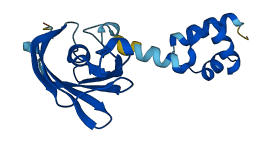
Descriptions
The autoinhibited protein was predicted that may have potential autoinhibitory elements via cis-regPred.
Autoinhibitory domains (AIDs)
Target domain |
|
Relief mechanism |
|
Assay |
cis-regPred |
Accessory elements
No accessory elements
Autoinhibited structure

Activated structure
3 structures for O34835
| Entry ID | Method | Resolution | Chain | Position | Source |
|---|---|---|---|---|---|
| 2F3X | X-ray | 310 A | A/B | 44-188 | PDB |
| 2F41 | X-ray | 250 A | A/B/C/D | 68-188 | PDB |
| AF-O34835-F1 | Predicted | AlphaFoldDB |
No variants for O34835
| Variant ID(s) | Position | Change | Description | Diseaes Association | Provenance |
|---|---|---|---|---|---|
| No variants for O34835 | |||||
No associated diseases with O34835
1 regional properties for O34835
| Type | Name | Position | InterPro Accession |
|---|---|---|---|
| domain | Thioesterase domain | 107 - 166 | IPR006683 |
No GO annotations of cellular component
| Name | Definition |
|---|---|
| No GO annotations for cellular component |
2 GO annotations of molecular function
| Name | Definition |
|---|---|
| DNA binding | Any molecular function by which a gene product interacts selectively and non-covalently with DNA (deoxyribonucleic acid). |
| DNA-binding transcription factor activity | A transcription regulator activity that modulates transcription of gene sets via selective and non-covalent binding to a specific double-stranded genomic DNA sequence (sometimes referred to as a motif) within a cis-regulatory region. Regulatory regions include promoters (proximal and distal) and enhancers. Genes are transcriptional units, and include bacterial operons. |
3 GO annotations of biological process
| Name | Definition |
|---|---|
| fatty acid biosynthetic process | The chemical reactions and pathways resulting in the formation of a fatty acid, any of the aliphatic monocarboxylic acids that can be liberated by hydrolysis from naturally occurring fats and oils. Fatty acids are predominantly straight-chain acids of 4 to 24 carbon atoms, which may be saturated or unsaturated; branched fatty acids and hydroxy fatty acids also occur, and very long chain acids of over 30 carbons are found in waxes. |
| negative regulation of DNA-templated transcription | Any process that stops, prevents, or reduces the frequency, rate or extent of cellular DNA-templated transcription. |
| negative regulation of fatty acid biosynthetic process | Any process that stops, prevents, or reduces the frequency, rate or extent of the chemical reactions and pathways resulting in the formation of fatty acids. |
No homologous proteins in AiPD
| UniProt AC | Gene Name | Protein Name | Species | Evidence Code |
|---|---|---|---|---|
| No homologous proteins | ||||
| 10 | 20 | 30 | 40 | 50 | 60 |
| MRRNKRERQE | LLQQTIQATP | FITDEELAGK | FGVSIQTIRL | DRLELSIPEL | RERIKNVAEK |
| 70 | 80 | 90 | 100 | 110 | 120 |
| TLEDEVKSLS | LDEVIGEIID | LELDDQAISI | LEIKQEHVFS | RNQIARGHHL | FAQANSLAVA |
| 130 | 140 | 150 | 160 | 170 | 180 |
| VIDDELALTA | SADIRFTRQV | KQGERVVAKA | KVTAVEKEKG | RTVVEVNSYV | GEEIVFSGRF |
| DMYRSKHS |