O34653
Gene name |
des (desA, yocE, BSU19180) |
Protein name |
Fatty acid desaturase |
Names |
Delta(5) acyl-lipid desaturase, Delta(5) desaturase |
Species |
Bacillus subtilis (strain 168) |
KEGG Pathway |
bsu:BSU19180 |
EC number |
|
Protein Class |
|
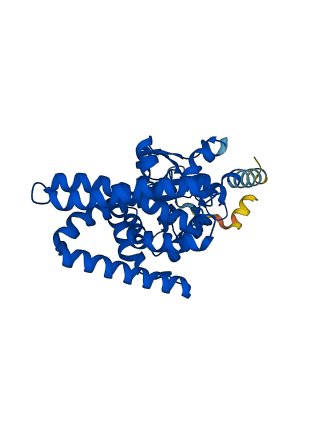
Descriptions
The autoinhibited protein was predicted that may have potential autoinhibitory elements via cis-regPred.
Autoinhibitory domains (AIDs)
Target domain |
|
Relief mechanism |
|
Assay |
cis-regPred |
Accessory elements
No accessory elements
Autoinhibited structure

Activated structure
1 structures for O34653
| Entry ID | Method | Resolution | Chain | Position | Source |
|---|---|---|---|---|---|
| AF-O34653-F1 | Predicted | AlphaFoldDB |
No variants for O34653
| Variant ID(s) | Position | Change | Description | Diseaes Association | Provenance |
|---|---|---|---|---|---|
| No variants for O34653 | |||||
No associated diseases with O34653
1 regional properties for O34653
| Type | Name | Position | InterPro Accession |
|---|---|---|---|
| domain | Fatty acid desaturase domain | 57 - 297 | IPR005804 |
2 GO annotations of cellular component
| Name | Definition |
|---|---|
| integral component of membrane | The component of a membrane consisting of the gene products and protein complexes having at least some part of their peptide sequence embedded in the hydrophobic region of the membrane. |
| plasma membrane | The membrane surrounding a cell that separates the cell from its external environment. It consists of a phospholipid bilayer and associated proteins. |
1 GO annotations of molecular function
| Name | Definition |
|---|---|
| oxidoreductase activity, acting on paired donors, with oxidation of a pair of donors resulting in the reduction of molecular oxygen to two molecules of water | Catalysis of an oxidation-reduction (redox) reaction in which hydrogen or electrons are transferred from each of two donors, and molecular oxygen is reduced to two molecules of water. |
2 GO annotations of biological process
| Name | Definition |
|---|---|
| fatty acid biosynthetic process | The chemical reactions and pathways resulting in the formation of a fatty acid, any of the aliphatic monocarboxylic acids that can be liberated by hydrolysis from naturally occurring fats and oils. Fatty acids are predominantly straight-chain acids of 4 to 24 carbon atoms, which may be saturated or unsaturated; branched fatty acids and hydroxy fatty acids also occur, and very long chain acids of over 30 carbons are found in waxes. |
| lipid metabolic process | The chemical reactions and pathways involving lipids, compounds soluble in an organic solvent but not, or sparingly, in an aqueous solvent. Includes fatty acids; neutral fats, other fatty-acid esters, and soaps; long-chain (fatty) alcohols and waxes; sphingoids and other long-chain bases; glycolipids, phospholipids and sphingolipids; and carotenes, polyprenols, sterols, terpenes and other isoprenoids. |
No homologous proteins in AiPD
| UniProt AC | Gene Name | Protein Name | Species | Evidence Code |
|---|---|---|---|---|
| No homologous proteins | ||||
| 10 | 20 | 30 | 40 | 50 | 60 |
| MTEQTIAHKQ | KQLTKQVAAF | AQPETKNSLI | QLLNTFIPFF | GLWFLAYLSL | DVSYLLTLAL |
| 70 | 80 | 90 | 100 | 110 | 120 |
| TVIAAGFLTR | IFIIFHDCCH | QSFFKQKRYN | HILGFLTGVL | TLFPYLQWQH | SHSIHHATSS |
| 130 | 140 | 150 | 160 | 170 | 180 |
| NLDKRGTGDI | WMLTVNEYKA | ASRRTKLAYR | LYRNPFIMFI | LGPIYVFLIT | NRFNKKGARR |
| 190 | 200 | 210 | 220 | 230 | 240 |
| KERVNTYLTN | LAIVALAAAC | CLIFGWQSFL | LVQGPIFLIS | GSIGVWLFYV | QHTFEDSYFE |
| 250 | 260 | 270 | 280 | 290 | 300 |
| ADENWSYVQA | AVEGSSFYKL | PKLLQWLTGN | IGYHHVHHLS | PKVPNYKLEV | AHEHHEPLKN |
| 310 | 320 | 330 | 340 | 350 | |
| VPTITLKTSL | QSLAFRLWDE | DNKQFVSFRA | IKHIPVSLPP | DSPEKQKLRK | NA |