O34507
Gene name |
prkC (yloP, BSU15770) |
Protein name |
Serine/threonine-protein kinase PrkC |
Names |
Ser/Thr-protein kinase PrkC |
Species |
Bacillus subtilis (strain 168) |
KEGG Pathway |
bsu:BSU15770 |
EC number |
2.7.11.1: Protein-serine/threonine kinases |
Protein Class |
|
Descriptions
The autoinhibited protein was predicted that may have potential autoinhibitory elements via cis-regPred.
Autoinhibitory domains (AIDs)
Target domain |
|
Relief mechanism |
|
Assay |
cis-regPred |
Accessory elements
No accessory elements
Autoinhibited structure

Activated structure
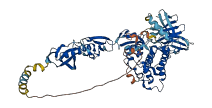
1 structures for O34507
| Entry ID | Method | Resolution | Chain | Position | Source |
|---|---|---|---|---|---|
| AF-O34507-F1 | Predicted | AlphaFoldDB |
No variants for O34507
| Variant ID(s) | Position | Change | Description | Diseaes Association | Provenance |
|---|---|---|---|---|---|
| No variants for O34507 | |||||
No associated diseases with O34507
6 regional properties for O34507
| Type | Name | Position | InterPro Accession |
|---|---|---|---|
| domain | Protein kinase domain | 11 - 271 | IPR000719 |
| domain | PASTA domain | 356 - 424 | IPR005543-1 |
| domain | PASTA domain | 425 - 492 | IPR005543-2 |
| domain | PASTA domain | 493 - 559 | IPR005543-3 |
| active_site | Serine/threonine-protein kinase, active site | 130 - 142 | IPR008271 |
| binding_site | Protein kinase, ATP binding site | 17 - 40 | IPR017441 |
Functions
| Description | ||
|---|---|---|
| EC Number | 2.7.11.1 | Protein-serine/threonine kinases |
| Subcellular Localization |
|
|
| PANTHER Family | ||
| PANTHER Subfamily | ||
| PANTHER Protein Class | ||
| PANTHER Pathway Category | No pathway information available | |
3 GO annotations of cellular component
| Name | Definition |
|---|---|
| cytosol | The part of the cytoplasm that does not contain organelles but which does contain other particulate matter, such as protein complexes. |
| integral component of membrane | The component of a membrane consisting of the gene products and protein complexes having at least some part of their peptide sequence embedded in the hydrophobic region of the membrane. |
| plasma membrane | The membrane surrounding a cell that separates the cell from its external environment. It consists of a phospholipid bilayer and associated proteins. |
4 GO annotations of molecular function
| Name | Definition |
|---|---|
| ATP binding | Binding to ATP, adenosine 5'-triphosphate, a universally important coenzyme and enzyme regulator. |
| peptidoglycan binding | Interacting selectively and non-covalently, in a non-covalent manner, with peptidoglycan, any of a class of glycoconjugates found in bacterial cell walls. |
| protein serine kinase activity | Catalysis of the reactions: ATP + protein serine = ADP + protein serine phosphate. |
| protein serine/threonine kinase activity | Catalysis of the reactions: ATP + protein serine = ADP + protein serine phosphate, and ATP + protein threonine = ADP + protein threonine phosphate. |
5 GO annotations of biological process
| Name | Definition |
|---|---|
| cellular response to peptidoglycan | Any process that results in a change in state or activity of a cell (in terms of movement, secretion, enzyme production, gene expression, etc.) as a result of a peptidoglycan stimulus. Peptidoglycan is a bacterial cell wall macromolecule. |
| peptidyl-serine phosphorylation | The phosphorylation of peptidyl-serine to form peptidyl-O-phospho-L-serine. |
| protein phosphorylation | The process of introducing a phosphate group on to a protein. |
| signal transduction | The cellular process in which a signal is conveyed to trigger a change in the activity or state of a cell. Signal transduction begins with reception of a signal (e.g. a ligand binding to a receptor or receptor activation by a stimulus such as light), or for signal transduction in the absence of ligand, signal-withdrawal or the activity of a constitutively active receptor. Signal transduction ends with regulation of a downstream cellular process, e.g. regulation of transcription or regulation of a metabolic process. Signal transduction covers signaling from receptors located on the surface of the cell and signaling via molecules located within the cell. For signaling between cells, signal transduction is restricted to events at and within the receiving cell. |
| spore germination | The physiological and developmental changes that occur in a spore following release from dormancy up to the earliest signs of growth (e.g. emergence from a spore wall). |
No homologous proteins in AiPD
| UniProt AC | Gene Name | Protein Name | Species | Evidence Code |
|---|---|---|---|---|
| No homologous proteins | ||||
| 10 | 20 | 30 | 40 | 50 | 60 |
| MLIGKRISGR | YQILRVIGGG | GMANVYLAED | IILDREVAIK | ILRFDYANDN | EFIRRFRREA |
| 70 | 80 | 90 | 100 | 110 | 120 |
| QSASSLDHPN | IVSIYDLGEE | DDIYYIVMEY | VEGMTLKEYI | TANGPLHPKE | ALNIMEQIVS |
| 130 | 140 | 150 | 160 | 170 | 180 |
| AIAHAHQNQI | VHRDIKPHNI | LIDHMGNIKV | TDFGIATALS | STTITHTNSV | LGSVHYLSPE |
| 190 | 200 | 210 | 220 | 230 | 240 |
| QARGGLATKK | SDIYALGIVL | FELLTGRIPF | DGESAVSIAL | KHLQAETPSA | KRWNPSVPQS |
| 250 | 260 | 270 | 280 | 290 | 300 |
| VENIILKATA | KDPFHRYETA | EDMEADIKTA | FDADRLNEKR | FTIQEDEEMT | KAIPIIKDEE |
| 310 | 320 | 330 | 340 | 350 | 360 |
| LAKAAGEKEA | EVTTAQENKT | KKNGKRKKWP | WVLLTICLVF | ITAGILAVTV | FPSLFMPKDV |
| 370 | 380 | 390 | 400 | 410 | 420 |
| KIPDVSGMEY | EKAAGLLEKE | GLQVDSEVLE | ISDEKIEEGL | MVKTDPKADT | TVKEGATVTL |
| 430 | 440 | 450 | 460 | 470 | 480 |
| YKSTGKAKTE | IGDVTGQTVD | QAKKALKDQG | FNHVTVNEVN | DEKNAGTVID | QNPSAGTELV |
| 490 | 500 | 510 | 520 | 530 | 540 |
| PSEDQVKLTV | SIGPEDITLR | DLKTYSKEAA | SGYLEDNGLK | LVEKEAYSDD | VPEGQVVKQK |
| 550 | 560 | 570 | 580 | 590 | 600 |
| PAAGTAVKPG | NEVEVTFSLG | PEKKPAKTVK | EKVKIPYEPE | NEGDELQVQI | AVDDADHSIS |
| 610 | 620 | 630 | 640 | ||
| DTYEEFKIKE | PTERTIELKI | EPGQKGYYQV | MVNNKVVSYK | TIEYPKDE |