Descriptions
The autoinhibited protein was predicted that may have potential autoinhibitory elements via cis-regPred.
Autoinhibitory domains (AIDs)
Target domain |
|
Relief mechanism |
|
Assay |
cis-regPred |
Accessory elements
No accessory elements
Autoinhibited structure

Activated structure
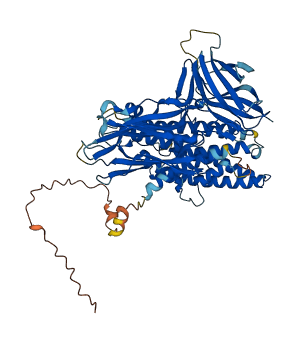
1 structures for O32307
| Entry ID | Method | Resolution | Chain | Position | Source |
|---|---|---|---|---|---|
| AF-O32307-F1 | Predicted | AlphaFoldDB |
No variants for O32307
| Variant ID(s) | Position | Change | Description | Diseaes Association | Provenance |
|---|---|---|---|---|---|
| No variants for O32307 | |||||
No associated diseases with O32307
1 regional properties for O32307
| Type | Name | Position | InterPro Accession |
|---|---|---|---|
| conserved_site | UbiA prenyltransferase conserved site | 62 - 84 | IPR030470 |
No GO annotations of cellular component
| Name | Definition |
|---|---|
| No GO annotations for cellular component |
2 GO annotations of molecular function
| Name | Definition |
|---|---|
| signaling receptor binding | Binding to one or more specific sites on a receptor molecule, a macromolecule that undergoes combination with a hormone, neurotransmitter, drug or intracellular messenger to initiate a change in cell function. |
| toxin activity | Interacting selectively with one or more biological molecules in another (target) organism, initiating pathogenesis (leading to an abnormal, generally detrimental state) in the target organism. The activity should refer to an evolved function of the active gene product, i.e. one that was selected for. Examples include the activity of botulinum toxin, and snake venom. |
2 GO annotations of biological process
| Name | Definition |
|---|---|
| cytolysis by symbiont of host cells | The killing by an organism of a cell in its host organism by means of the rupture of cell membranes and the loss of cytoplasm. The host is defined as the larger of the organisms involved in a symbiotic interaction. |
| sporulation resulting in formation of a cellular spore | The process in which a relatively unspecialized cell acquires the specialized features of a cellular spore, a cell form that can be used for dissemination, for survival of adverse conditions because of its heat and dessication resistance, and/or for reproduction. |
No homologous proteins in AiPD
| UniProt AC | Gene Name | Protein Name | Species | Evidence Code |
|---|---|---|---|---|
| No homologous proteins | ||||
| 10 | 20 | 30 | 40 | 50 | 60 |
| MHYYGNRNEY | DILNASSNDS | NMSNTYPRYP | LANPQQDLMQ | NTNYKDWLNV | CEGYHIENPR |
| 70 | 80 | 90 | 100 | 110 | 120 |
| EASVRAGLGK | GLGIVSTIVG | FFGGSIILDT | IGLFYQISEL | LWPEDDTQQY | TWQDIMNHVE |
| 130 | 140 | 150 | 160 | 170 | 180 |
| DLIDKRITEV | IRGNAIRTLA | DLQGKVDDYN | NWLKKWKDDP | KSTGNLSTLV | TKFTALDSDF |
| 190 | 200 | 210 | 220 | 230 | 240 |
| NGAIRTVNNQ | GSPGYELLLL | PVYAQIANLH | LLLLRDAQIY | GDKWWSARAN | ARDNYYQIQL |
| 250 | 260 | 270 | 280 | 290 | 300 |
| EKTKEYTEYC | INWYNKGLND | FRTAGQWVNF | NRYRREMTLT | VLDIISMFPI | YDARLYPTEV |
| 310 | 320 | 330 | 340 | 350 | 360 |
| KTELTREIYS | DVINGEIYGL | MTPYFSFEKA | ESLYTRAPHL | FTWLKGFRFV | TNSISYWTFL |
| 370 | 380 | 390 | 400 | 410 | 420 |
| SGGQNKYSYT | NNSSINEGSF | RGQDTDYGGT | SSTINIPSNS | YVYNLWTENY | EYIYPWGDPV |
| 430 | 440 | 450 | 460 | 470 | 480 |
| NITKMNFSVT | DNNSSKELIY | GAHRTNKPVV | RTDFDFLTNK | EGTELAKYND | YNHILSYMLI |
| 490 | 500 | 510 | 520 | 530 | 540 |
| NGETFGQKRH | GYSFAFTHSS | VDPNNTIAAN | KITQIPVVKA | SSINGSISIE | KGPGFTGGDL |
| 550 | 560 | 570 | 580 | 590 | 600 |
| VKMRADSGLT | MRFKAELLDK | KYRVRIRYKC | NYSSKLILRK | WKGEGYIQQQ | IHNISPTYGA |
| 610 | 620 | 630 | 640 | ||
| FSYLESFTIT | TTENIFDLTM | EVTYPYGRQF | VEDIPSLILD | KIEFLPTN |