O32130
Gene name |
lytH (yunA, yutA, BSU32340) |
Protein name |
L-Ala--D-Glu endopeptidase |
Names |
Peptidoglycan hydrolase, Sporulation-specific endopeptidase |
Species |
Bacillus subtilis (strain 168) |
KEGG Pathway |
bsu:BSU32340 |
EC number |
|
Protein Class |
|
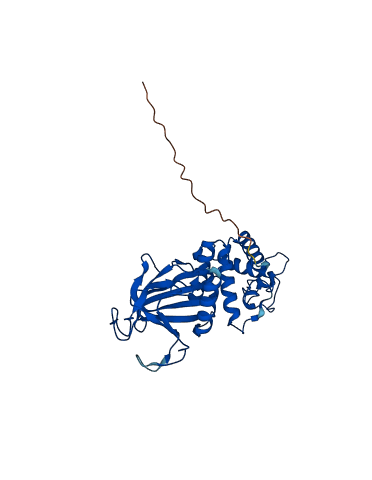
Descriptions
The autoinhibited protein was predicted that may have potential autoinhibitory elements via cis-regPred.
Autoinhibitory domains (AIDs)
Target domain |
|
Relief mechanism |
|
Assay |
cis-regPred |
Accessory elements
No accessory elements
Autoinhibited structure

Activated structure
1 structures for O32130
| Entry ID | Method | Resolution | Chain | Position | Source |
|---|---|---|---|---|---|
| AF-O32130-F1 | Predicted | AlphaFoldDB |
No variants for O32130
| Variant ID(s) | Position | Change | Description | Diseaes Association | Provenance |
|---|---|---|---|---|---|
| No variants for O32130 | |||||
No associated diseases with O32130
1 regional properties for O32130
| Type | Name | Position | InterPro Accession |
|---|---|---|---|
| domain | Peptidase M23 | 203 - 301 | IPR016047 |
No GO annotations of cellular component
| Name | Definition |
|---|---|
| No GO annotations for cellular component |
2 GO annotations of molecular function
| Name | Definition |
|---|---|
| metal ion binding | Binding to a metal ion. |
| metalloendopeptidase activity | Catalysis of the hydrolysis of internal, alpha-peptide bonds in a polypeptide chain by a mechanism in which water acts as a nucleophile, one or two metal ions hold the water molecule in place, and charged amino acid side chains are ligands for the metal ions. |
4 GO annotations of biological process
| Name | Definition |
|---|---|
| cell cycle | The progression of biochemical and morphological phases and events that occur in a cell during successive cell replication or nuclear replication events. Canonically, the cell cycle comprises the replication and segregation of genetic material followed by the division of the cell, but in endocycles or syncytial cells nuclear replication or nuclear division may not be followed by cell division. |
| cell wall organization | A process that results in the assembly, arrangement of constituent parts, or disassembly of the cell wall, the rigid or semi-rigid envelope lying outside the cell membrane of plant, fungal and most prokaryotic cells, maintaining their shape and protecting them from osmotic lysis. |
| proteolysis | The hydrolysis of proteins into smaller polypeptides and/or amino acids by cleavage of their peptide bonds. |
| sporulation resulting in formation of a cellular spore | The process in which a relatively unspecialized cell acquires the specialized features of a cellular spore, a cell form that can be used for dissemination, for survival of adverse conditions because of its heat and dessication resistance, and/or for reproduction. |
No homologous proteins in AiPD
| UniProt AC | Gene Name | Protein Name | Species | Evidence Code |
|---|---|---|---|---|
| No homologous proteins | ||||
| 10 | 20 | 30 | 40 | 50 | 60 |
| MKVLLSALLL | LLFAFEPSAS | GKKLSDPVLS | KRMELYHKIE | AVTQIPWYAL | AAVDQYEENV |
| 70 | 80 | 90 | 100 | 110 | 120 |
| RSNRKDLPEK | AGIISIYIPD | DIWSGPENPN | PKDDAPLSIK | VFDGIGMDGD | GDGKAEVSND |
| 130 | 140 | 150 | 160 | 170 | 180 |
| EDILYTFSQY | LLSYGTDEDN | IRIGLWNYYR | RDQTVGIISE | FMKLFKAYGH | IDLGEHAFPL |
| 190 | 200 | 210 | 220 | 230 | 240 |
| PIRTDYSYRS | TWGDARGFGG | RRIHEGTDIF | AHYGLPVKST | CYGVVEMKGW | NRFGGWRIGI |
| 250 | 260 | 270 | 280 | 290 | 300 |
| RDINNTYHYF | AHLNGFAKGI | KTGQIVEPGQ | VIGSVGSSGY | GPPGTAGKFP | PHLHYGMYKD |
| 310 | 320 | ||||
| NGRTEWSFDP | YPHLRAWERY | EYQKKK |