O26978
Gene name |
MTH_892 |
Protein name |
Putative lon protease homolog |
Names |
ATP-dependent protease La homolog |
Species |
Methanothermobacter thermautotrophicus (strain ATCC 29096 / DSM 1053 / JCM 10044 / NBRC 100330 / Delta H) (Methanobacterium thermoautotrophicum) |
KEGG Pathway |
mth:MTH_892 |
EC number |
|
Protein Class |
|
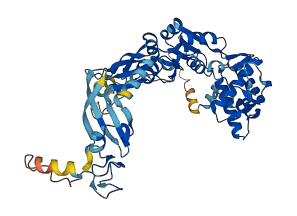
Descriptions
The autoinhibited protein was predicted that may have potential autoinhibitory elements via cis-regPred.
Autoinhibitory domains (AIDs)
Target domain |
|
Relief mechanism |
|
Assay |
cis-regPred |
Accessory elements
No accessory elements
Autoinhibited structure

Activated structure
1 structures for O26978
| Entry ID | Method | Resolution | Chain | Position | Source |
|---|---|---|---|---|---|
| AF-O26978-F1 | Predicted | AlphaFoldDB |
No variants for O26978
| Variant ID(s) | Position | Change | Description | Diseaes Association | Provenance |
|---|---|---|---|---|---|
| No variants for O26978 | |||||
No associated diseases with O26978
6 regional properties for O26978
| Type | Name | Position | InterPro Accession |
|---|---|---|---|
| domain | Helicase, C-terminal | 269 - 424 | IPR001650 |
| domain | AAA+ ATPase domain | 46 - 331 | IPR003593 |
| domain | DEAD/DEAH box helicase domain | 34 - 216 | IPR011545 |
| domain | DEAD/H associated | 641 - 828 | IPR013701 |
| domain | Helicase superfamily 1/2, ATP-binding domain | 29 - 250 | IPR014001 |
| domain | Helicase Lhr-like, winged helix domain | 421 - 565 | IPR045628 |
No GO annotations of cellular component
| Name | Definition |
|---|---|
| No GO annotations for cellular component |
3 GO annotations of molecular function
| Name | Definition |
|---|---|
| ATP binding | Binding to ATP, adenosine 5'-triphosphate, a universally important coenzyme and enzyme regulator. |
| ATP-dependent peptidase activity | Catalysis of the hydrolysis of peptide bonds, driven by ATP hydrolysis. |
| serine-type endopeptidase activity | Catalysis of the hydrolysis of internal, alpha-peptide bonds in a polypeptide chain by a catalytic mechanism that involves a catalytic triad consisting of a serine nucleophile that is activated by a proton relay involving an acidic residue (e.g. aspartate or glutamate) and a basic residue (usually histidine). |
2 GO annotations of biological process
| Name | Definition |
|---|---|
| protein catabolic process | The chemical reactions and pathways resulting in the breakdown of a protein by the destruction of the native, active configuration, with or without the hydrolysis of peptide bonds. |
| proteolysis | The hydrolysis of proteins into smaller polypeptides and/or amino acids by cleavage of their peptide bonds. |
No homologous proteins in AiPD
| UniProt AC | Gene Name | Protein Name | Species | Evidence Code |
|---|---|---|---|---|
| No homologous proteins | ||||
| 10 | 20 | 30 | 40 | 50 | 60 |
| MYVDMNREYL | KDINTTEDVK | IPEDPLERVI | GHEDVMPMIK | IAAKQRRHLL | LVGPPGIGKS |
| 70 | 80 | 90 | 100 | 110 | 120 |
| LLAQAISFHL | PEPSEEITVV | HNPERPERPF | VEIKNRKEIE | DEILEIERAE | GELIDPQSAP |
| 130 | 140 | 150 | 160 | 170 | 180 |
| DAVAERLGFK | CIHCGEYSSA | YNSICPRCGG | DKFSHIKARR | KHIGDLLGMF | EMSSGSLSVP |
| 190 | 200 | 210 | 220 | 230 | 240 |
| QKRVTTTRII | DGVEEVVIYE | RVGGEEIKVL | DQRALEKRRQ | IVEEKPRNVI | VPLDRKTFVQ |
| 250 | 260 | 270 | 280 | 290 | 300 |
| ATGASETELL | GDVRHDPYGG | HPDLGSQPYE | RVVPGAIHEA | HEGVLFIDEI | VHIAGLQRFI |
| 310 | 320 | 330 | 340 | 350 | 360 |
| FSAMQDKTFP | IVGRNPQSAG | SSVKVDEVPC | DFIFVGACNI | ADLQYILPPL | RSRIQGEGYE |
| 370 | 380 | 390 | 400 | 410 | 420 |
| LLLNTTMPDT | DENRAKIAQF | VAQEIELDGK | IPHARAAAVE | LLIEEARRRA | RAVDDVDNAL |
| 430 | 440 | 450 | 460 | 470 | 480 |
| TLRLRDLGGV | VRMAGDLAVM | DGSPYIETRH | MEVAIRKAVS | VEDQIIRRYK | SYEKALEKDL |
| 490 | 500 | ||||
| SSSQRMSQHG | YSSENIDRSY | M |