O25149
Gene name |
priA |
Protein name |
Primosomal protein N' |
Names |
ATP-dependent helicase PriA |
Species |
Helicobacter pylori (strain ATCC 700392 / 26695) (Campylobacter pylori) |
KEGG Pathway |
hpy:HP_0387 |
EC number |
|
Protein Class |
|
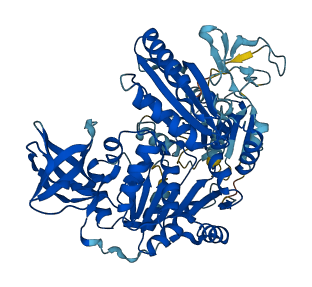
Descriptions
The autoinhibited protein was predicted that may have potential autoinhibitory elements via cis-regPred.
Autoinhibitory domains (AIDs)
Target domain |
|
Relief mechanism |
|
Assay |
cis-regPred |
Accessory elements
No accessory elements
Autoinhibited structure

Activated structure
1 structures for O25149
| Entry ID | Method | Resolution | Chain | Position | Source |
|---|---|---|---|---|---|
| AF-O25149-F1 | Predicted | AlphaFoldDB |
No variants for O25149
| Variant ID(s) | Position | Change | Description | Diseaes Association | Provenance |
|---|---|---|---|---|---|
| No variants for O25149 | |||||
No associated diseases with O25149
6 regional properties for O25149
| Type | Name | Position | InterPro Accession |
|---|---|---|---|
| domain | Helicase, C-terminal | 371 - 532 | IPR001650 |
| domain | DEAD/DEAH box helicase domain | 114 - 274 | IPR011545 |
| domain | Helicase superfamily 1/2, ATP-binding domain | 107 - 297 | IPR014001 |
| domain | PriA DNA helicase, Cys-rich region (CRR) domain | 345 - 371 | IPR040498 |
| domain | Primosomal protein N', 3' DNA-binding domain | 15 - 92 | IPR041222 |
| domain | Primosomal protein N, C-terminal domain | 527 - 615 | IPR041236 |
1 GO annotations of cellular component
| Name | Definition |
|---|---|
| primosome complex | Any of a family of protein complexes that form at the origin of replication or stalled replication forks and function in replication primer synthesis in all organisms. Early complexes initiate double-stranded DNA unwinding. The core unit consists of a replicative helicase and a primase. The helicase further unwinds the DNA and recruits the polymerase machinery. The primase synthesizes RNA primers that act as templates for complementary stand replication by the polymerase machinery. The primosome contains a number of associated proteins and protein complexes and contributes to the processes of replication initiation, lagging strand elongation, and replication restart. |
5 GO annotations of molecular function
| Name | Definition |
|---|---|
| 3'-5' DNA helicase activity | Unwinding a DNA helix in the direction 5' to 3', driven by ATP hydrolysis. |
| ATP binding | Binding to ATP, adenosine 5'-triphosphate, a universally important coenzyme and enzyme regulator. |
| DNA binding | Any molecular function by which a gene product interacts selectively and non-covalently with DNA (deoxyribonucleic acid). |
| hydrolase activity | Catalysis of the hydrolysis of various bonds, e.g. C-O, C-N, C-C, phosphoric anhydride bonds, etc. |
| zinc ion binding | Binding to a zinc ion (Zn). |
5 GO annotations of biological process
| Name | Definition |
|---|---|
| DNA recombination | Any process in which a new genotype is formed by reassortment of genes resulting in gene combinations different from those that were present in the parents. In eukaryotes genetic recombination can occur by chromosome assortment, intrachromosomal recombination, or nonreciprocal interchromosomal recombination. Interchromosomal recombination occurs by crossing over. In bacteria it may occur by genetic transformation, conjugation, transduction, or F-duction. |
| DNA replication initiation | The process in which DNA-dependent DNA replication is started; this begins with the ATP dependent loading of an initiator complex onto the DNA, this is followed by DNA melting and helicase activity. In bacteria, the gene products that enable the helicase activity are loaded after the initial melting and in archaea and eukaryotes, the gene products that enable the helicase activity are inactive when they are loaded and subsequently activate. |
| DNA replication, synthesis of RNA primer | The synthesis of a short RNA polymer, usually 4-15 nucleotides long, using one strand of unwound DNA as a template; the RNA then serves as a primer from which DNA polymerases extend synthesis. |
| DNA unwinding involved in DNA replication | The process in which interchain hydrogen bonds between two strands of DNA are broken or 'melted', generating unpaired template strands for DNA replication. |
| double-strand break repair | The repair of double-strand breaks in DNA via homologous and nonhomologous mechanisms to reform a continuous DNA helix. |
No homologous proteins in AiPD
| UniProt AC | Gene Name | Protein Name | Species | Evidence Code |
|---|---|---|---|---|
| No homologous proteins | ||||
| 10 | 20 | 30 | 40 | 50 | 60 |
| MFYHLIAPLK | NKTPPLTYFS | KEQHQKGALV | NIPLRNKTLL | GVVLEEVSKP | SFECLELEKT |
| 70 | 80 | 90 | 100 | 110 | 120 |
| PYFLLPFQME | LAIFIAQYYS | ANLSSVLSLF | APFKECDLVG | LEKIEPILNI | LSQTQTNALK |
| 130 | 140 | 150 | 160 | 170 | 180 |
| ELQKHSASLL | FGDTGSGKTE | IYMHAIAQTL | EQKKSALLLV | PEIALTPQMQ | QRLKRVFKEN |
| 190 | 200 | 210 | 220 | 230 | 240 |
| LGLWHSKLSQ | NQKKQFLEKL | YSQEIKLVVG | TRSALFLPLK | ELGLIIVDEE | HDFSYKSHQS |
| 250 | 260 | 270 | 280 | 290 | 300 |
| PMYNARDLCL | YLSHKFPIQV | ILGSATPSLN | SYKRFKDKAL | VRLKGRYTPT | QKNIIFEKTE |
| 310 | 320 | 330 | 340 | 350 | 360 |
| RFITPKLLEA | LQQVLDKNEQ | AIIFVPTRAN | FKTLLCQSCY | KSVQCPFCSV | NMSLHLKTNK |
| 370 | 380 | 390 | 400 | 410 | 420 |
| LMCHYCHFSS | PIPKICSACQ | SEVLVGKRIG | TMQVLKELES | LLEGAKIAIL | DKDHTSTQKK |
| 430 | 440 | 450 | 460 | 470 | 480 |
| LHNILNDFNA | QKTNILIGTQ | MISKGHDYAK | VSLAVVLGID | NIIKSNSYRA | LEEGVSLLYQ |
| 490 | 500 | 510 | 520 | 530 | 540 |
| IAGRSARQIS | GQVFIQSTET | DLLENFLEDY | EDFLQYELQE | RCELYPPFSR | LCLLEFKHKN |
| 550 | 560 | 570 | 580 | 590 | 600 |
| EEKAQQLSLK | ASQTLSSCLE | KGVTLSNFKA | PIEKIASSYR | YLILLRSKNP | LSLIKSVHAF |
| 610 | |||||
| LKSAPSIPCS | VNMDPVDIF |