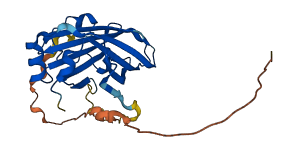
Descriptions
The autoinhibited protein was predicted that may have potential autoinhibitory elements via cis-regPred.
Autoinhibitory domains (AIDs)
Target domain |
|
Relief mechanism |
|
Assay |
cis-regPred |
Accessory elements
No accessory elements
Autoinhibited structure

Activated structure
1 structures for O19177
| Entry ID | Method | Resolution | Chain | Position | Source |
|---|---|---|---|---|---|
| AF-O19177-F1 | Predicted | AlphaFoldDB |
No variants for O19177
| Variant ID(s) | Position | Change | Description | Diseaes Association | Provenance |
|---|---|---|---|---|---|
| No variants for O19177 | |||||
No associated diseases with O19177
1 regional properties for O19177
| Type | Name | Position | InterPro Accession |
|---|---|---|---|
| domain | GMP phosphodiesterase, delta subunit | 80 - 236 | IPR008015 |
Functions
5 GO annotations of cellular component
| Name | Definition |
|---|---|
| centrosome | A structure comprised of a core structure (in most organisms, a pair of centrioles) and peripheral material from which a microtubule-based structure, such as a spindle apparatus, is organized. Centrosomes occur close to the nucleus during interphase in many eukaryotic cells, though in animal cells it changes continually during the cell-division cycle. |
| cytoplasm | The contents of a cell excluding the plasma membrane and nucleus, but including other subcellular structures. |
| intercellular bridge | A direct connection between the cytoplasm of two cells that is formed following the completion of cleavage furrow ingression during cell division. They are usually present only briefly prior to completion of cytokinesis. However, in some cases, such as the bridges between germ cells during their development, they become stabilised. |
| spindle midzone | The area in the center of the spindle where the spindle microtubules from opposite poles overlap. |
| spindle pole | Either of the ends of a spindle, where spindle microtubules are organized; usually contains a microtubule organizing center and accessory molecules, spindle microtubules and astral microtubules. |
1 GO annotations of molecular function
| Name | Definition |
|---|---|
| lipid binding | Binding to a lipid. |
9 GO annotations of biological process
| Name | Definition |
|---|---|
| endocytosis | A vesicle-mediated transport process in which cells take up external materials or membrane constituents by the invagination of a small region of the plasma membrane to form a new membrane-bounded vesicle. |
| lipoprotein transport | The directed movement of any conjugated, water-soluble protein in which the nonprotein group consists of a lipid or lipids, into, out of or within a cell, or between cells, by means of some agent such as a transporter or pore. |
| mitotic cytokinesis | A cell cycle process that results in the division of the cytoplasm of a cell after mitosis, resulting in the separation of the original cell into two daughter cells. |
| negative regulation of caveolin-mediated endocytosis | Any process that stops, prevents or reduces the frequency, rate or extent of caveolin-mediated endocytosis. |
| negative regulation of clathrin-dependent endocytosis | Any process that stops, prevents or reduces the frequency, rate or extent of clathrin-mediated endocytosis. |
| nervous system development | The process whose specific outcome is the progression of nervous tissue over time, from its formation to its mature state. |
| positive regulation of protein tyrosine kinase activity | Any process that increases the rate, frequency, or extent of protein tyrosine kinase activity. |
| response to stimulus | Any process that results in a change in state or activity of a cell or an organism (in terms of movement, secretion, enzyme production, gene expression, etc.) as a result of a stimulus. The process begins with detection of the stimulus and ends with a change in state or activity or the cell or organism. |
| visual perception | The series of events required for an organism to receive a visual stimulus, convert it to a molecular signal, and recognize and characterize the signal. Visual stimuli are detected in the form of photons and are processed to form an image. |
4 homologous proteins in AiPD
| UniProt AC | Gene Name | Protein Name | Species | Evidence Code |
|---|---|---|---|---|
| Q3SYR2 | UNC119 | Protein unc-119 homolog A | Bos taurus (Bovine) | PR |
| Q13432 | UNC119 | Protein unc-119 homolog A | Homo sapiens (Human) | PR |
| Q9Z2R6 | Unc119 | Protein unc-119 homolog A | Mus musculus (Mouse) | PR |
| Q62885 | Unc119 | Protein unc-119 homolog A | Rattus norvegicus (Rat) | PR |
| 10 | 20 | 30 | 40 | 50 | 60 |
| MKVKKGGGGA | GTGAEPASGA | PGPSVEPKPE | PQAESESGSE | SEPEAGPGPR | PGPLQRKQRI |
| 70 | 80 | 90 | 100 | 110 | 120 |
| GPEDVLGLQR | ITGDYLCSPE | ENIYKIDFIR | FKIRDMDSGT | VLFEIKKPPA | SERLPINRRD |
| 130 | 140 | 150 | 160 | 170 | 180 |
| LDPNAGRFVR | YQFTPAFLRL | RQVGATVEFT | VGDKPVNNFR | MIERHYFRNQ | LLKSFDFHFG |
| 190 | 200 | 210 | 220 | 230 | |
| FCIPSSKNTC | EHIYDFPPLS | EELINEMIRH | PYETQSDSFY | FVDDRLVMHN | KADYSYSGTP |