O19104
Gene name |
FANCC (FACC) |
Protein name |
Fanconi anemia group C protein homolog |
Names |
Protein FACC |
Species |
Bos taurus (Bovine) |
KEGG Pathway |
bta:281762 |
EC number |
|
Protein Class |
|
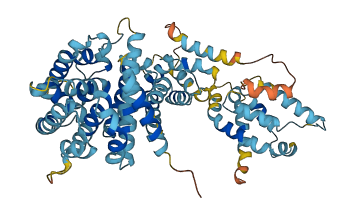
Descriptions
The autoinhibited protein was predicted that may have potential autoinhibitory elements via cis-regPred.
Autoinhibitory domains (AIDs)
Target domain |
|
Relief mechanism |
|
Assay |
cis-regPred |
Accessory elements
No accessory elements
Autoinhibited structure

Activated structure
1 structures for O19104
| Entry ID | Method | Resolution | Chain | Position | Source |
|---|---|---|---|---|---|
| AF-O19104-F1 | Predicted | AlphaFoldDB |
No variants for O19104
| Variant ID(s) | Position | Change | Description | Diseaes Association | Provenance |
|---|---|---|---|---|---|
| No variants for O19104 | |||||
No associated diseases with O19104
No regional properties for O19104
| Type | Name | Position | InterPro Accession |
|---|---|---|---|
| No domain, repeats, and functional sites for O19104 | |||
2 GO annotations of cellular component
| Name | Definition |
|---|---|
| cytoplasm | The contents of a cell excluding the plasma membrane and nucleus, but including other subcellular structures. |
| Fanconi anaemia nuclear complex | A protein complex composed of the Fanconi anaemia (FA) proteins including A, C, E, G and F (FANCA-F). Functions in the activation of the downstream protein FANCD2 by monoubiquitylation, and is essential for protection against chromosome breakage. |
No GO annotations of molecular function
| Name | Definition |
|---|---|
| No GO annotations for molecular function |
3 GO annotations of biological process
| Name | Definition |
|---|---|
| cellular response to oxidative stress | Any process that results in a change in state or activity of a cell (in terms of movement, secretion, enzyme production, gene expression, etc.) as a result of oxidative stress, a state often resulting from exposure to high levels of reactive oxygen species, e.g. superoxide anions, hydrogen peroxide (H2O2), and hydroxyl radicals. |
| interstrand cross-link repair | Removal of a DNA interstrand crosslink (a covalent attachment of DNA bases on opposite strands of the DNA) and restoration of the DNA. DNA interstrand crosslinks occur when both strands of duplex DNA are covalently tethered together (e.g. by an exogenous or endogenous agent), thus preventing the strand unwinding necessary for essential DNA functions such as transcription and replication. |
| nucleotide-excision repair | A DNA repair process in which a small region of the strand surrounding the damage is removed from the DNA helix as an oligonucleotide. The small gap left in the DNA helix is filled in by the sequential action of DNA polymerase and DNA ligase. Nucleotide excision repair recognizes a wide range of substrates, including damage caused by UV irradiation (pyrimidine dimers and 6-4 photoproducts) and chemicals (intrastrand cross-links and bulky adducts). |
No homologous proteins in AiPD
| UniProt AC | Gene Name | Protein Name | Species | Evidence Code |
|---|---|---|---|---|
| No homologous proteins | ||||
| 10 | 20 | 30 | 40 | 50 | 60 |
| MAEDSAGLPS | NYQFWMQKLS | VWTQASTLET | QRDICLHLPQ | FQEFLRRMYE | TLKEMDSNAI |
| 70 | 80 | 90 | 100 | 110 | 120 |
| IERFPTICQL | LAKSCWSPFI | LAYDESPKIL | IWCLCCLIKK | DPQNSRESKL | NSWTRRLLSH |
| 130 | 140 | 150 | 160 | 170 | 180 |
| IVSTSRFDIK | EVGLFNQVLG | YAPTDYYPGL | LKNMVLSLVS | ELRENHLNGF | SSQRRCPERV |
| 190 | 200 | 210 | 220 | 230 | 240 |
| RSLSRDRVPL | LTLPDFEPLV | EALLTYHGHE | PQEVLCPEFF | DAVNEASLLK | KISLPTSAIL |
| 250 | 260 | 270 | 280 | 290 | 300 |
| CLWLRHLPSL | ENTMLHLLEK | LISSERNSLR | RIKCFMKDSL | RPEAAACHPA | IFRVVDEIFR |
| 310 | 320 | 330 | 340 | 350 | 360 |
| SALLETDGAP | EVLAGLQVFT | RCFVEALEKE | NKQLKFALKT | YFPYASPALV | MVLLQHPKDI |
| 370 | 380 | 390 | 400 | 410 | 420 |
| PQGLWHQSLK | HISEMLKEIV | EDHGSYGGPF | ESWFLFVHFG | GWADITAEQL | LMSEAEAEPP |
| 430 | 440 | 450 | 460 | 470 | 480 |
| EALLWLLAFS | CSPGAGHQQR | ARTMVEVKTV | LGCLTKLFRS | PALSARDLQA | AAGENLGGDP |
| 490 | 500 | 510 | 520 | 530 | 540 |
| RPPACQQLVR | RLLLHFLLWA | PGGHTIAREV | ITLMAQTDAI | MNEIIGFLDY | TLYRWDHLCV |
| 550 | 560 | ||||
| EAHRSRKLAR | ELLTELREQA | LPGQVNQ |