Descriptions
The autoinhibited protein was predicted that may have potential autoinhibitory elements via cis-regPred.
Autoinhibitory domains (AIDs)
Target domain |
|
Relief mechanism |
|
Assay |
cis-regPred |
Accessory elements
No accessory elements
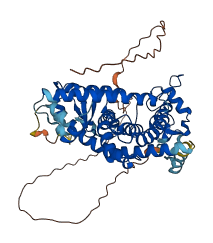
Autoinhibited structure

Activated structure
1 structures for O19052
| Entry ID | Method | Resolution | Chain | Position | Source |
|---|---|---|---|---|---|
| AF-O19052-F1 | Predicted | AlphaFoldDB |
No variants for O19052
| Variant ID(s) | Position | Change | Description | Diseaes Association | Provenance |
|---|---|---|---|---|---|
| No variants for O19052 | |||||
No associated diseases with O19052
3 regional properties for O19052
Functions
2 GO annotations of cellular component
| Name | Definition |
|---|---|
| cytoplasm | The contents of a cell excluding the plasma membrane and nucleus, but including other subcellular structures. |
| nucleus | A membrane-bounded organelle of eukaryotic cells in which chromosomes are housed and replicated. In most cells, the nucleus contains all of the cell's chromosomes except the organellar chromosomes, and is the site of RNA synthesis and processing. In some species, or in specialized cell types, RNA metabolism or DNA replication may be absent. |
6 GO annotations of molecular function
| Name | Definition |
|---|---|
| chromatin binding | Binding to chromatin, the network of fibers of DNA, protein, and sometimes RNA, that make up the chromosomes of the eukaryotic nucleus during interphase. |
| DNA-binding transcription factor activity | A transcription regulator activity that modulates transcription of gene sets via selective and non-covalent binding to a specific double-stranded genomic DNA sequence (sometimes referred to as a motif) within a cis-regulatory region. Regulatory regions include promoters (proximal and distal) and enhancers. Genes are transcriptional units, and include bacterial operons. |
| E-box binding | Binding to an E-box, a DNA motif with the consensus sequence CANNTG that is found in the promoters of a wide array of genes expressed in neurons, muscle and other tissues. |
| nuclear receptor activity | A DNA-binding transcription factor activity regulated by binding to a ligand that modulates the transcription of specific gene sets transcribed by RNA polymerase II. Nuclear receptor ligands are usually lipid-based (such as a steroid hormone) and the binding of the ligand to its receptor often occurs in the cytoplasm, which leads to its tranlocation to the nucleus. |
| transcription cis-regulatory region binding | Binding to a specific sequence of DNA that is part of a regulatory region that controls transcription of that section of the DNA. The transcribed region might be described as a gene, cistron, or operon. |
| zinc ion binding | Binding to a zinc ion (Zn). |
10 GO annotations of biological process
| Name | Definition |
|---|---|
| cellular response to insulin stimulus | Any process that results in a change in state or activity of a cell (in terms of movement, secretion, enzyme production, gene expression, etc.) as a result of an insulin stimulus. Insulin is a polypeptide hormone produced by the islets of Langerhans of the pancreas in mammals, and by the homologous organs of other organisms. |
| macrophage derived foam cell differentiation | The process in which a monocyte acquires the specialized features of a foam cell. A foam cell is a type of cell containing lipids in small vacuoles and typically seen in atherosclerotic lesions, as well as other conditions. |
| positive regulation of DNA-templated transcription | Any process that activates or increases the frequency, rate or extent of cellular DNA-templated transcription. |
| positive regulation of fat cell differentiation | Any process that activates or increases the frequency, rate or extent of adipocyte differentiation. |
| positive regulation of transcription by RNA polymerase II | Any process that activates or increases the frequency, rate or extent of transcription from an RNA polymerase II promoter. |
| regulation of circadian rhythm | Any process that modulates the frequency, rate or extent of a circadian rhythm. A circadian rhythm is a biological process in an organism that recurs with a regularity of approximately 24 hours. |
| regulation of DNA-templated transcription | Any process that modulates the frequency, rate or extent of cellular DNA-templated transcription. |
| regulation of transcription by RNA polymerase II | Any process that modulates the frequency, rate or extent of transcription mediated by RNA polymerase II. |
| retinoic acid receptor signaling pathway | The series of molecular signals generated as a consequence of a retinoic acid receptor binding to one of its physiological ligands. |
| rhythmic process | Any process pertinent to the generation and maintenance of rhythms in the physiology of an organism. |
No homologous proteins in AiPD
| UniProt AC | Gene Name | Protein Name | Species | Evidence Code |
|---|---|---|---|---|
| No homologous proteins | ||||
| 10 | 20 | 30 | 40 | 50 | 60 |
| MVDTEMPFWP | TNFGIGSVDL | SVMDDHSHSF | DIKPFTTVDF | SSISAPHYED | LPFARADPMV |
| 70 | 80 | 90 | 100 | 110 | 120 |
| ADYKYDLKLQ | EYQSAIKVEP | ASPPYYSEKT | QLYNKTHEEP | SNSLMAIECR | VCSDKASGFH |
| 130 | 140 | 150 | 160 | 170 | 180 |
| YGVHACEGCK | GFFRRTIRLK | LIYDRCDLNC | RIHKKSRNKC | QYCRFQKCLA | VGMSHNAIRF |
| 190 | 200 | 210 | 220 | 230 | 240 |
| GRMPQAEKEK | LLAEISSDID | QLNPESADLR | ALAKHLYDSY | IKSFPLTKAK | ARAILTGKTT |
| 250 | 260 | 270 | 280 | 290 | 300 |
| DKSPFVIYDM | NSLMMGEDKI | KFKHITPLQE | QSKEVAIRIF | QGCQFRSVEA | VQEITEYAKN |
| 310 | 320 | 330 | 340 | 350 | 360 |
| IPGFVSLDLN | DQVTLLKYGV | HEIIYTMLAS | LMNKDGVLIS | EGQGFMTREF | LKSLRKPFGD |
| 370 | 380 | 390 | 400 | 410 | 420 |
| FMEPKFEFAV | KFNALELDDS | DLAIFIAVII | LSGDRPGLLN | VKPIEDIQDN | LLQALELQLK |
| 430 | 440 | 450 | 460 | 470 | |
| LNHPEASQLF | AKLLQKMTDL | RQIVTEHVQL | LQVIKKTETD | MSLHPLLQEI | YKDLY |