Descriptions
The autoinhibited protein was predicted that may have potential autoinhibitory elements via cis-regPred.
Autoinhibitory domains (AIDs)
Target domain |
|
Relief mechanism |
|
Assay |
cis-regPred |
Accessory elements
No accessory elements
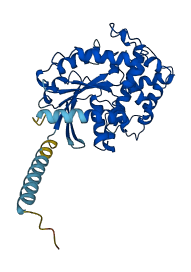
Autoinhibited structure

Activated structure
1 structures for O14438
| Entry ID | Method | Resolution | Chain | Position | Source |
|---|---|---|---|---|---|
| AF-O14438-F1 | Predicted | AlphaFoldDB |
No variants for O14438
| Variant ID(s) | Position | Change | Description | Diseaes Association | Provenance |
|---|---|---|---|---|---|
| No variants for O14438 | |||||
No associated diseases with O14438
No regional properties for O14438
| Type | Name | Position | InterPro Accession |
|---|---|---|---|
| No domain, repeats, and functional sites for O14438 | |||
1 GO annotations of cellular component
| Name | Definition |
|---|---|
| heterotrimeric G-protein complex | Any of a family of heterotrimeric GTP-binding and hydrolyzing proteins; they belong to a superfamily of GTPases that includes monomeric proteins such as EF-Tu and RAS. Heterotrimeric G-proteins consist of three subunits; the alpha subunit contains the guanine nucleotide binding site and possesses GTPase activity; the beta and gamma subunits are tightly associated and function as a beta-gamma heterodimer; extrinsic plasma membrane proteins (cytoplasmic face) that function as a complex to transduce signals from G protein-coupled receptors to an effector protein. |
5 GO annotations of molecular function
| Name | Definition |
|---|---|
| G protein-coupled receptor binding | Binding to a G protein-coupled receptor. |
| G-protein beta/gamma-subunit complex binding | Binding to a complex of G-protein beta/gamma subunits. |
| GTP binding | Binding to GTP, guanosine triphosphate. |
| GTPase activity | Catalysis of the reaction: GTP + H2O = GDP + H+ + phosphate. |
| metal ion binding | Binding to a metal ion. |
1 GO annotations of biological process
| Name | Definition |
|---|---|
| G protein-coupled receptor signaling pathway | The series of molecular signals initiated by a ligand binding to its receptor, in which the activated receptor promotes the exchange of GDP for GTP on the alpha-subunit of an associated heterotrimeric G-protein complex. The GTP-bound activated alpha-G-protein then dissociates from the beta- and gamma-subunits to further transmit the signal within the cell. The pathway begins with receptor-ligand interaction, and ends with regulation of a downstream cellular process. The pathway can start from the plasma membrane, Golgi or nuclear membrane. |
No homologous proteins in AiPD
| UniProt AC | Gene Name | Protein Name | Species | Evidence Code |
|---|---|---|---|---|
| No homologous proteins | ||||
| 10 | 20 | 30 | 40 | 50 | 60 |
| MGNCLSSSDQ | KEAKDRSVAI | DKQIEQDSRQ | FKKECKILLL | GSGESGKSTI | VKQMKIIHQN |
| 70 | 80 | 90 | 100 | 110 | 120 |
| GYSKDELLLY | RLTVIKNLVD | SAQAIVLALR | KFKMEPEMPE | NRENVDVILQ | YRVDADPGAT |
| 130 | 140 | 150 | 160 | 170 | 180 |
| LDHPMARKVD | SLWKDPIIPA | IMERSSEFYL | MDSAAYFFDN | VNRIGQADYV | PDENDVLRAR |
| 190 | 200 | 210 | 220 | 230 | 240 |
| SKTTGISETR | FNMGQLSIHL | FDVGGQRSER | KKWIHCFEAV | TSIIFCVALS | EYDQVLLEES |
| 250 | 260 | 270 | 280 | 290 | 300 |
| GQNRMAESLV | LFESVVNSRW | FLRTSVILFL | NKIDIFKQKI | PKQPLSKYFP | EYSGGPDINK |
| 310 | 320 | 330 | 340 | 350 | |
| AAKYILWRFT | QTNRARLSIY | PHLTQATDTS | NIRLVFAAVK | ETILTNALKD | SGIL |