O14285
Gene name |
spc34 (SPAC8C9.17c) |
Protein name |
DASH complex subunit spc34 |
Names |
Outer kinetochore protein spc34 |
Species |
Schizosaccharomyces pombe (strain 972 / ATCC 24843) (Fission yeast) |
KEGG Pathway |
spo:SPAC8C9.17c |
EC number |
|
Protein Class |
|
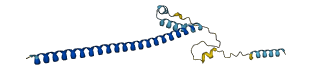
Descriptions
The autoinhibited protein was predicted that may have potential autoinhibitory elements via cis-regPred.
Autoinhibitory domains (AIDs)
Target domain |
|
Relief mechanism |
|
Assay |
cis-regPred |
Accessory elements
No accessory elements
Autoinhibited structure

Activated structure
1 structures for O14285
| Entry ID | Method | Resolution | Chain | Position | Source |
|---|---|---|---|---|---|
| AF-O14285-F1 | Predicted | AlphaFoldDB |
1 variants for O14285
| Variant ID(s) | Position | Change | Description | Diseaes Association | Provenance |
|---|---|---|---|---|---|
| I_3674598_C_T | 66 | R>K | No | Jeffares_SNPs |
No associated diseases with O14285
No regional properties for O14285
| Type | Name | Position | InterPro Accession |
|---|---|---|---|
| No domain, repeats, and functional sites for O14285 | |||
Functions
8 GO annotations of cellular component
| Name | Definition |
|---|---|
| condensed chromosome, centromeric region | The region of a condensed chromosome that includes the centromere and associated proteins, including the kinetochore. In monocentric chromosomes, this region corresponds to a single area of the chromosome, whereas in holocentric chromosomes, it is evenly distributed along the chromosome. |
| cytosol | The part of the cytoplasm that does not contain organelles but which does contain other particulate matter, such as protein complexes. |
| DASH complex | A large protein complex, containing around 8-10 subunits in yeast, including Duo1p, Dam1p, Dad1p and Ask1p. The complex forms part of the outer kinetochore, associates with microtubules when the kinetochore attaches to the spindle, and plays a role in spindle attachment, chromosome segregation and spindle stability. |
| kinetochore | A multisubunit complex that is located at the centromeric region of DNA and provides an attachment point for the spindle microtubules. |
| mitotic spindle | A spindle that forms as part of mitosis. Mitotic and meiotic spindles contain distinctive complements of proteins associated with microtubules. |
| mitotic spindle pole body | The microtubule organizing center that forms as part of the mitotic cell cycle; functionally homologous to the animal cell centrosome. |
| nucleus | A membrane-bounded organelle of eukaryotic cells in which chromosomes are housed and replicated. In most cells, the nucleus contains all of the cell's chromosomes except the organellar chromosomes, and is the site of RNA synthesis and processing. In some species, or in specialized cell types, RNA metabolism or DNA replication may be absent. |
| spindle microtubule | Any microtubule that is part of a mitotic or meiotic spindle; anchored at one spindle pole. |
No GO annotations of molecular function
| Name | Definition |
|---|---|
| No GO annotations for molecular function |
3 GO annotations of biological process
| Name | Definition |
|---|---|
| cell division | The process resulting in division and partitioning of components of a cell to form more cells; may or may not be accompanied by the physical separation of a cell into distinct, individually membrane-bounded daughter cells. |
| mitotic sister chromatid biorientation | The mitotic cell cycle process in which sister chromatids establish stable, end-on attachments to the plus ends of microtubules emanating from opposite spindle poles, oriented such that separation can proceed. This is the final step in metaphase plate congression. |
| monopolar spindle attachment to meiosis I kinetochore | The process in which spindle microtubules become physically associated with the proteins making up the kinetochore complex during meiosis I. During meiosis I sister kinetochores are lying next to each other facing the same spindle pole and monopolar attachment of the chromatid to the spindle occurs. |
No homologous proteins in AiPD
| UniProt AC | Gene Name | Protein Name | Species | Evidence Code |
|---|---|---|---|---|
| No homologous proteins | ||||
| 10 | 20 | 30 | 40 | 50 | 60 |
| MSDLLNYLQS | IAATSEKLLE | PENPNAARFT | DAVLHTHAIT | DLIRDTQKEE | LIAAEFKSLP |
| 70 | 80 | 90 | 100 | 110 | 120 |
| KDWSERLASE | NPADYVACIE | ELLDIYPMQG | GREYLETLVE | KYNLHMSGIE | NLENVLLEQK |
| 130 | 140 | 150 | 160 | ||
| EQLQQLEKRQ | TDQVSARENI | LQRETSEIQR | LEREIEKVKQ | LIQS |