O14241
Gene name |
arc2 (arc34, SPAC6F6.10c) |
Protein name |
Actin-related protein 2/3 complex subunit 2 |
Names |
Arp2/3 complex 34 kDa subunit, p34-ARC |
Species |
Schizosaccharomyces pombe (strain 972 / ATCC 24843) (Fission yeast) |
KEGG Pathway |
spo:SPAC6F6.10c |
EC number |
|
Protein Class |
|
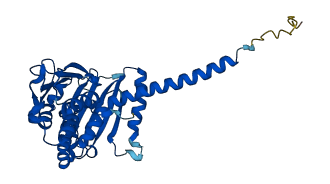
Descriptions
The autoinhibited protein was predicted that may have potential autoinhibitory elements via cis-regPred.
Autoinhibitory domains (AIDs)
Target domain |
|
Relief mechanism |
|
Assay |
cis-regPred |
Accessory elements
No accessory elements
Autoinhibited structure

Activated structure
2 variants for O14241
| Variant ID(s) | Position | Change | Description | Diseaes Association | Provenance |
|---|---|---|---|---|---|
| I_2750515_T_A | 139 | K>N | No | Jeffares_SNPs | |
| I_2750484_G_T | 150 | Q>K | No | Jeffares_SNPs |
No associated diseases with O14241
No regional properties for O14241
| Type | Name | Position | InterPro Accession |
|---|---|---|---|
| No domain, repeats, and functional sites for O14241 | |||
6 GO annotations of cellular component
| Name | Definition |
|---|---|
| actin cortical patch | An endocytic patch that consists of an actin-containing structure found at the plasma membrane in cells; formed of networks of branched actin filaments that lie just beneath the plasma membrane and assemble, move, and disassemble rapidly. An example of this is the actin cortical patch found in Saccharomyces cerevisiae. |
| Arp2/3 protein complex | A stable protein complex that contains two actin-related proteins, Arp2 and Arp3, and five novel proteins (ARPC1-5), and functions in the nucleation of branched actin filaments. |
| cell division site | The eventual plane of cell division (also known as cell cleavage or cytokinesis) in a dividing cell. In Eukaryotes, the cleavage apparatus, composed of septin structures and the actomyosin contractile ring, forms along this plane, and the mitotic, or meiotic, spindle is aligned perpendicular to the division plane. In bacteria, the cell division site is generally located at mid-cell and is the site at which the cytoskeletal structure, the Z-ring, assembles. |
| cell tip | The region at the end of the longest axis of a cylindrical or elongated cell. |
| cytosol | The part of the cytoplasm that does not contain organelles but which does contain other particulate matter, such as protein complexes. |
| nucleus | A membrane-bounded organelle of eukaryotic cells in which chromosomes are housed and replicated. In most cells, the nucleus contains all of the cell's chromosomes except the organellar chromosomes, and is the site of RNA synthesis and processing. In some species, or in specialized cell types, RNA metabolism or DNA replication may be absent. |
2 GO annotations of molecular function
| Name | Definition |
|---|---|
| actin filament binding | Binding to an actin filament, also known as F-actin, a helical filamentous polymer of globular G-actin subunits. |
| structural constituent of cytoskeleton | The action of a molecule that contributes to the structural integrity of a cytoskeletal structure. |
5 GO annotations of biological process
| Name | Definition |
|---|---|
| actin cortical patch assembly | Assembly of an actin cortical patch, a discrete actin-containing structure found at the plasma membrane of fungal cells. |
| actin filament polymerization | Assembly of actin filaments by the addition of actin monomers to a filament. |
| Arp2/3 complex-mediated actin nucleation | The actin nucleation process in which actin monomers combine to form a new branch on the side of an existing actin filament; mediated by the Arp2/3 protein complex and its interaction with other proteins. |
| endocytosis | A vesicle-mediated transport process in which cells take up external materials or membrane constituents by the invagination of a small region of the plasma membrane to form a new membrane-bounded vesicle. |
| regulation of actin filament polymerization | Any process that modulates the frequency, rate or extent of the assembly of actin filaments by the addition of actin monomers to a filament. |
No homologous proteins in AiPD
| UniProt AC | Gene Name | Protein Name | Species | Evidence Code |
|---|---|---|---|---|
| No homologous proteins | ||||
| 10 | 20 | 30 | 40 | 50 | 60 |
| MLSLDYNNIF | IYELLTERFS | SENPSSIDQV | VTDFDGVTFH | ISTPEEKTKI | LISLSMKCYP |
| 70 | 80 | 90 | 100 | 110 | 120 |
| ELVNYGTLDL | LKQIYGAYVH | EPEMGYNFSI | LIDLQQLPAT | DEEKEQLAMS | ISMLKRNVLA |
| 130 | 140 | 150 | 160 | 170 | 180 |
| APFHRAFTKQ | AELADLARKD | PENAPMLDKQ | ATSQELMAIH | YRDEETIVLW | PEHDRVTVVF |
| 190 | 200 | 210 | 220 | 230 | 240 |
| STKFREETDR | IFGKVFLQEF | VDARRRPAIQ | TAPQVLFSYR | DPPLEIRDIQ | GIQKGDDFGF |
| 250 | 260 | 270 | 280 | 290 | 300 |
| VTFVLFERHF | TPQNREDCIS | HIQVFRNTLH | FHIKASKAYM | HQRMRKRVAD | FQKVLNRAKP |
| 310 | |||||
| DVELERKTAT | GRSFVRA |