O14085
Gene name |
sec72 (SPAC2F3.02) |
Protein name |
Translocation protein sec72 |
Names |
|
Species |
Schizosaccharomyces pombe (strain 972 / ATCC 24843) (Fission yeast) |
KEGG Pathway |
spo:SPAC2F3.02 |
EC number |
|
Protein Class |
|
Descriptions
The autoinhibited protein was predicted that may have potential autoinhibitory elements via cis-regPred.
Autoinhibitory domains (AIDs)
Target domain |
|
Relief mechanism |
|
Assay |
cis-regPred |
Accessory elements
No accessory elements
Autoinhibited structure

Activated structure
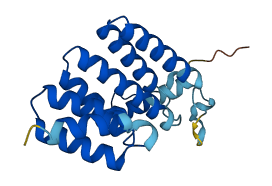
1 structures for O14085
| Entry ID | Method | Resolution | Chain | Position | Source |
|---|---|---|---|---|---|
| AF-O14085-F1 | Predicted | AlphaFoldDB |
No variants for O14085
| Variant ID(s) | Position | Change | Description | Diseaes Association | Provenance |
|---|---|---|---|---|---|
| No variants for O14085 | |||||
No associated diseases with O14085
3 regional properties for O14085
| Type | Name | Position | InterPro Accession |
|---|---|---|---|
| repeat | Tetratricopeptide repeat | 62 - 95 | IPR019734-1 |
| repeat | Tetratricopeptide repeat | 109 - 142 | IPR019734-2 |
| repeat | Tetratricopeptide repeat | 143 - 176 | IPR019734-3 |
3 GO annotations of cellular component
| Name | Definition |
|---|---|
| cytosol | The part of the cytoplasm that does not contain organelles but which does contain other particulate matter, such as protein complexes. |
| nucleus | A membrane-bounded organelle of eukaryotic cells in which chromosomes are housed and replicated. In most cells, the nucleus contains all of the cell's chromosomes except the organellar chromosomes, and is the site of RNA synthesis and processing. In some species, or in specialized cell types, RNA metabolism or DNA replication may be absent. |
| Sec62/Sec63 complex | A protein complex involved in the posttranslational targeting of proteins to the ER. In yeast, it is a tetrameric complex consisting of Sec62p, Sec63p, Sec71p and Sec72p. |
2 GO annotations of molecular function
| Name | Definition |
|---|---|
| Hsp70 protein binding | Binding to a Hsp70 protein, heat shock proteins around 70kDa in size. |
| Hsp90 protein binding | Binding to Hsp90 proteins, any of a group of heat shock proteins around 90kDa in size. |
2 GO annotations of biological process
| Name | Definition |
|---|---|
| post-translational protein targeting to endoplasmic reticulum membrane | The targeting of proteins to a membrane that occurs after their translation. Some secretory proteins exhibit posttranslational transport into the endoplasmic reticulum (ER) lumen: they are synthesized in their entirety on free cytosolic ribosomes and then released into the cytosol, where they are bound by chaperones which keep them in an unfolded state, and subsequently are translocated across the ER membrane. |
| protein folding | The process of assisting in the covalent and noncovalent assembly of single chain polypeptides or multisubunit complexes into the correct tertiary structure. |
No homologous proteins in AiPD
| UniProt AC | Gene Name | Protein Name | Species | Evidence Code |
|---|---|---|---|---|
| No homologous proteins | ||||
| 10 | 20 | 30 | 40 | 50 | 60 |
| MVAKQESVVA | PQVDVSKWSG | KELELGKKVN | EYAKSLATFK | YPFFIPPPYP | PAKPNMALST |
| 70 | 80 | 90 | 100 | 110 | 120 |
| QVNKMKQTAN | EAFKRKKYEE | AKKLYGLALQ | LALNRCTWEP | SILTREEASV | MLCNRAAAEI |
| 130 | 140 | 150 | 160 | 170 | 180 |
| ALSQFPEALA | DANAALKIRN | NYGKCYYRKA | KALEAMHRIE | EAKQVVRDGL | ILAEPVTRNE |
| 190 | |||||
| LVALWASYTE | KD |