Descriptions
The autoinhibited protein was predicted that may have potential autoinhibitory elements via cis-regPred.
Autoinhibitory domains (AIDs)
Target domain |
|
Relief mechanism |
|
Assay |
cis-regPred |
Accessory elements
No accessory elements
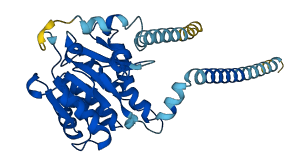
Autoinhibited structure

Activated structure
1 structures for O14084
| Entry ID | Method | Resolution | Chain | Position | Source |
|---|---|---|---|---|---|
| AF-O14084-F1 | Predicted | AlphaFoldDB |
3 variants for O14084
| Variant ID(s) | Position | Change | Description | Diseaes Association | Provenance |
|---|---|---|---|---|---|
| I_3922420_C_T | 23 | L>F | No | Jeffares_SNPs | |
| I_3923096_G_A | 248 | G>E | No | Jeffares_SNPs | |
| I_3923212_G_A | 287 | A>T | No | Jeffares_SNPs |
No associated diseases with O14084
1 regional properties for O14084
| Type | Name | Position | InterPro Accession |
|---|---|---|---|
| conserved_site | Glycosyltransferase, DXD sugar-binding motif | 78 - 168 | IPR007577 |
Functions
4 GO annotations of cellular component
| Name | Definition |
|---|---|
| cis-Golgi network membrane | The lipid bilayer surrounding any of the compartments that make up the cis-Golgi network. |
| Golgi apparatus | A membrane-bound cytoplasmic organelle of the endomembrane system that further processes the core oligosaccharides (e.g. N-glycans) added to proteins in the endoplasmic reticulum and packages them into membrane-bound vesicles. The Golgi apparatus operates at the intersection of the secretory, lysosomal, and endocytic pathways. |
| integral component of membrane | The component of a membrane consisting of the gene products and protein complexes having at least some part of their peptide sequence embedded in the hydrophobic region of the membrane. |
| trans-Golgi network membrane | The lipid bilayer surrounding any of the compartments that make up the trans-Golgi network. |
2 GO annotations of molecular function
| Name | Definition |
|---|---|
| mannose binding | Binding to mannose, a monosaccharide hexose, stereoisomeric with glucose, that occurs naturally only in polymerized forms called mannans. |
| mannosyltransferase activity | Catalysis of the transfer of a mannosyl group to an acceptor molecule, typically another carbohydrate or a lipid. |
1 GO annotations of biological process
| Name | Definition |
|---|---|
| mannosyl-inositol phosphorylceramide biosynthetic process | The chemical reactions and pathways resulting in the formation of mannosyl-inositol phosphorylceramide, any lipid with a phosphodiester bridge between an inositol residue and the ceramide group which contains a phosphoryl (-P(O)=) groups and a mannose derivative. |
No homologous proteins in AiPD
| UniProt AC | Gene Name | Protein Name | Species | Evidence Code |
|---|---|---|---|---|
| No homologous proteins | ||||
| 10 | 20 | 30 | 40 | 50 | 60 |
| MGRKCRKLLL | KGIPICGVIL | LILWGYSLYN | TLRFMVPGKA | TEPFTLSLSD | VSDDTSAPGE |
| 70 | 80 | 90 | 100 | 110 | 120 |
| MEKIPRVIHQ | LWKDENIPER | WSNTVNSCRR | QHPDENGWQF | ILWTDEKIMS | FMNENYSWFM |
| 130 | 140 | 150 | 160 | 170 | 180 |
| PVFHSYPYNI | QKFDAARYFI | LYHYGGVYMD | LDIGCKKPMD | PLLSKATFIL | PSTEPIGYSN |
| 190 | 200 | 210 | 220 | 230 | 240 |
| DWFAATPKHP | FLYQAIHNLS | KFNHRYFTKY | PTVFLSAGPL | FLSYQFCKYL | LTPHEPVRVL |
| 250 | 260 | 270 | 280 | 290 | 300 |
| PALLYGNGPN | SFFSHVTGDS | WHGTDAKVFI | WIDRNSKSVL | FFAFLAAFAI | LFLCLRVVFK |
| 310 | |||||
| RRRKRGIAAS | HSQIQELYP |