O13853
Gene name |
its3 (SPAC19G12.14) |
Protein name |
Phosphatidylinositol 4-phosphate 5-kinase its3 |
Names |
1-phosphatidylinositol 4-phosphate kinase, Diphosphoinositide kinase, PIP5K, PtdIns(4)P-5-kinase |
Species |
Schizosaccharomyces pombe (strain 972 / ATCC 24843) (Fission yeast) |
KEGG Pathway |
spo:SPAC19G12.14 |
EC number |
2.7.1.68: Phosphotransferases with an alcohol group as acceptor |
Protein Class |
|
Descriptions
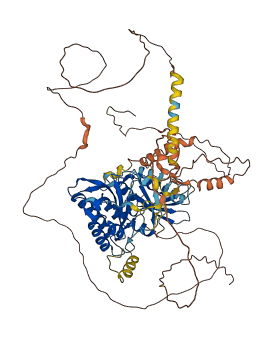
The autoinhibited protein was predicted that may have potential autoinhibitory elements via cis-regPred.
Autoinhibitory domains (AIDs)
Target domain |
|
Relief mechanism |
|
Assay |
cis-regPred |
Accessory elements
No accessory elements
Autoinhibited structure

Activated structure
1 structures for O13853
| Entry ID | Method | Resolution | Chain | Position | Source |
|---|---|---|---|---|---|
| AF-O13853-F1 | Predicted | AlphaFoldDB |
3 variants for O13853
| Variant ID(s) | Position | Change | Description | Diseaes Association | Provenance |
|---|---|---|---|---|---|
| I_4072417_A_G | 14 | I>M | No | Jeffares_SNPs | |
| I_4072536_G_A | 54 | R>H | No | Jeffares_SNPs | |
| I_4072928_C_T | 185 | R>W | No | Jeffares_SNPs |
No associated diseases with O13853
1 regional properties for O13853
| Type | Name | Position | InterPro Accession |
|---|---|---|---|
| domain | Phosphatidylinositol-4-phosphate 5-kinase, core | 264 - 663 | IPR002498 |
Functions
| Description | ||
|---|---|---|
| EC Number | 2.7.1.68 | Phosphotransferases with an alcohol group as acceptor |
| Subcellular Localization |
|
|
| PANTHER Family | ||
| PANTHER Subfamily | ||
| PANTHER Protein Class | ||
| PANTHER Pathway Category | No pathway information available | |
3 GO annotations of cellular component
| Name | Definition |
|---|---|
| division septum | A cell septum which forms as part of the division site and functions in the compartmentalization of a cell into two daughter cells at division. A division septum spans a cell and does not allow exchange of organelles or cytoplasm between compartments. |
| nucleus | A membrane-bounded organelle of eukaryotic cells in which chromosomes are housed and replicated. In most cells, the nucleus contains all of the cell's chromosomes except the organellar chromosomes, and is the site of RNA synthesis and processing. In some species, or in specialized cell types, RNA metabolism or DNA replication may be absent. |
| plasma membrane | The membrane surrounding a cell that separates the cell from its external environment. It consists of a phospholipid bilayer and associated proteins. |
5 GO annotations of molecular function
| Name | Definition |
|---|---|
| 1-phosphatidylinositol-3-phosphate 4-kinase activity | Catalysis of the reaction: a 1-phosphatidyl-1D-myo-inositol 3-phosphate + ATP = a 1-phosphatidyl-1D-myo-inositol 3,4-bisphosphate + ADP + 2 H(+). |
| 1-phosphatidylinositol-4-phosphate 5-kinase activity | Catalysis of the reaction: 1-phosphatidyl-1D-myo-inositol 4-phosphate + ATP = 1-phosphatidyl-1D-myo-inositol 4,5-bisphosphate + ADP + 2 H(+). |
| ATP binding | Binding to ATP, adenosine 5'-triphosphate, a universally important coenzyme and enzyme regulator. |
| phosphatidylinositol-3,4-bisphosphate 5-kinase activity | Catalysis of the reaction: 1-phosphatidyl-1D-myo-inositol 3,4-bisphosphate + ATP = a 1-phosphatidyl-1D-myo-inositol 3,4,5-trisphosphate + ADP + 2 H(+). |
| phospholipid binding | Binding to a phospholipid, a class of lipids containing phosphoric acid as a mono- or diester. |
4 GO annotations of biological process
| Name | Definition |
|---|---|
| cell division | The process resulting in division and partitioning of components of a cell to form more cells; may or may not be accompanied by the physical separation of a cell into distinct, individually membrane-bounded daughter cells. |
| dynein-driven meiotic oscillatory nuclear movement | Oscillatory movement of the nucleus involved in meiosis I. This oscillatory movement is led by an astral microtubule array emanating from the spindle pole body, and driven by the microtubule motor cytoplasmic dynein. |
| phosphatidylinositol phosphate biosynthetic process | The chemical reactions and pathways resulting in the formation of phosphatidylinositol phosphate. |
| phosphorylation | The process of introducing a phosphate group into a molecule, usually with the formation of a phosphoric ester, a phosphoric anhydride or a phosphoric amide. |
No homologous proteins in AiPD
| UniProt AC | Gene Name | Protein Name | Species | Evidence Code |
|---|---|---|---|---|
| No homologous proteins | ||||
| 10 | 20 | 30 | 40 | 50 | 60 |
| MKIDSNGIVN | PHSITNEIPS | YDEKQAVDLN | GNAFAPNGTF | QKKDLISHKN | DFERTMRHDV |
| 70 | 80 | 90 | 100 | 110 | 120 |
| LHTNPKIEVR | SETHIYEPND | SLFKENQDFP | SNPTAHSPSS | SSNDSVITAT | GVPDGILRDS |
| 130 | 140 | 150 | 160 | 170 | 180 |
| PIVSALEPPS | SNSSSSPQLQ | NLKHQLSSPQ | PSRAPIDRSS | SNPVTSSQQP | PNDRSTLSSS |
| 190 | 200 | 210 | 220 | 230 | 240 |
| QKAKRPLKRS | YSEKNSSNAE | PSGSRSGDRG | TNVSTSGSLL | DGIPPDIGSA | SWAEAVKQKR |
| 250 | 260 | 270 | 280 | 290 | 300 |
| VNMRRRREEL | DDECVLVGTR | VSEGHENYVT | AYNMLTGIRV | GVSRCQAKMD | RELTPADFTA |
| 310 | 320 | 330 | 340 | 350 | 360 |
| RHKFTFDITG | NELTPSAKYD | FKFKDYAPWV | FRHLRQLFHL | DAADYLVSLT | SKYILSELDS |
| 370 | 380 | 390 | 400 | 410 | 420 |
| PGKSGSFFYF | SRDYRFIIKT | IHHSEHKFLR | EILYDYYEHV | KNNPNTLISQ | FYGLHRVKLP |
| 430 | 440 | 450 | 460 | 470 | 480 |
| FGRKIHFVVM | NNLFPPHRDI | HQTFDLKGST | LGRELDENQP | CQSPMCTMKD | TNWIRRNMHL |
| 490 | 500 | 510 | 520 | 530 | 540 |
| QFGPLKRQIF | LTQVKADIDM | LSSLGIMDYS | LLVGIHDLSR | GNRDKIRNSI | LSVYDPNVSQ |
| 550 | 560 | 570 | 580 | 590 | 600 |
| HRVPSINGNE | SHSNVHVIRQ | VVNSTGPVSL | DQSCNLLPTD | QFVERRNFMF | YSDDGGFQAT |
| 610 | 620 | 630 | 640 | 650 | 660 |
| DENNEPGNFI | FYIGIIDLLT | KYSYVKRVEH | LWKGINHSDS | VISAVPPAEY | ASRFYKFVES |
| 670 | 680 | 690 | 700 | 710 | 720 |
| SIKPTLLVLK | PFPLKPQDGQ | RVNKQQSVNA | GNVRTNNKHG | SLNNNTAPSS | RNAKSTSAHK |
| 730 | 740 | ||||
| SPKTEHRFPF | PCRNVTTNTS | SS |