O13055
Gene name |
gnai2 |
Protein name |
Guanine nucleotide-binding protein G(i) subunit alpha-2 |
Names |
Adenylate cyclase-inhibiting G alpha protein, Gi alpha c, Gi2 subunit alpha |
Species |
Oryzias latipes (Japanese rice fish) (Japanese killifish) |
KEGG Pathway |
ola:100125814 |
EC number |
|
Protein Class |
|
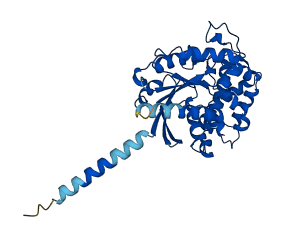
Descriptions
The autoinhibited protein was predicted that may have potential autoinhibitory elements via cis-regPred.
Autoinhibitory domains (AIDs)
Target domain |
|
Relief mechanism |
|
Assay |
cis-regPred |
Accessory elements
No accessory elements
Autoinhibited structure

Activated structure
1 structures for O13055
| Entry ID | Method | Resolution | Chain | Position | Source |
|---|---|---|---|---|---|
| AF-O13055-F1 | Predicted | AlphaFoldDB |
No variants for O13055
| Variant ID(s) | Position | Change | Description | Diseaes Association | Provenance |
|---|---|---|---|---|---|
| No variants for O13055 | |||||
No associated diseases with O13055
1 regional properties for O13055
| Type | Name | Position | InterPro Accession |
|---|---|---|---|
| domain | DALR anticodon binding | 585 - 680 | IPR008909 |
5 GO annotations of cellular component
| Name | Definition |
|---|---|
| centrosome | A structure comprised of a core structure (in most organisms, a pair of centrioles) and peripheral material from which a microtubule-based structure, such as a spindle apparatus, is organized. Centrosomes occur close to the nucleus during interphase in many eukaryotic cells, though in animal cells it changes continually during the cell-division cycle. |
| cytoplasm | The contents of a cell excluding the plasma membrane and nucleus, but including other subcellular structures. |
| heterotrimeric G-protein complex | Any of a family of heterotrimeric GTP-binding and hydrolyzing proteins; they belong to a superfamily of GTPases that includes monomeric proteins such as EF-Tu and RAS. Heterotrimeric G-proteins consist of three subunits; the alpha subunit contains the guanine nucleotide binding site and possesses GTPase activity; the beta and gamma subunits are tightly associated and function as a beta-gamma heterodimer; extrinsic plasma membrane proteins (cytoplasmic face) that function as a complex to transduce signals from G protein-coupled receptors to an effector protein. |
| midbody | A thin cytoplasmic bridge formed between daughter cells at the end of cytokinesis. The midbody forms where the contractile ring constricts, and may persist for some time before finally breaking to complete cytokinesis. |
| plasma membrane | The membrane surrounding a cell that separates the cell from its external environment. It consists of a phospholipid bilayer and associated proteins. |
5 GO annotations of molecular function
| Name | Definition |
|---|---|
| G protein-coupled receptor binding | Binding to a G protein-coupled receptor. |
| G-protein beta/gamma-subunit complex binding | Binding to a complex of G-protein beta/gamma subunits. |
| GTP binding | Binding to GTP, guanosine triphosphate. |
| GTPase activity | Catalysis of the reaction: GTP + H2O = GDP + H+ + phosphate. |
| metal ion binding | Binding to a metal ion. |
6 GO annotations of biological process
| Name | Definition |
|---|---|
| adenylate cyclase-inhibiting G protein-coupled receptor signaling pathway | A G protein-coupled receptor signaling pathway in which the signal is transmitted via the inhibition of adenylyl cyclase activity and a subsequent decrease in the intracellular concentration of cyclic AMP (cAMP). |
| adenylate cyclase-modulating G protein-coupled receptor signaling pathway | A G protein-coupled receptor signaling pathway in which the signal is transmitted via the activation or inhibition of adenylyl cyclase activity and a subsequent change in the intracellular concentration of cyclic AMP (cAMP). |
| cell cycle | The progression of biochemical and morphological phases and events that occur in a cell during successive cell replication or nuclear replication events. Canonically, the cell cycle comprises the replication and segregation of genetic material followed by the division of the cell, but in endocycles or syncytial cells nuclear replication or nuclear division may not be followed by cell division. |
| cell division | The process resulting in division and partitioning of components of a cell to form more cells; may or may not be accompanied by the physical separation of a cell into distinct, individually membrane-bounded daughter cells. |
| G protein-coupled adenosine receptor signaling pathway | The series of molecular signals generated as a consequence of a receptor binding to extracellular adenosine and transmitting the signal to a heterotrimeric G-protein complex to initiate a change in cell activity. |
| gamma-aminobutyric acid signaling pathway | The series of molecular signals generated by the binding of gamma-aminobutyric acid (GABA, 4-aminobutyrate), an amino acid which acts as a neurotransmitter in some organisms, to its receptor on the surface of a target cell. |
No homologous proteins in AiPD
| UniProt AC | Gene Name | Protein Name | Species | Evidence Code |
|---|---|---|---|---|
| No homologous proteins | ||||
| 10 | 20 | 30 | 40 | 50 | 60 |
| MGCTVSQEDK | AAADRSKMID | KNLREDGEKA | AREVKLLLLG | AGESGKSTIV | KQMKIIHEDG |
| 70 | 80 | 90 | 100 | 110 | 120 |
| YSEDECKQYR | AVVYSNTVQS | IMAIIKAMTI | LHLDYERPER | EEDAKRLFKM | AAEAEERGDL |
| 130 | 140 | 150 | 160 | 170 | 180 |
| PEELANIIKD | LWADSGIQHC | LTRAREYQLN | DSAAYYLKDL | ERISKPDYIP | TQQDVLRTRV |
| 190 | 200 | 210 | 220 | 230 | 240 |
| KTTGIVETHF | TFKDLHFKMF | DVGGQRSERK | KWIHCFEGVT | AIIFCVAMSA | YDLVLAEDEE |
| 250 | 260 | 270 | 280 | 290 | 300 |
| MNRMHESMKL | FDSICNNKWF | TETSIILFLN | KKDLFEQKIA | HSPLTICFPE | YEGPNTYQEA |
| 310 | 320 | 330 | 340 | 350 | |
| QAYIQTKFED | LNKKKETKEI | YTHFTCATDT | KNVQFVFDAV | TDVIIKNNLK | DCGLF |