O08901
Gene name |
Bub1 |
Protein name |
Mitotic checkpoint serine/threonine-protein kinase BUB1 |
Names |
mBUB1, BUB1A |
Species |
Mus musculus (Mouse) |
KEGG Pathway |
mmu:12235 |
EC number |
2.7.11.1: Protein-serine/threonine kinases |
Protein Class |
|
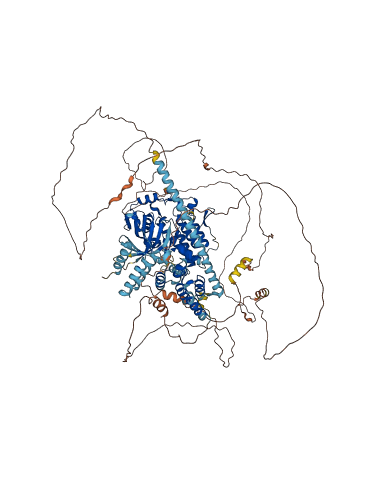
Descriptions
The autoinhibited protein was predicted that may have potential autoinhibitory elements via cis-regPred.
Autoinhibitory domains (AIDs)
Target domain |
|
Relief mechanism |
|
Assay |
cis-regPred |
Accessory elements
No accessory elements
Autoinhibited structure

Activated structure
1 structures for O08901
| Entry ID | Method | Resolution | Chain | Position | Source |
|---|---|---|---|---|---|
| AF-O08901-F1 | Predicted | AlphaFoldDB |
No variants for O08901
| Variant ID(s) | Position | Change | Description | Diseaes Association | Provenance |
|---|---|---|---|---|---|
| No variants for O08901 | |||||
No associated diseases with O08901
Functions
| Description | ||
|---|---|---|
| EC Number | 2.7.11.1 | Protein-serine/threonine kinases |
| Subcellular Localization |
|
|
| PANTHER Family | ||
| PANTHER Subfamily | ||
| PANTHER Protein Class | ||
| PANTHER Pathway Category | No pathway information available | |
6 GO annotations of cellular component
| Name | Definition |
|---|---|
| chromosome, centromeric region | The region of a chromosome that includes the centromeric DNA and associated proteins. In monocentric chromosomes, this region corresponds to a single area of the chromosome, whereas in holocentric chromosomes, it is evenly distributed along the chromosome. |
| condensed chromosome, centromeric region | The region of a condensed chromosome that includes the centromere and associated proteins, including the kinetochore. In monocentric chromosomes, this region corresponds to a single area of the chromosome, whereas in holocentric chromosomes, it is evenly distributed along the chromosome. |
| cytosol | The part of the cytoplasm that does not contain organelles but which does contain other particulate matter, such as protein complexes. |
| intracellular membrane-bounded organelle | Organized structure of distinctive morphology and function, bounded by a single or double lipid bilayer membrane and occurring within the cell. Includes the nucleus, mitochondria, plastids, vacuoles, and vesicles. Excludes the plasma membrane. |
| kinetochore | A multisubunit complex that is located at the centromeric region of DNA and provides an attachment point for the spindle microtubules. |
| nucleoplasm | That part of the nuclear content other than the chromosomes or the nucleolus. |
4 GO annotations of molecular function
| Name | Definition |
|---|---|
| ATP binding | Binding to ATP, adenosine 5'-triphosphate, a universally important coenzyme and enzyme regulator. |
| protein kinase activity | Catalysis of the phosphorylation of an amino acid residue in a protein, usually according to the reaction: a protein + ATP = a phosphoprotein + ADP. |
| protein serine kinase activity | Catalysis of the reactions: ATP + protein serine = ADP + protein serine phosphate. |
| protein serine/threonine kinase activity | Catalysis of the reactions: ATP + protein serine = ADP + protein serine phosphate, and ATP + protein threonine = ADP + protein threonine phosphate. |
9 GO annotations of biological process
| Name | Definition |
|---|---|
| cell division | The process resulting in division and partitioning of components of a cell to form more cells; may or may not be accompanied by the physical separation of a cell into distinct, individually membrane-bounded daughter cells. |
| chromosome segregation | The process in which genetic material, in the form of chromosomes, is organized into specific structures and then physically separated and apportioned to two or more sets. In eukaryotes, chromosome segregation begins with the condensation of chromosomes, includes chromosome separation, and ends when chromosomes have completed movement to the spindle poles. |
| intrinsic apoptotic signaling pathway | The series of molecular signals in which an intracellular signal is conveyed to trigger the apoptotic death of a cell. The pathway starts with reception of an intracellular signal (e.g. DNA damage, endoplasmic reticulum stress, oxidative stress etc.), and ends when the execution phase of apoptosis is triggered. The intrinsic apoptotic signaling pathway is crucially regulated by permeabilization of the mitochondrial outer membrane (MOMP). |
| meiotic sister chromatid cohesion, centromeric | The cell cycle process in which centromeres of sister chromatids are joined during meiosis. |
| mitotic spindle assembly checkpoint signaling | A signal transduction process that contributes to a mitotic cell cycle spindle assembly checkpoint, that delays the metaphase/anaphase transition of a mitotic nuclear division until the spindle is correctly assembled and chromosomes are attached to the spindle. |
| positive regulation of intrinsic apoptotic signaling pathway | Any process that activates or increases the frequency, rate or extent of intrinsic apoptotic signaling pathway. |
| protein phosphorylation | The process of introducing a phosphate group on to a protein. |
| regulation of chromosome segregation | Any process that modulates the frequency, rate or extent of chromosome segregation, the process in which genetic material, in the form of chromosomes, is organized and then physically separated and apportioned to two or more sets. |
| regulation of sister chromatid cohesion | Any process that modulates the frequency, rate or extent of sister chromatid cohesion. |
| 10 | 20 | 30 | 40 | 50 | 60 |
| MDNLENVFRM | FEAHMQSYTG | NDPLGEWESF | IKWVEENFPD | NKEYLMTLLE | HLMKEFLHKK |
| 70 | 80 | 90 | 100 | 110 | 120 |
| NYHNDSRFIN | YCLKFAEYNS | DRHQFFEFLY | NQGIGTKSSY | IYMSWAGHLE | AQGELQHASA |
| 130 | 140 | 150 | 160 | 170 | 180 |
| IFQTGIHNEA | EPKELLQQQY | RLFQARLTGI | HLPAQATTSE | PLHSAQILNQ | VMMTNSSPEK |
| 190 | 200 | 210 | 220 | 230 | 240 |
| NSACVPKSQG | SECSGVASST | CDEKSNMEQR | VIMISKSECS | VSSSVAPKPE | AQQVMYCKEK |
| 250 | 260 | 270 | 280 | 290 | 300 |
| LIRGDSEFSF | EELRAQKYNQ | RKKHEQWVSE | DRNYMKRKEA | NAFEEQLLKQ | KMDELHKKLH |
| 310 | 320 | 330 | 340 | 350 | 360 |
| QVVELSHKDL | PASENRPDVS | LVCVGQNTCS | QQELRGPSLS | SISHQTSESS | GEKPQEEPSV |
| 370 | 380 | 390 | 400 | 410 | 420 |
| PLMVNAVNST | LLFPAANLPA | LPVPVSGQSL | TDSRCVNQSV | HEFMPQCGPE | TKEVCETNKV |
| 430 | 440 | 450 | 460 | 470 | 480 |
| ASINDFHTTP | NTSLGMVQGT | PCKVQPSPTV | HTKEALGFIM | DMFQAPTLPD | ISDDKDEWPS |
| 490 | 500 | 510 | 520 | 530 | 540 |
| LDQNEDAFEA | QFQKNAVSSG | DWGVKKIMTL | SSAFPIFEDG | NKENYGLPQP | KNKPLGARTF |
| 550 | 560 | 570 | 580 | 590 | 600 |
| GERSLSKYSS | RSNEMPHTDE | FMDDSTVCGI | RCNKTLAPSP | KSIGDFTSAA | QLSSTPFHKF |
| 610 | 620 | 630 | 640 | 650 | 660 |
| PADLVQIPED | KENVVATQYT | HMALDSCKEN | IVDLSKGRKL | GPIQEKISAS | LPCPSQPATG |
| 670 | 680 | 690 | 700 | 710 | 720 |
| GLFTQEAVFG | LEAFKCTGID | HATVEDLSDA | NAGLQVECVQ | TLGNVNAPSF | TVENPWDDEL |
| 730 | 740 | 750 | 760 | 770 | 780 |
| ILKLLSGLSK | PVTSYSNTFE | WQSKLPAIKT | KTEYQLGSLL | VYVNHLLGEG | AFAQVFEAIH |
| 790 | 800 | 810 | 820 | 830 | 840 |
| GDVRNAKSEQ | KCILKVQRPA | NSWEFYIGMQ | LMERLKPEVH | HMFIKFYSAH | LFKNGSILVG |
| 850 | 860 | 870 | 880 | 890 | 900 |
| ELYSYGTLLN | VINLYKNTSE | KVMPQALVLT | FAIRMLYMVE | QVHSCEIIHG | DIKPDNFILG |
| 910 | 920 | 930 | 940 | 950 | 960 |
| HRFLEQADED | LATGLALIDL | GQSIDMKLFP | KGTVFTGKCE | TSGFQCPEML | SNKPWNYQID |
| 970 | 980 | 990 | 1000 | 1010 | 1020 |
| YFGVAATIYC | MLFGSYMKVK | NEGGVWKPEG | LFRRLPHLDM | WEEFFHIMLN | IPDCHNLPSL |
| 1030 | 1040 | 1050 | |||
| DFLRQNMKKL | LEQQYSNKIK | TLRNRLIVML | SEYKRSRK |