O08807
Gene name |
Prdx4 |
Protein name |
Peroxiredoxin-4 |
Names |
Antioxidant enzyme AOE372, Peroxiredoxin IV, Prx-IV, Thioredoxin peroxidase AO372, Thioredoxin-dependent peroxide reductase A0372, Thioredoxin-dependent peroxiredoxin 4 |
Species |
Mus musculus (Mouse) |
KEGG Pathway |
mmu:53381 |
EC number |
1.11.1.24: Peroxidases |
Protein Class |
|
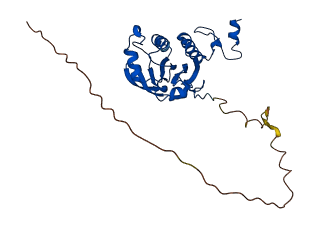
Descriptions
The autoinhibited protein was predicted that may have potential autoinhibitory elements via cis-regPred.
Autoinhibitory domains (AIDs)
Target domain |
|
Relief mechanism |
|
Assay |
cis-regPred |
Accessory elements
No accessory elements
Autoinhibited structure

Activated structure
5 structures for O08807
| Entry ID | Method | Resolution | Chain | Position | Source |
|---|---|---|---|---|---|
| 3VWU | X-ray | 330 A | A/B/C/D/E/F/G/H/I/J | 41-274 | PDB |
| 3VWV | X-ray | 180 A | A/B | 87-274 | PDB |
| 3W8J | X-ray | 210 A | C/D | 244-263 | PDB |
| 3WGX | X-ray | 092 A | C/D | 244-263 | PDB |
| AF-O08807-F1 | Predicted | AlphaFoldDB |
13 variants for O08807
| Variant ID(s) | Position | Change | Description | Diseaes Association | Provenance |
|---|---|---|---|---|---|
| rs3389548639 | 72 | V>D | No | EVA | |
| rs3410981140 | 135 | G>I | No | EVA | |
| rs3389584482 | 166 | P>L | No | EVA | |
| rs3389588208 | 171 | G>V | No | EVA | |
| rs3389574122 | 184 | N>S | No | EVA | |
| rs13470613 | 211 | K>N | No | EVA | |
| rs3412526769 | 213 | V>G | No | EVA | |
| rs3389548560 | 215 | R>K | No | EVA | |
| rs3411985170 | 220 | N>T | No | EVA | |
| rs3412406506 | 224 | V>D | No | EVA | |
| rs3389584532 | 235 | V>I | No | EVA | |
| rs3389592925 | 246 | E>D | No | EVA | |
| rs3412526790 | 246 | E>G | No | EVA |
No associated diseases with O08807
Functions
| Description | ||
|---|---|---|
| EC Number | 1.11.1.24 | Peroxidases |
| Subcellular Localization |
|
|
| PANTHER Family | ||
| PANTHER Subfamily | ||
| PANTHER Protein Class | ||
| PANTHER Pathway Category | No pathway information available | |
6 GO annotations of cellular component
| Name | Definition |
|---|---|
| cytoplasm | The contents of a cell excluding the plasma membrane and nucleus, but including other subcellular structures. |
| cytosol | The part of the cytoplasm that does not contain organelles but which does contain other particulate matter, such as protein complexes. |
| endoplasmic reticulum | The irregular network of unit membranes, visible only by electron microscopy, that occurs in the cytoplasm of many eukaryotic cells. The membranes form a complex meshwork of tubular channels, which are often expanded into slitlike cavities called cisternae. The ER takes two forms, rough (or granular), with ribosomes adhering to the outer surface, and smooth (with no ribosomes attached). |
| extracellular space | That part of a multicellular organism outside the cells proper, usually taken to be outside the plasma membranes, and occupied by fluid. |
| mitochondrion | A semiautonomous, self replicating organelle that occurs in varying numbers, shapes, and sizes in the cytoplasm of virtually all eukaryotic cells. It is notably the site of tissue respiration. |
| smooth endoplasmic reticulum | The smooth endoplasmic reticulum (smooth ER or SER) has no ribosomes attached to it. The smooth ER is the recipient of the proteins synthesized in the rough ER. Those proteins to be exported are passed to the Golgi complex, the resident proteins are returned to the rough ER and the lysosomal proteins after phosphorylation of their mannose residues are passed to the lysosomes. Glycosylation of the glycoproteins also continues. The smooth ER is the site of synthesis of lipids, including the phospholipids. The membranes of the smooth ER also contain enzymes that catalyze a series of reactions to detoxify both lipid-soluble drugs and harmful products of metabolism. Large quantities of certain compounds such as phenobarbital cause an increase in the amount of the smooth ER. |
3 GO annotations of molecular function
| Name | Definition |
|---|---|
| identical protein binding | Binding to an identical protein or proteins. |
| molecular sequestering activity | Binding to a specific molecule to prevent it from interacting with other partners or to inhibit its localization to the area of the cell or complex where it is active. |
| thioredoxin-dependent peroxiredoxin activity | Catalysis of the reaction: |
9 GO annotations of biological process
| Name | Definition |
|---|---|
| cell redox homeostasis | Any process that maintains the redox environment of a cell or compartment within a cell. |
| extracellular matrix organization | A process that is carried out at the cellular level which results in the assembly, arrangement of constituent parts, or disassembly of an extracellular matrix. |
| male gonad development | The process whose specific outcome is the progression of the male gonad over time, from its formation to the mature structure. |
| negative regulation of male germ cell proliferation | Any process that stops, prevents or reduces the frequency, rate or extent of male germ cell proliferation. |
| peptidyl-proline hydroxylation to 4-hydroxy-L-proline | The modification of peptidyl-proline to form 4-hydroxy-L-proline; catalyzed by procollagen-proline,2-oxoglutarate-4-dioxygenase. |
| protein maturation by protein folding | The process of assisting in the covalent and noncovalent assembly of single chain polypeptides or multisubunit complexes into the correct tertiary structure that results in the attainment of the full functional capacity of a protein. |
| reactive oxygen species metabolic process | The chemical reactions and pathways involving a reactive oxygen species, any molecules or ions formed by the incomplete one-electron reduction of oxygen. They contribute to the microbicidal activity of phagocytes, regulation of signal transduction and gene expression, and the oxidative damage to biopolymers. |
| response to oxidative stress | Any process that results in a change in state or activity of a cell or an organism (in terms of movement, secretion, enzyme production, gene expression, etc.) as a result of oxidative stress, a state often resulting from exposure to high levels of reactive oxygen species, e.g. superoxide anions, hydrogen peroxide (H2O2), and hydroxyl radicals. |
| spermatogenesis | The developmental process by which male germ line stem cells self renew or give rise to successive cell types resulting in the development of a spermatozoa. |
No homologous proteins in AiPD
| UniProt AC | Gene Name | Protein Name | Species | Evidence Code |
|---|---|---|---|---|
| No homologous proteins | ||||
| 10 | 20 | 30 | 40 | 50 | 60 |
| MEARSKLLDG | TTASRRWTRK | LVLLLPPLLL | FLLRTESLQG | LESDERFRTR | ENECHFYAGG |
| 70 | 80 | 90 | 100 | 110 | 120 |
| QVYPGEASRV | SVADHSLHLS | KAKISKPAPY | WEGTAVINGE | FKELKLTDYR | GKYLVFFFYP |
| 130 | 140 | 150 | 160 | 170 | 180 |
| LDFTFVCPTE | IIAFGDRIEE | FKSINTEVVA | CSVDSQFTHL | AWINTPRRQG | GLGPIRIPLL |
| 190 | 200 | 210 | 220 | 230 | 240 |
| SDLNHQISKD | YGVYLEDSGH | TLRGLFIIDD | KGVLRQITLN | DLPVGRSVDE | TLRLVQAFQY |
| 250 | 260 | 270 | |||
| TDKHGEVCPA | GWKPGSETII | PDPAGKLKYF | DKLN |