O08579
Gene name |
Emd (Sta) |
Protein name |
Emerin |
Names |
|
Species |
Mus musculus (Mouse) |
KEGG Pathway |
mmu:13726 |
EC number |
|
Protein Class |
|
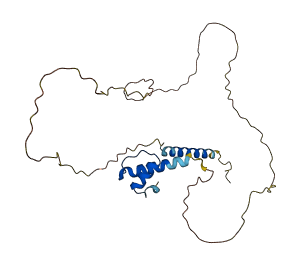
Descriptions
The autoinhibited protein was predicted that may have potential autoinhibitory elements via cis-regPred.
Autoinhibitory domains (AIDs)
Target domain |
|
Relief mechanism |
|
Assay |
cis-regPred |
Accessory elements
No accessory elements
Autoinhibited structure

Activated structure
1 structures for O08579
| Entry ID | Method | Resolution | Chain | Position | Source |
|---|---|---|---|---|---|
| AF-O08579-F1 | Predicted | AlphaFoldDB |
18 variants for O08579
| Variant ID(s) | Position | Change | Description | Diseaes Association | Provenance |
|---|---|---|---|---|---|
| rs3389544358 | 18 | Q>K | No | EVA | |
| rs3389569062 | 35 | E>K | No | EVA | |
| rs3389564976 | 79 | K>Q | No | EVA | |
| rs3389565009 | 82 | D>E | No | EVA | |
| rs3389576526 | 87 | Q>L | No | EVA | |
| rs3389558731 | 89 | K>E | No | EVA | |
| rs3410942011 | 97 | E>Q | No | EVA | |
| rs3409331951 | 98 | E>G | No | EVA | |
| rs3389513483 | 105 | T>A | No | EVA | |
| rs3409419024 | 121 | P>A | No | EVA | |
| rs3412948577 | 124 | S>T | No | EVA | |
| rs3409418979 | 133 | H>Q | No | EVA | |
| rs3410942099 | 143 | L>* | No | EVA | |
| rs3411052857 | 143 | L>I | No | EVA | |
| rs3410889073 | 146 | E>K | No | EVA | |
| rs3410834639 | 147 | G>V | No | EVA | |
| rs3410799722 | 222 | R>L | No | EVA | |
| rs3410730521 | 224 | V>F | No | EVA |
No associated diseases with O08579
No regional properties for O08579
| Type | Name | Position | InterPro Accession |
|---|---|---|---|
| No domain, repeats, and functional sites for O08579 | |||
Functions
14 GO annotations of cellular component
| Name | Definition |
|---|---|
| cortical endoplasmic reticulum | A cortical network of highly dynamic tubules that are juxtaposed to the plasma membrane and undergo ring closure and tubule-branching movements. |
| cytoplasm | The contents of a cell excluding the plasma membrane and nucleus, but including other subcellular structures. |
| endoplasmic reticulum | The irregular network of unit membranes, visible only by electron microscopy, that occurs in the cytoplasm of many eukaryotic cells. The membranes form a complex meshwork of tubular channels, which are often expanded into slitlike cavities called cisternae. The ER takes two forms, rough (or granular), with ribosomes adhering to the outer surface, and smooth (with no ribosomes attached). |
| integral component of membrane | The component of a membrane consisting of the gene products and protein complexes having at least some part of their peptide sequence embedded in the hydrophobic region of the membrane. |
| microtubule | Any of the long, generally straight, hollow tubes of internal diameter 12-15 nm and external diameter 24 nm found in a wide variety of eukaryotic cells; each consists (usually) of 13 protofilaments of polymeric tubulin, staggered in such a manner that the tubulin monomers are arranged in a helical pattern on the microtubular surface, and with the alpha/beta axes of the tubulin subunits parallel to the long axis of the tubule; exist in equilibrium with pool of tubulin monomers and can be rapidly assembled or disassembled in response to physiological stimuli; concerned with force generation, e.g. in the spindle. |
| nuclear envelope | The double lipid bilayer enclosing the nucleus and separating its contents from the rest of the cytoplasm; includes the intermembrane space, a gap of width 20-40 nm (also called the perinuclear space). |
| nuclear inner membrane | The inner, i.e. lumen-facing, lipid bilayer of the nuclear envelope. |
| nuclear lamina | The fibrous, electron-dense layer lying on the nucleoplasmic side of the inner membrane of a cell nucleus, composed of lamin filaments. The polypeptides of the lamina are thought to be concerned in the dissolution of the nuclear envelope and its re-formation during mitosis. The lamina is composed of lamin A and lamin C filaments cross-linked into an orthogonal lattice, which is attached via lamin B to the inner nuclear membrane through interactions with a lamin B receptor, an IFAP, in the membrane. |
| nuclear membrane | Either of the lipid bilayers that surround the nucleus and form the nuclear envelope; excludes the intermembrane space. |
| nuclear outer membrane | The outer, i.e. cytoplasm-facing, lipid bilayer of the nuclear envelope; continuous with the endoplasmic reticulum of the cell and sometimes studded with ribosomes. |
| nucleoplasm | That part of the nuclear content other than the chromosomes or the nucleolus. |
| nucleus | A membrane-bounded organelle of eukaryotic cells in which chromosomes are housed and replicated. In most cells, the nucleus contains all of the cell's chromosomes except the organellar chromosomes, and is the site of RNA synthesis and processing. In some species, or in specialized cell types, RNA metabolism or DNA replication may be absent. |
| spindle | The array of microtubules and associated molecules that forms between opposite poles of a eukaryotic cell during mitosis or meiosis and serves to move the duplicated chromosomes apart. |
| spindle pole centrosome | A centrosome from which one pole of a mitotic or meiotic spindle is organized. |
2 GO annotations of molecular function
| Name | Definition |
|---|---|
| actin binding | Binding to monomeric or multimeric forms of actin, including actin filaments. |
| beta-tubulin binding | Binding to the microtubule constituent protein beta-tubulin. |
7 GO annotations of biological process
| Name | Definition |
|---|---|
| cellular response to growth factor stimulus | Any process that results in a change in state or activity of a cell (in terms of movement, secretion, enzyme production, gene expression, etc.) as a result of a growth factor stimulus. |
| negative regulation of canonical Wnt signaling pathway | Any process that decreases the rate, frequency, or extent of the Wnt signaling pathway through beta-catenin, the series of molecular signals initiated by binding of a Wnt protein to a frizzled family receptor on the surface of the target cell, followed by propagation of the signal via beta-catenin, and ending with a change in transcription of target genes. |
| negative regulation of fibroblast proliferation | Any process that stops, prevents, or reduces the frequency, rate or extent of multiplication or reproduction of fibroblast cells. |
| nuclear membrane organization | A process that is carried out at the cellular level which results in the assembly, arrangement of constituent parts, or disassembly of the nuclear inner or outer membrane. |
| positive regulation of protein export from nucleus | Any process that activates or increases the frequency, rate or extent of directed movement of proteins from the nucleus into the cytoplasm. |
| regulation of canonical Wnt signaling pathway | Any process that modulates the rate, frequency, or extent of the Wnt signaling pathway through beta-catenin, the series of molecular signals initiated by binding of a Wnt protein to a frizzled family receptor on the surface of the target cell, followed by propagation of the signal via beta-catenin, and ending with a change in transcription of target genes. |
| skeletal muscle cell differentiation | The process in which a relatively unspecialized cell acquires specialized features of a skeletal muscle cell, a somatic cell located in skeletal muscle. |
No homologous proteins in AiPD
| UniProt AC | Gene Name | Protein Name | Species | Evidence Code |
|---|---|---|---|---|
| No homologous proteins | ||||
| 10 | 20 | 30 | 40 | 50 | 60 |
| MDDYAVLSDT | ELAAVLRQYN | IPHGPIVGST | RKLYEKKIFE | YETQRRRLLP | PNSSSSSFSY |
| 70 | 80 | 90 | 100 | 110 | 120 |
| QFSDLDSAAV | DSDMYDLPKK | EDALLYQSKD | YNDDYYEESY | LTTKTYGEPE | SVGMSKSFRQ |
| 130 | 140 | 150 | 160 | 170 | 180 |
| PGTSLVDADT | FHHQVRDDIF | SSLEEEGKDR | ERLIYGQDSA | YQSIAHYRPI | SNVSRSSLGL |
| 190 | 200 | 210 | 220 | 230 | 240 |
| SYYPTSSTSS | VSSSSSSPSS | WLTRRAIRPE | KQAPAAALGQ | DRQVPLWGQL | LLFLVFAAFL |
| 250 | |||||
| LFVYYSIQAE | EGNPFWMDP |